
What Is a PLC? Programmable Logic Controller Explained

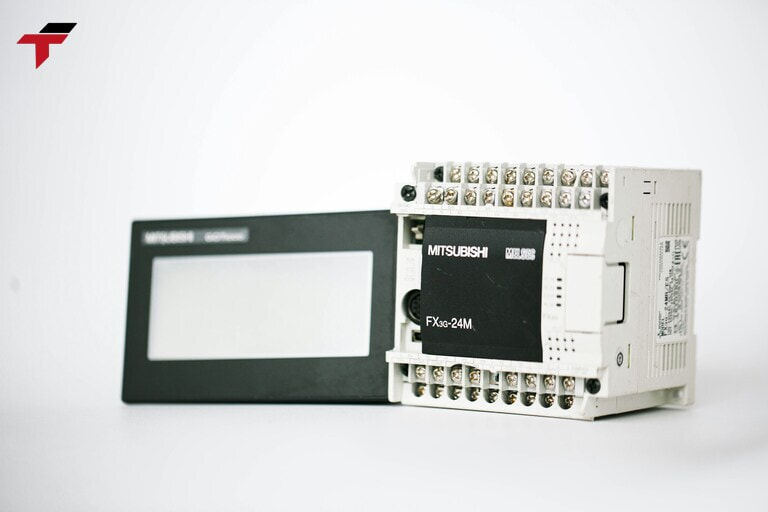
A Programmable Logic Controller (PLC) is a ruggedised industrial computer that reads inputs from sensors and switches, executes stored control logic, and activates connected outputs – motors, valves, conveyors, and actuators – in a continuous, deterministic cycle. PLCs replaced hard-wired relay control panels beginning in 1969 and remain the standard automation controller across manufacturing worldwide. In Malaysian factories, PLCs govern rubber glove production lines in Selangor, semiconductor fabrication in Penang, palm oil processing across the peninsula, and halal food and beverage packaging – any process where machine behaviour must be precise, repeatable, and fail-safe.
This article covers how the scan cycle operates, what sits inside a PLC unit, the four principal types and when to deploy each, the five IEC 61131-3 programming languages, how PLCs integrate with HMI and SCADA systems, and how procurement teams and system integrators in Malaysia can select and source the right controller for their application.
What Is a PLC?
In industrial automation, a Programmable Logic Controller is a specialised computing device built to control electromechanical processes under factory conditions – extreme temperatures, vibration, electrical interference, and continuous operation for years without restart. The defining characteristic of a PLC is deterministic execution: unlike a general-purpose PC, a PLC runs its control program the same way, every scan, with no background processes, no OS updates mid-cycle, and no unpredictable latency.
The concept originated in 1968, when engineer Dick Morley wrote specifications for a programmable replacement for relay-based control panels – one that could be reprogrammed without physical rewiring. His company, Modicon, shipped the first unit (the Model 084) to General Motors in 1969. Modicon is now part of Schneider Electric. The architecture Morley specified – isolated I/O, sequential scan execution, relay-derived programming syntax – remains the foundation of every PLC produced today.
A PLC differs from a PC in three concrete ways: it is sealed against industrial environments; it executes control logic with guaranteed cycle times measured in milliseconds; and it interfaces directly with field devices – sensors, actuators, variable speed drives, and valves – through dedicated I/O modules rated for industrial voltages and current loads.
The term “programmable logic controller” is often shortened to PLC or “programmable controller.” Both refer to the same class of hardware; IEC standard 61131 uses “programmable controller” as the formal designation.
How a PLC Works: The Scan Cycle
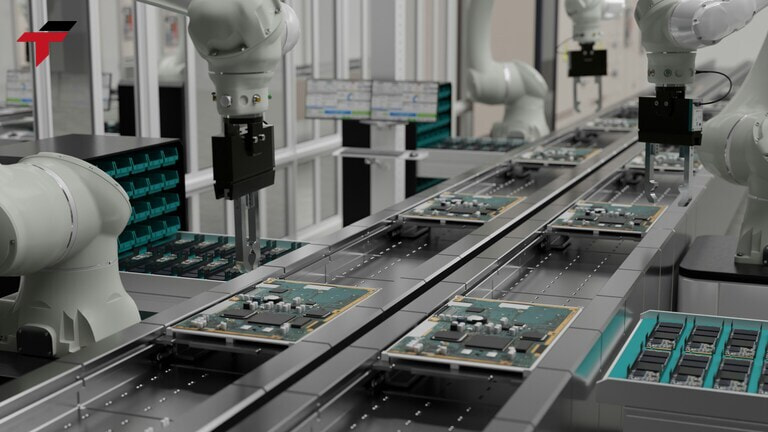
A PLC, at the execution layer of any production line, operates by running a fixed four-step loop – the scan cycle – continuously from the moment it powers on. This loop is what distinguishes PLC control from general computing: it is not event-driven, it does not wait, and it does not skip steps.
Step 1 – Input Scan: The CPU copies all input signal states from connected sensors, limit switches, encoders, and pushbuttons into a memory image table. Every input is captured at the same moment, creating a frozen snapshot of the physical world for that cycle.
Step 2 – Program Execution: The CPU runs the stored control program from the first instruction to the last, using the input snapshot – not live field signals – to evaluate logic and calculate required output states. If a temperature sensor reads above a defined threshold, the logic triggers a cooling valve output. If a part-present sensor is high and a quality check signal is confirmed, the conveyor advance output activates.
Step 3 – Output Update: All calculated output states write to physical output modules simultaneously – only after the complete program has executed. Motors start, valves open, and indicators change state as a single atomic update. No partial output refresh occurs mid-program.
Step 4 – Housekeeping: The CPU handles communication tasks, internal diagnostics, and watchdog timer reset, then immediately restarts Step 1.
A typical scan cycle completes in 1 to 50 milliseconds (0.001–0.05 s / 20–1,000 Hz effective decision rate), depending on program size and complexity. A 10 ms cycle time means the PLC makes 100 complete control decisions per second. Because inputs are captured once per scan and outputs write once per scan, race conditions and mid-cycle signal changes cannot affect program behaviour – an entire class of control faults is structurally eliminated.
PLCs process two signal types. Digital I/O handles binary on/off states: limit switches, proximity sensors, pushbuttons, and relay coils. Analog I/O handles continuous signal ranges: temperature probes transmitting 4–20 mA (1–5 V DC / 250 Ω standard input impedance), pressure transducers outputting 0–10 V DC, and flow meters sending pulse trains. Both types are read in the same scan.
How a PLC Works: The Scan Cycle
Key Components Inside a PLC
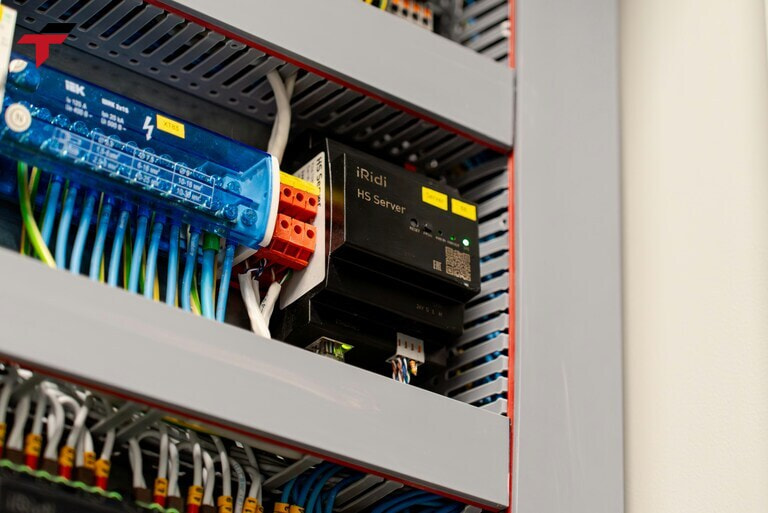
Inside a standard PLC unit, six core components work together to read field data, process logic, and drive outputs. Whether the PLC is a compact unit or a large modular rack, these same functional blocks are present.
The core components of every PLC are:
- CPU (Central Processing Unit): Executes the control program, manages the scan cycle, and coordinates all data movement between I/O and memory. Industrial CPUs prioritise consistent execution timing over raw clock speed.
- Input Modules: Convert field signals into digital values the CPU processes. A 24 V DC digital input module reads switch states; an analog input module converts a 4–20 mA sensor signal into a scaled engineering value. Optical isolation on every input channel protects the CPU from electrical noise and ground loops on field wiring.
- Output Modules: Translate CPU logic results into physical control signals. Relay output modules switch loads up to 240 V AC. Transistor output modules handle high-speed DC switching for servo drives and high-frequency pulse outputs. Triac output modules control AC loads without mechanical contact wear.
- Power Supply: Conditions incoming mains voltage – typically 240 V AC / 50 Hz in Malaysian industrial panels – and delivers regulated 24 V DC or 5 V DC to the CPU and I/O modules. Industrial power supplies absorb the voltage spikes, sags, and harmonic distortion that would damage standard electronics.
- Memory: Two types are present in every PLC. Non-volatile memory (flash or EEPROM) retains the control program through power loss. Volatile RAM stores runtime data – timer accumulated values, counter counts, I/O state tables – refreshed every scan.
- Communication Interface: Connects the PLC to HMIs, SCADA servers, other PLCs, and enterprise networks. Common industrial protocols include PROFINET, EtherNet/IP, CC-Link IE, and Modbus TCP. Communication modules are typically field-replaceable in modular PLCs.
In compact PLCs, these components are integrated into a single housing. In modular PLCs, each is a separate rack-mounted card – enabling individual replacement, independent upgrade, and higher total I/O capacity.
Key Components Inside a PLC
Types of PLCs: Compact, Modular, Safety, and Micro
Across industrial automation deployments, PLC hardware divides into four types, each suited to a different scale and safety requirement. Selecting the wrong type is a common and costly specification error – under-specifying leads to expansion dead-ends; over-specifying adds unnecessary cost to simple applications.
| Type | I/O Points | Typical Application | Example Models |
| Micro PLC | 8–32 | Single machine, pump, conveyor segment | Unitronics Jazz, IDEC SmartRelay |
| Compact PLC | 16–512 | Packaging line, F&B unit, HVAC, glove line section | Mitsubishi FX5U, Omron CP1E, Siemens S7-1200 |
| Modular PLC | 512 and above | Automotive assembly, large process plants, semiconductor fab | Siemens S7-1500, Omron CJ2M, Allen-Bradley ControlLogix |
| Safety PLC | Varies | Emergency stop, light curtain, safety interlock, process shutdown | Siemens F-series, Pilz PNOZmulti |
Compact PLCs integrate CPU, power supply, and base I/O into a single fixed housing. Most models allow limited expansion through add-on I/O units or bus-connected expansion modules up to their rated maximum. They are the workhorse of Malaysian manufacturing: a glove line dipping section, a food filling machine, a water dosing system, or a conveyor sorting station. Once the I/O ceiling is reached, the application requires a modular controller.
Modular PLCs mount CPU, I/O, communication, and function modules as separate cards on an expandable rack. Systems with more than 512 I/O points, redundant CPU configurations, dedicated motion control axes, or mixed communication protocol requirements use modular hardware. The per-card replacement model also reduces maintenance downtime – a failed I/O module swaps out without taking the CPU or adjacent modules offline.
Safety PLCs run redundant internal processors with continuous cross-checking and self-diagnostics to achieve certified reliability levels for safety-critical functions. Emergency stop circuits, light curtains, safety gates, and process emergency shutdown systems must use safety-rated controllers – a standard PLC does not qualify regardless of program logic. In practice, safety PLCs operate alongside standard PLCs: the standard controller runs production logic; the safety PLC retains authority to override and halt the system instantly.
Micro PLCs control single-function or auxiliary applications where full compact hardware is overengineered: a single pump, a small conveyor, a level control loop, or a utility function. Per-unit cost is significantly lower than compact hardware, and programming is typically simplified. Malaysian water treatment facilities and small F&B operations use micro PLCs extensively for auxiliary loops.
PLC Programming Languages
Under the IEC 61131-3 standard, five PLC programming languages are defined – each suited to different control structures and engineering backgrounds. All five produce equivalent machine code; the choice of language is a matter of application type and team familiarity.
The five IEC 61131-3 languages are:
- Ladder Logic (LD): A graphical language modelled directly on relay wiring diagrams. Horizontal rungs represent logic conditions; input contacts (sensor states) and output coils (actuator states) connect between vertical power rails. Ladder Logic is the dominant language in Malaysian factories – any engineer who understood relay panel wiring can read and modify a Ladder Logic program without additional programming training.
- Function Block Diagram (FBD): Connects pre-built function blocks – PID controllers, timers, counters, comparators, math operations – with signal flow lines. Data flows from left to right between blocks. FBD is used in process control applications where analog variables require continuous manipulation: temperature regulation, flow control, pressure management.
- Structured Text (ST): A high-level textual language with syntax resembling Pascal. Handles complex calculations, string operations, array processing, and looping constructs that become unmanageable in Ladder Logic. Increasingly used for advanced motion control sequences and data processing routines on modular controllers.
- Sequential Function Chart (SFC): Represents process sequences as explicit flowchart steps with transition conditions between them. Makes process state visible and traceable. Used for batch processes, recipe management, and multi-step operations where the sequence must be clearly documented and audited.
- Instruction List (IL): A low-level mnemonic language similar to assembly code. Largely replaced by Structured Text in modern PLC programming; retained in IEC 61131-3 for legacy compatibility.
Each PLC brand implements these languages within its own proprietary programming environment. Siemens uses TIA Portal; Mitsubishi uses GX Works3; Omron uses Sysmac Studio; Panasonic uses FPWIN Pro. The IEC 61131-3 standard defines language syntax – it does not mandate program portability between vendors.
How PLC, HMI, and SCADA Work Together
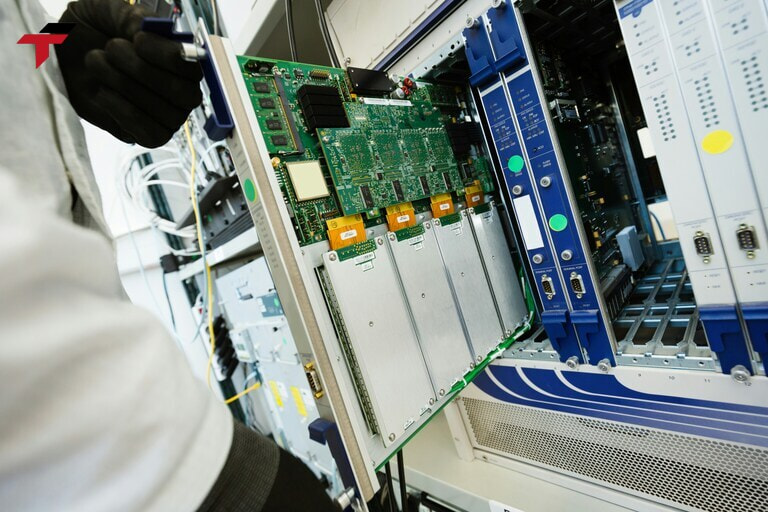
Within a full automation architecture, the PLC, HMI panels, and SCADA systems work together as three distinct but interdependent layers – PLC executes control, HMI displays machine status, SCADA manages facility-wide data. No single layer can provide what the other two deliver.
HMI (Human-Machine Interface) is the operator panel or touchscreen mounted at or near the machine. It reads data tags from the PLC – sensor values, alarm states, production counters – and displays them on a configurable screen. Operators use the HMI to start and stop machines, adjust setpoints, and acknowledge alarms; the HMI writes those inputs back to the PLC as digital or analog output values, which the PLC evaluates within its normal scan cycle. One HMI typically covers one machine or one line section.
A range of [HMI units available from Flextech](/product-category/hmi/) – including Delta and Xinje models – communicate directly with the PLC brands listed in this article using standard industrial protocols.
SCADA (Supervisory Control and Data Acquisition) operates at facility or enterprise level. A SCADA system polls data from multiple PLCs across an entire plant, stores trend data in a process historian database, generates production and compliance reports, and delivers system-wide alarm notifications to maintenance teams. A palm oil mill might have a single SCADA server polling PLCs across steriliser stations, pressing sections, clarification units, and the effluent treatment plant – giving operators and engineers a single view of the entire facility.
The operational hierarchy: PLCs execute millisecond-level control → HMIs display machine-level status to operators → SCADA aggregates plant-level data for management and compliance. Communication between all three layers uses industrial Ethernet protocols – most commonly PROFINET, EtherNet/IP, and Modbus TCP.
How PLC, HMI, and SCADA Work Together
PLC vs Relay Logic: Why the Switch Was Inevitable
From a control engineering standpoint, PLCs replaced relay-based control panels because reprogrammable software logic is categorically more practical than rewired hardware logic for any application that changes over time.
Before PLCs, factory control logic lived in relay cabinets – banks of electromagnetic contactors wired together to define machine behaviour. Changing a production process meant physically rewiring the cabinet: a task requiring electricians, days of production downtime, and full re-validation of the modified circuit. Every model changeover at an automotive plant required complete panel teardown and rewiring.
PLCs eliminated the rewiring requirement. Modifying machine behaviour means editing a software program – which can be written, tested in offline simulation, and downloaded to the controller in hours. Retooling time drops from days to hours. Changes are documented automatically in version-controlled program files, not in hand-drawn wiring diagrams.
Relay panels also fail mechanically. Contacts wear through millions of switching cycles; springs fatigue; coils burn out under sustained current. PLCs have no moving parts in the logic execution path. Solid-state I/O modules switch millions of cycles without wear, and the CPU executes indefinitely.
Where relay panels remain appropriate: fixed-function applications with fewer than a dozen switching operations and no foreseeable need for modification. In Malaysian SME manufacturing, this represents an increasingly small share of applications – cost-effective micro and compact PLCs have displaced relay panels even in simple utility control.
──────────────────────────────────────────────────
Summary: Core PLC Concepts
PLCs execute deterministic control logic in milliseconds, interface directly with industrial field devices through isolated I/O modules, and replace relay panel wiring with reprogrammable software. Compact units handle single machines from under RM 3,000; modular systems manage entire production lines above RM 15,000. Ladder Logic remains the dominant programming language in Malaysian factories. HMIs give operators local machine visibility; SCADA extends that visibility to the full facility.
Where PLCs Are Used in Malaysian Manufacturing
In the Malaysian manufacturing context, PLCs are the primary control technology across five sectors that define the country’s industrial output – each with distinct application requirements that influence PLC type and brand selection.
Rubber and Glove Manufacturing (Selangor, Negeri Sembilan)
Glove production lines run compact and modular PLCs to control dipping conveyor speed, latex compound temperature, stripping mechanisms, online defect detection, and line sequencing. These lines operate 24 hours across multiple shifts, making PLC reliability and mean-time-between-failure the decisive selection criteria. Downtime on a glove line is measured in thousands of rejected pieces per hour.
Semiconductor and Electronics (Penang, Kulim Hi-Tech Park)
Semiconductor fabrication and SMT assembly require PLCs for wafer handling robots, cleanroom HVAC pressure control, process chamber environment management, and automated optical inspection integration. This sector specifies Omron SYSMAC and Siemens SIMATIC at the modular tier – both support the deterministic motion control and high-speed counting functions that semiconductor equipment demands.
Palm Oil Processing
Palm oil mills deploy PLCs across steriliser pressure vessel cycles, thresher drum speed control, digester temperature management, and centrifuge clarification. The process combines sequential batch logic (steriliser cycle steps) with continuous analog control (temperature, pressure, flow) – applications where both Ladder Logic and Function Block Diagram programming appear in the same controller.
Food and Beverage (Halal-Certified Lines)
Halal F&B manufacturers require PLCs that log process parameters – batch temperature, time, ingredient weight, and batch ID – for regulatory traceability and Halal audit compliance. Compact PLCs with analog I/O modules and data logging capability handle mixing, cooking, filling, and packaging on these lines. Mitsubishi FX5U and Omron CP1H are common in this segment.
Utilities and Water Treatment
Municipal water treatment plants and industrial effluent facilities across Malaysia use PLCs with SCADA integration to manage pump stations, chemical dosing, aeration systems, and continuous monitoring. These systems often run unattended with remote HMI access, placing a premium on communication reliability and long-term hardware availability.
System integrators sourcing PLCs for Malaysian plants consistently identify local stock availability as a tier-one procurement criterion. Import lead times on specific models can reach 8–12 weeks from origin. A plant operating on lean production schedules cannot absorb that downtime window – local stock and local warranty coverage carry equal weight to technical specification.
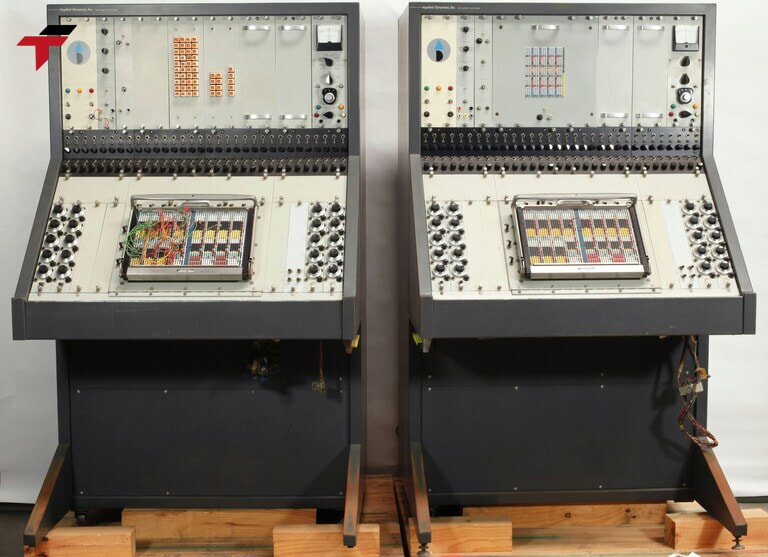
Where PLCs Are Used in Malaysian Manufacturing
How to Choose the Right PLC in Malaysia
For procurement and engineering teams in Malaysia, choosing the right PLC involves four criteria evaluated in sequence: I/O count, application complexity, brand ecosystem, and local availability.
- I/O Count – Size the Controller to the Machine
I/O count is the primary sizing variable. Count every discrete and analog input (sensors, switches, encoders, transmitters) and every discrete and analog output (motors, valves, indicators, drives) the machine requires. Add 15–20% spare I/O capacity for future expansion and maintenance flexibility.
| I/O Requirement | Recommended Type | Indicative Price Range (RM) |
| Under 32 I/O | Micro PLC | RM 600 – RM 2,500 |
| 32–512 I/O | Compact PLC | RM 2,500 – RM 15,000 |
| Above 512 I/O | Modular PLC | RM 15,000 – RM 80,000+ |
Price ranges are indicative for the Malaysian market and vary by brand, model configuration, and I/O module selection.
- Application Complexity
On/off sequencing with basic timers and counters falls within micro or compact capability. Applications requiring PID control loops, high-speed pulse counting above 100 kHz, synchronised multi-axis motion, or structured data exchange with ERP systems require compact or modular hardware with the corresponding function modules. Safety-critical functions – emergency stops, machine guarding, safety interlocks – require a safety-rated PLC regardless of I/O count.
- Brand Ecosystem
Each PLC brand carries an associated programming environment, HMI compatibility set, and local support infrastructure. Once a plant or OEM standardises on a brand, migrating to a different platform later incurs reprogram, revalidation, and retraining costs. Mitsubishi and Omron have established service networks in Malaysia with local technical support. Siemens serves heavier industrial and semiconductor applications. Panasonic FP series competes on compact panel space and cost. Select the brand with the strongest local support for the target industry sector – not solely the lowest unit cost.
- Local Stock and Warranty Coverage
For Malaysian manufacturers, a PLC model on overseas backorder for 8–12 weeks is not a viable option when a line is down. Local stock means days, not weeks, to restore production. Local warranty coverage means a warranty claim is resolved domestically, not through a foreign principal’s slow RMA process. Confirm stock level and warranty terms before finalising the specification.
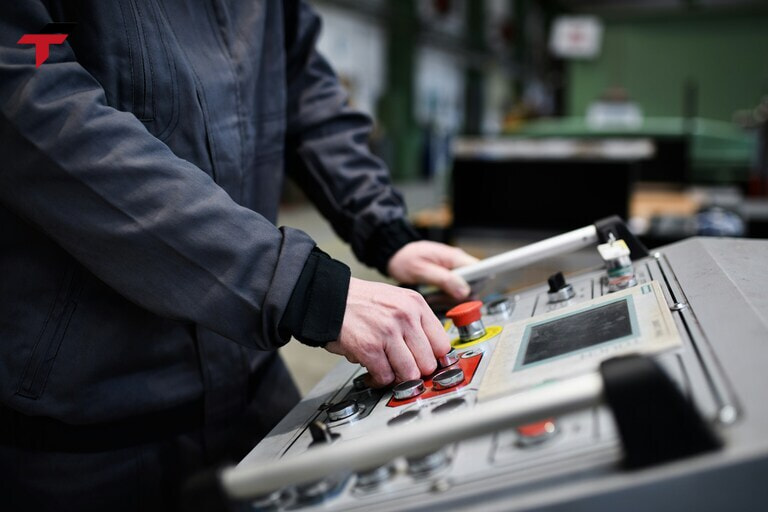
How to Choose the Right PLC in Malaysia
PLC Brands Available in Malaysia
Among the PLC brands stocked in Malaysia for industrial automation applications, six are widely deployed across the sectors described above.
Mitsubishi Electric – MELSEC Series
The FX series – particularly FX3U and FX5U – is the most broadly deployed compact PLC range in Malaysian manufacturing. GX Works3 programming software supports Ladder Logic, SFC, and Structured Text. The iQ-R series handles modular applications requiring high-speed communication and multi-axis motion.
Omron – SYSMAC Series
Omron’s SYSMAC CP1E and CP1L are the standard compact options for general machine control; CP1H adds high-speed pulse outputs for servo positioning. CJ2M and NX1 handle modular applications. Omron is the preferred brand in Penang’s semiconductor and electronics sector. Sysmac Studio provides an integrated environment covering PLC, motion, safety, and vision.
Siemens – SIMATIC Series
S7-1200 is the compact standard for industrial-grade applications requiring PROFINET connectivity and advanced PID. S7-1500 handles modular, large-scale systems with integrated motion and safety. TIA Portal integrates PLC programming, HMI configuration, and network diagnostics in a single environment. Common in multinational and heavy industrial facilities.
Panasonic – FP Series
FP-X0, FP-XH, and FP0R are compact controllers suited to space-constrained panel installations in F&B, water treatment, and auxiliary machine control. Competitive unit pricing in the compact segment. FPWIN Pro handles programming across the FP range.
Xinje
A cost-effective option for budget-sensitive applications with low-to-moderate I/O and standard Ladder Logic requirements. Compatible with standard IEC 61131-3 programming tools and supported by local stocking for fast replacement.
Allen-Bradley – Rockwell Automation
ControlLogix and CompactLogix are the North American industry standards, specified in Malaysian plants operated by multinationals with global Rockwell standardisation. Higher unit cost than Asian-origin brands; selected where corporate engineering standards mandate the platform, not on unit economics alone.
For quotation and availability on any of these brands – with local stock confirmation and local warranty coverage – contact.
Frequently Asked Questions
What is a PLC in simple terms?
A Programmable Logic Controller is a ruggedised industrial computer that reads signals from sensors and switches, executes a stored control program, and turns connected equipment – motors, valves, conveyors – on or off based on that logic. It does this in a continuous repeating loop, thousands of times per second, with the same result every cycle.
What is the difference between a PLC and a PC?
A PLC executes control logic in a fixed deterministic scan cycle with no operating system interference. A general-purpose PC runs a multi-tasking OS that introduces unpredictable latency – unacceptable for millisecond-precise machine control. PLCs are also built to withstand factory environments (vibration, electrical noise, wide temperature ranges) that would fail standard PC hardware within months.
What is the difference between a PLC and a DCS?
A PLC controls discrete machines and production lines – it handles binary I/O and mixed analog/discrete control at the machine level. A Distributed Control System (DCS) manages continuous process control across an entire plant – refineries, chemical facilities, power stations – with tightly integrated historian databases and operator workstations. DCS systems are overengineered and over-budget for the machine-level tasks that PLCs handle efficiently.
How long does a PLC last in production?
Industrial PLCs from established brands – Mitsubishi, Omron, Siemens – are designed and specified for long-term continuous operation. Units operating within rated temperature and electrical specifications routinely run for 10 to 20 years before requiring replacement. The principal failure modes are capacitor ageing in the power supply and I/O module contact wear, both of which are field-replaceable in modular systems.
How do I get a PLC quotation in Malaysia?
Provide the following to your supplier: preferred brand or application description, I/O count breakdown (digital inputs, digital outputs, analog inputs, analog outputs), communication protocol requirements, and whether expansion modules or special function cards are needed. Flextech Industrial stocks Mitsubishi, Omron, Panasonic, Xinje, and other brands with local warranty coverage.