
Types of Industrial Sensors: Detection, Wiring, and Selection for Automation Engineers

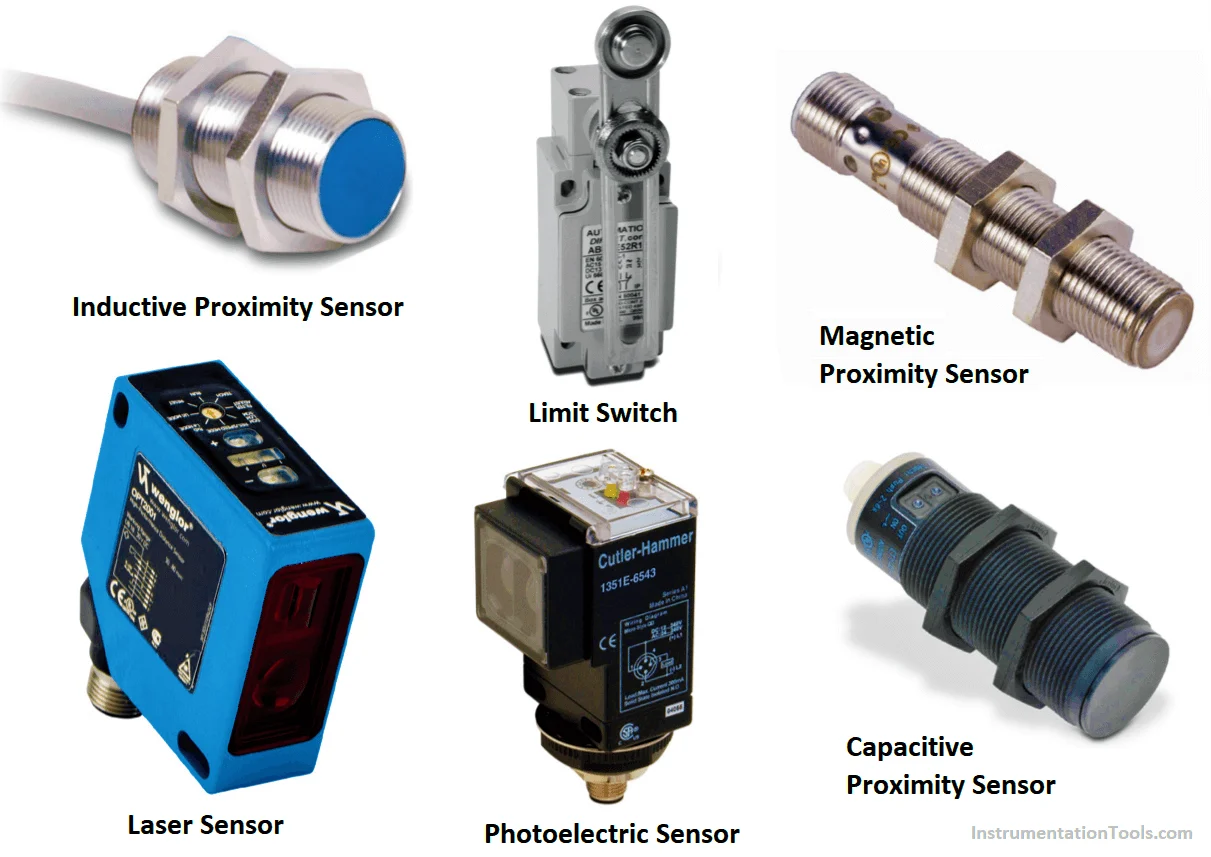
Industrial sensors are the data-collection layer of every automation system – each device detects a physical condition and converts it into an electrical signal that a PLC, controller, or monitoring platform acts on. Selecting the wrong industrial sensor type for an application causes more than inconvenience: it produces false trigger signals, damages PLC input cards through output mismatch, and creates unplanned downtime on production lines where every minute of stoppage carries a measurable cost. The detect-and-convert principle is universal across all sensor technologies, but the specific technology, output type, and environmental rating require precise matching to the target material, process variable, and operating environment.
This guide covers the two main sensor families used in industrial automation – presence detection sensors and process variable measurement sensors – along with electrical output types, PLC wiring conventions, IP environmental ratings, and a five-criteria selection framework. It is written for system integrators, maintenance engineers, and procurement managers sourcing sensors for manufacturing operations in Malaysia.
What Is an Industrial Sensor – Detection, Conversion, and Signal Output
An industrial sensor detects a physical stimulus and converts it into an electrical signal that an automation or control system uses – the signal output is the form that detection takes. Every sensor performs two core functions: detection via a sensing element, and conversion via a transduction mechanism that produces a measurable electrical output – voltage, current, resistance change, or a digital signal.
The same detect-and-convert principle applies regardless of sensor type. A temperature sensor’s thermocouple generates a small voltage proportional to temperature. A pressure sensor’s diaphragm deforms under applied force and outputs a proportional signal. A proximity sensor’s electromagnetic field collapses when a metal target enters range and switches a transistor output.
Industrial sensors are also classified by whether they require an external power source. An active sensor produces an output signal without external excitation – a thermocouple is a standard example. A passive sensor requires an external power supply to generate its output – a Resistance Temperature Detector (RTD) changes resistance with temperature but needs excitation current to produce a readable voltage. In automation practice, nearly all switching-type sensors (inductive, capacitive, photoelectric) are powered devices and fall into the passive category, though the active/passive label matters more in instrumentation and signal conditioning than in day-to-day sensor selection.
The first meaningful classification in any sensor selection decision is not the sensor’s function but its detection method – whether it physically contacts the target or senses it without touch.
Contact vs Non-Contact Sensing – The Primary Classification Framework
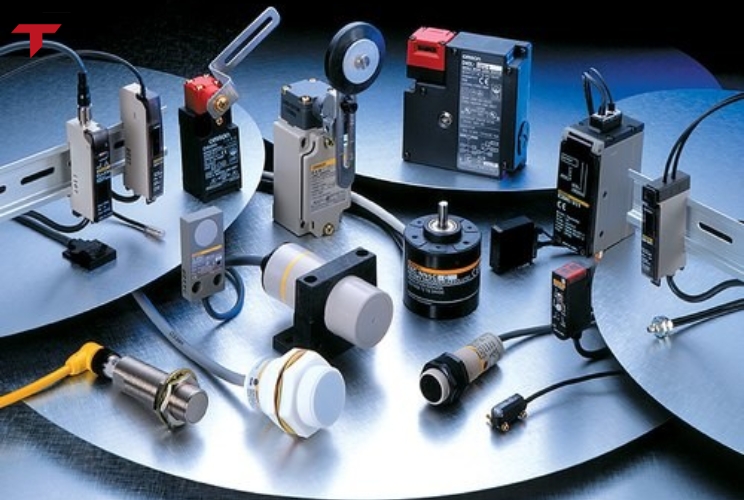
Contact vs non-contact sensing is the primary classification framework for industrial sensors – the detection method determines wear characteristics, switching speed, and suitability for different target types before any sensor technology is evaluated.
Contact sensing (electromechanical) relies on physical collision between the sensor actuator and the target. Mechanical limit switches are the primary example. They are robust, simple to wire, and immune to electrical noise and electromagnetic interference – characteristics that make them reliable in environments with heavy motor-driven equipment and variable power quality. Their limitation is mechanical wear: the actuator, plunger, or roller wears with each actuation cycle, limiting service life in high-cycle applications. Physical contact also poses a risk of damaging delicate or fragile targets.
Non-contact sensing uses magnetic fields, light beams, sound waves, or electrostatic fields to detect targets without physical touch. The result is wear-free operation – no mechanical components degrade over time. Electronic switching frequencies for non-contact sensors reach 5,000 or more operations per second, enabling detection on high-speed conveyor and packaging lines where contact sensors lack the response speed. Non-contact sensing is also safe for targets that cannot tolerate physical impact: freshly painted surfaces, wet food products, semiconductor components, and glass.
| Parameter | Contact Sensing | Non-Contact Sensing |
| Detection method | Physical actuator contact | Magnetic field, light, sound, capacitance |
| Wear | Mechanical wear over time | No moving parts – wear-free |
| Switching speed | Limited by mechanical response | Electronic switching – high frequency |
| Electrical noise immunity | High (mechanical contact) | Varies by technology (inductive = high) |
| Target safety | Risk of damage on delicate targets | Safe for fragile, wet, or soft targets |
| Typical application | Safety limits, heavy-duty machinery | Automated manufacturing, high-speed lines |
Contact sensing remains the appropriate choice for heavy-duty safety limit applications – end-of-travel detection on large presses, for example – and in environments with extreme electromagnetic interference where electronic sensors are prone to false triggering. For the majority of modern automated manufacturing, non-contact sensing is the standard. Within non-contact sensing, the target material determines which technology applies.
Presence Detection Sensors – Object Sensing by Target Material
Presence detection sensors output a binary signal: the target is either present or absent. The correct sensor technology for a given application is determined first by what the target is made of, and second by the operating environment and required sensing range.
The five primary presence detection technologies are summarised below:
| Sensor Type | Detection Principle | Target Material | Key Advantage |
| Inductive | Oscillating electromagnetic field | Metallic (ferrous and non-ferrous) | Resistant to oil, coolant, water – robust in harsh environments |
| Capacitive | Electrostatic field | Non-metals, liquids, granules, powder | Detects through container walls; sensitivity adjustable |
| Photoelectric | LED or laser light beam | Most materials; color and transparency options | Most flexible sensing range; three operating modes |
| Magnetic | Permanent magnetic field | Magnet on pneumatic cylinder piston | Non-intrusive – detects through cylinder wall without drilling |
| Ultrasonic | High-frequency sound wave echo | Any sound-reflecting material | Color-blind, transparency-blind – works where optical sensors fail |
Inductive Sensors – Ferrous and Non-Ferrous Metal Detection
Inductive sensors generate an oscillating electromagnetic field at the sensing face. When a metallic target enters this field, the eddy currents induced in the target dampen the oscillation and trigger a switching output. The sensor detects ferrous metals (steel, iron) and non-ferrous metals (aluminium, copper, brass) – though the nominal sensing range for non-ferrous targets is reduced compared to steel, typically by a correction factor stated in the sensor datasheet.
Sensing range scales with sensor body diameter: an M8 cylindrical sensor detects a standard steel target at approximately 2mm, while an M18 sensor reaches 8mm or more. Applications on Malaysian factory floors include metal mould position detection on rubber glove conveyor lines, cam and gear tooth counting in drive systems, and metal workpiece positioning in CNC machine tool fixtures.
The primary advantage is resistance to contamination. Inductive sensors rated IP67 operate reliably in cutting fluid, oil mist, and washdown water – conditions that eliminate optical sensing options. [Autonics and Omron inductive sensors](https://www.flextech-industrial.com/product-category/sensors/) are stocked by Flextech Industrial for applications across Selangor, Penang, and Johor.
Capacitive Sensors – Non-Metal, Liquid, and Powder Detection
Capacitive sensors detect changes in the electrostatic field generated at the sensing face. Any material with a dielectric constant different from air – liquids, granules, powder, wood, plastic, glass – alters the field and triggers the sensor output. Sensitivity is adjustable via a potentiometer, allowing the sensor to ignore a container wall and detect only the material inside.
This through-container detection capability makes capacitive sensors the standard choice for liquid level control: mount the sensor on the outside of a plastic or glass tank and detect the liquid inside without penetrating the vessel. In Malaysian palm oil processing, capacitive level sensors monitor crude palm oil in storage tanks. In food and beverage production, they control liquid fill levels on bottling and packaging lines.
The limitation is sensitivity to surface contamination. Accumulated dust, condensation, or heavy oil film on the sensing face can trigger false outputs – inductive sensors are more tolerant of contamination. Capacitive sensors in dirty environments require regular face cleaning or a housing with a longer non-flush installation distance.
Photoelectric Sensors – Through-Beam, Retro-Reflective, and Diffuse Modes
Photoelectric sensors use a modulated LED or laser light beam to detect targets. Three operating modes address different installation constraints and target types. Each mode uses a distinct emitter-receiver configuration suited to different installation realities.
| Mode | Configuration | Sensing Range | Best For |
| Through-beam | Separate emitter and receiver, target interrupts beam | Longest (up to several metres) | High reliability counting, transparent object detection, high-speed lines |
| Retro-reflective | Emitter and receiver in one housing, reflector opposite, target interrupts beam | Medium | Compact installations with space on one side only |
| Diffuse | Emitter and receiver in one housing, target reflects beam back | Shortest | Simplest installation; one-sided mounting; varied object sizes |
Through-beam mode provides the highest detection reliability and is used in semiconductor packaging lines and F&B conveyor counting where false negatives carry significant cost. Diffuse mode is the most common in general-purpose automation. Background suppression (BGS) diffuse sensors eliminate false triggering from the conveyor belt surface by using triangulation to distinguish near targets from the background.
For clear or transparent targets – glass bottles, clear film, acrylic panels – through-beam is the only reliable mode. Diffuse sensors cannot reliably detect transparent objects because the return signal is too weak.
Magnetic Sensors – Pneumatic Cylinder End-of-Stroke Confirmation
Magnetic sensors detect a permanent magnet embedded in the piston of a pneumatic cylinder. The sensor mounts in a groove on the cylinder body exterior – no drilling, no modification to the cylinder required. When the piston reaches the end of its travel (full extension or full retraction), the magnet passes the sensor and triggers the output.
This provides reliable end-of-stroke confirmation for pneumatic clamps, grippers, and actuators used in automated assembly jigs and welding fixtures. The sensor output confirms that the cylinder has completed its stroke before the PLC advances to the next sequence step – preventing part misalignment and tooling damage from sequences that proceed before a clamp is fully closed.
The application is specific: magnetic cylinder sensors detect only the magnet in the target cylinder. They are not general-purpose presence detection devices.
Ultrasonic Sensors – Color-Blind, Material-Agnostic Detection
Ultrasonic sensors emit high-frequency sound pulses and measure the time taken for the echo to return from the target surface. Because detection relies on sound reflection rather than light or magnetic properties, ultrasonic sensors are agnostic to target color, surface finish, and optical transparency.
This makes them the solution of choice when photoelectric sensing fails: detecting clear plastic film on a conveyor, sensing foam or liquid surfaces where light refraction causes false readings, or detecting objects of varying colors and materials on the same line without sensor adjustment. Ultrasonic sensors also function reliably in dusty or steam-filled environments where optical sensors are obscured.
The limitation is that highly absorbent surfaces – loose fabric, open-cell foam – can dampen the echo return to the point where detection range is significantly reduced. Verify sensing range against actual target material, not just the datasheet nominal distance.
Summary – Presence Detection Sensor Selection
Inductive sensors detect metal targets through oil and coolant (IP67 standard). Capacitive sensors detect non-metals and liquids through container walls, with adjustable sensitivity. Photoelectric sensors operate in three modes – through-beam for maximum range and reliability, retro-reflective for compact one-sided installation, diffuse for general-purpose detection. Magnetic sensors confirm pneumatic cylinder end-of-stroke without modifying the cylinder body. Ultrasonic sensors detect any sound-reflecting target regardless of color or optical transparency. Target material is the first filter: metal → inductive; non-metal or liquid → capacitive or photoelectric; transparent or variable-surface → ultrasonic.
Process Variable Measurement Sensors
Process variable sensors output an analog signal proportional to a continuously varying physical quantity – temperature, pressure, flow rate, liquid level, or mechanical vibration. Unlike presence detection sensors that output a binary on/off state, measurement sensors provide a continuous value that a PLC or controller uses for closed-loop control, trend monitoring, or alarm generation.
Temperature Sensors – Thermocouple, RTD, and Infrared Types
Three technologies cover the range of industrial temperature measurement. Thermocouples generate a small voltage from the junction of two dissimilar metals – they are robust, cover wide temperature ranges (commonly −200°C to over 1,200°C), and are the standard for high-temperature applications such as furnaces and kilns. Resistance Temperature Detectors (RTDs), particularly the PT100 type, change electrical resistance predictably with temperature – they offer higher accuracy than thermocouples over a narrower range and are standard for motor winding, bearing, and heat exchanger monitoring. Infrared thermometers measure surface temperature from emitted thermal radiation without physical contact, suited to moving targets, electrical panels, and surfaces that cannot be touched.
In Malaysian manufacturing, temperature sensors appear in palm oil clarification and fractionation processes, F&B pasteurisation lines, rubber vulcanisation ovens, and motor temperature monitoring on semiconductor equipment drive systems.
Pressure Sensors – Gauge, Absolute, and Differential
Pressure sensors convert force applied to a diaphragm into an electrical output. Three measurement references cover different applications: gauge pressure (relative to atmospheric pressure) is standard for hydraulic systems and compressed air; absolute pressure (relative to perfect vacuum) is used in process applications where atmospheric variation matters; differential pressure (the difference between two measurement points) detects flow rate via the pressure drop across an orifice, or monitors filter condition by measuring the pressure drop across a filter element.
In industrial maintenance, pressure sensors on compressed air lines provide early warning of developing leaks. On hydraulic systems, they confirm that operating pressure is within the normal range before a cycle begins. In Malaysian rubber manufacturing, pressure sensors monitor vulcanisation vessel pressure during the curing process.
Flow Sensors – Rate and Volume Measurement
Flow sensors measure the rate or total volume of fluid or gas passing through a pipe or channel. Common measurement technologies include turbine (a rotor spun by fluid flow), electromagnetic (for conductive liquids), and ultrasonic (clamp-on, non-invasive). Output is typically an analog 4-20mA signal proportional to flow rate, or a pulse-per-unit-volume signal for totalisation.
Flow sensors are used on cooling water circuits in machine tools and semiconductor equipment, lubricant supply lines in gearboxes and large motors, and chemical dosing systems in process industries.
Level Sensors – Point-Level and Continuous Measurement
Level sensors monitor the amount of material – liquid, granule, or powder – in a container. Two measurement modes serve different needs. Point-level sensors trigger a discrete output when material reaches a specific threshold: overfill prevention, low-level alarm, or demand-based refill triggers. Continuous-level sensors output an analog signal proportional to the current level, enabling real-time inventory monitoring and proportional control of filling or draining.
Technologies include float switches, vibrating forks (point-level), and ultrasonic or guided radar sensors (continuous). Capacitive sensors (covered in H2-3) also function as level sensors for liquids detected through tank walls.
Vibration Sensors – Rotating Machinery Fault Detection
Vibration sensors measure acceleration, velocity, or displacement in rotating machinery – motors, pumps, fans, compressors, and gearboxes. A piezoelectric accelerometer is the most common type: it generates a charge signal proportional to the acceleration applied to it, which is then conditioned to a 4-20mA or digital output.
The value of vibration monitoring is early fault detection. A developing bearing fault changes the vibration signature of a motor weeks before the bearing fails mechanically – the vibration amplitude and frequency content shift in characteristic ways that a trained monitoring system can identify and alert on. In Malaysian manufacturing, vibration monitoring on critical drive motors in semiconductor and palm oil processing plants allows maintenance to be planned and executed during scheduled downtime rather than after an unplanned failure.
Sensor Output, Wiring, and PLC Integration
Selecting the correct sensor technology is half the task. The sensor’s electrical output requires matching to the PLC input card specification – mismatch causes wiring faults, permanent PLC input card damage, or false signal states that produce erratic machine behaviour.
NPN vs PNP and Normally Open vs Normally Closed
Sensor output wiring type and switching state are two independent specifications – both require correct selection for reliable PLC integration.
Wiring output – NPN vs PNP:
| Parameter | NPN (Sinking) | PNP (Sourcing) |
| Also known as | Sinking | Sourcing |
| What it switches | Negative (0V) line to the load | Positive (+24V) line to the load |
| Standard region | Asia, United States | Europe |
| Common with | Mitsubishi, Omron, Panasonic PLCs | Siemens PLCs |
| Fault safety | Short to +24V = false ON signal | Short to 0V = blown fuse (safer) |
In Malaysia, Mitsubishi, Omron, and Panasonic PLCs dominate the installed base – all use NPN-compatible [PLC input cards](https://www.flextech-industrial.com/product-category/plc/) by default. Order NPN sensors unless the PLC specification sheet explicitly states PNP input. Mixing NPN sensors with PNP-only input cards produces a permanently ON input state – a common commissioning fault.
Switching state – NO vs NC:
Normally Open (NO): the output is OFF with no target present, and switches ON when a target is detected. This is the standard mode for counting, positioning, and presence detection applications.
Normally Closed (NC): the output is ON with no target present, and switches OFF when a target is detected. This mode is used in safety-critical applications – end-of-travel limits, guard door interlocks – because a broken wire or power loss also drives the output to OFF, which is the safe state. Machines wired with NC logic stop automatically on cable failure rather than remaining in motion.
Discrete vs Analog Output – 4-20mA and 0-10V Signals
Presence detection sensors output a discrete (switching) signal – a binary 0 or 1 that tells the PLC “target present” or “target absent.” Process variable measurement sensors output an analog signal proportional to the measured value.
Two analog signal standards are used in industrial automation:
4-20mA current loop: 4mA represents the minimum of the measurement range, 20mA represents the full scale. The current loop format is preferred for long cable runs because current is not affected by voltage drop along the cable. The live zero at 4mA provides an important diagnostic advantage: if the signal drops to 0mA, the PLC knows the cable is broken or the sensor has lost power – it is not a valid “zero value” reading. This wire-break detection capability is the reason 4-20mA is standard for process instrumentation on runs longer than 10 metres.
0-10V voltage: simpler wiring, suitable for short cable runs. Standard in HVAC, building automation, and straightforward process monitoring applications where cable length is not a concern.
IO-Link – Smart Sensor Communication for IIoT
IO-Link is a point-to-point digital communication protocol (IEC 61131-9) that converts a standard sensor into a configurable smart device. An IO-Link-capable sensor communicates bidirectionally with an IO-Link master module connected to the PLC – the same standard 3-wire cable is used, but the sensor is no longer just a switching device.
IO-Link enables two capabilities that reduce maintenance overhead. First, remote parameter configuration: sensing distance, output polarity, and response time can be changed from the PLC engineering software without sending a technician to the machine. Second, sensor-level diagnostics: the sensor can report its own status – lens contamination, target out of range, or internal fault – before the machine stops, enabling predictive maintenance at the field device level rather than waiting for a production failure to reveal the problem.
IO-Link adoption in Malaysian manufacturing is growing in semiconductor and precision electronics facilities, where the cost of unplanned downtime justifies the investment in smarter field infrastructure.
Environmental Ratings – IP67, IP68, IP69K, and ATEX
Environmental ratings – IP67, IP68, IP69K, and ATEX – determine whether a sensor survives its installation environment: a device that passes bench testing fails within hours on a factory floor when the environmental protection grade does not match the actual operating conditions. Two rating systems govern industrial sensor environmental suitability: IP ratings for ingress protection and ATEX/IECEx for explosive atmospheres.
IP Ratings Explained – What Each Grade Means in Practice
IP (Ingress Protection) ratings are defined by IEC 60529. The two-digit code specifies protection against solid particles (first digit) and liquids (second digit).
| IP Rating | Solid Protection | Liquid Protection | Typical Application |
| IP54 | Dust-protected (limited ingress) | Splash-resistant | Control cabinets, clean indoor assembly |
| IP67 | Dust-tight | Temporary immersion (1m, 30 min) | General factory automation – most common industrial standard |
| IP68 | Dust-tight | Continuous immersion (depth/duration per manufacturer spec) | Machine tools, permanently wet environments |
| IP69K | Dust-tight | High-pressure, high-temperature steam jet (80°C, 80 bar, at 0.1–0.15m) | Food and beverage washdown zones, pharmaceutical, rubber glove manufacturing |
In Malaysian manufacturing, the minimum requirement by sector is: semiconductor cleanrooms – IP67; general factory automation – IP67; food and beverage production lines – IP69K for washdown zones, IP67 for non-washdown areas; rubber glove manufacturing (chemical and steam exposure) – IP67 to IP69K depending on zone. Sensors specified at IP54 for indoor environments will fail within weeks if exposed to direct washdown, coolant spray, or outdoor weather.
ATEX and IECEx – Explosion-Proof Sensors for Hazardous Areas
In facilities where flammable gases, vapours, or combustible dust are present – paint shops, flour mills, oil and gas installations, chemical plants – a sensor spark is sufficient to trigger an explosion. Two certification frameworks govern sensor use in these environments.
ATEX (EU Directive 2014/34/EU) and IECEx (IEC international certification scheme) both define requirements for equipment used in explosive atmospheres. Two design approaches meet these requirements: intrinsically safe sensors limit electrical energy in the circuit below the ignition threshold of the surrounding atmosphere; explosion-proof (flameproof) housings are designed to contain any internal ignition without propagating to the external atmosphere.
Malaysian petrochemical facilities in Kertih and Johor Bahru, and solvent-based manufacturing operations, require ATEX or IECEx certified sensors in classified zones. Sensor selection for these environments requires zone classification (Zone 0/1/2 for gas, Zone 20/21/22 for dust) and matching sensor category certification.
Summary – Output Wiring and Environmental Protection
NPN (sinking) is the default in Malaysian automation – compatible with Mitsubishi, Omron, and Panasonic PLC input cards. PNP (sourcing) applies to European Siemens-based systems. Normally Closed wiring is the safety-standard choice for limit and guard applications: cable break drives the output to OFF, stopping the machine. For analog measurement signals, 4-20mA is preferred on cable runs longer than 10 metres – the live zero at 4mA distinguishes a valid zero-value reading from a broken cable (which reads 0mA). IP67 is the minimum for general factory environments. IP69K applies wherever high-pressure, high-temperature washdown is part of the daily cleaning process.
How to Select the Right Industrial Sensor – 5 Decision Criteria
Sensor selection follows a consistent five-step process regardless of application type. Working through these criteria in order eliminates the most common selection errors before they reach the purchasing stage.
- Identify the target material and detection requirement. Is the target metallic? Use an inductive sensor. Is it non-metal, liquid, or powder? Use capacitive or photoelectric. Does the application need to measure a process variable continuously – temperature, pressure, flow, level, or vibration? Use the appropriate measurement sensor type. This first question eliminates the majority of inappropriate technology choices.
- Determine sensing range and switching speed. For inductive sensors, larger body diameter = longer sensing range. Confirm that the required sensing distance falls within the sensor’s nominal range for the specific target material. For high-speed applications – packaging lines, bottle counting, gear tooth detection – check the sensor’s response frequency specification against the target speed and required detection reliability.
- Assess environmental hazards. Are there daily washdowns? Specify IP69K. Is welding slag, cutting fluid, or heavy oil mist present? Specify inductive sensors with Teflon-coated sensing faces and IP67 or IP68 rating, with PUR cable jacket. Is the environment a classified explosive atmosphere? Require ATEX/IECEx certification with the correct zone category. Is it a food-contact or pharmaceutical environment? Confirm food-grade housing material (stainless steel SS316L) and applicable regulatory compliance.
- Confirm electrical output and PLC compatibility. Identify the PLC input card type from the PLC specification sheet – NPN or PNP input. Determine whether the application requires a discrete switching output or an analog measurement output (4-20mA or 0-10V). Confirm that the sensor supply voltage matches the panel voltage (typically 24V DC for automation applications). Mismatches at this stage are the most common cause of commissioning delays.
- Match housing style and connection type. Cylindrical threaded sensors (M8, M12, M18, M30) allow sensing distance adjustment by repositioning the sensor in its mounting bracket – larger diameter = longer range. Pre-wired sensors (fixed cable) are lower cost but require the entire cable to be re-routed if the sensor fails. Sensors with an M12 connector (pigtail) allow the sensor body to be replaced without re-routing cable – a significant maintenance time advantage in systems with many sensors or difficult routing paths.
Industrial Sensors in Malaysian Manufacturing
Industrial sensors in Malaysian manufacturing operate across four primary sectors – semiconductor, palm oil processing, rubber and glove, and food and beverage – each with environment and output requirements that differ from generic automation specifications.
Semiconductor manufacturing (Penang, Selangor): Precision electronics handling demands fiber optic and laser displacement sensors for die bonding, pick-and-place, and PCB inspection – targets are miniature, static-sensitive, and often positioned in spaces too small for standard cylindrical sensors. Photoelectric sensors on packaging and test lines must distinguish transparent film and clear component trays reliably. NPN output is the standard for Japanese and Taiwanese equipment that dominates the sector. IP67 is the minimum in cleanroom environments; cleanroom-compatible materials and low outgassing sensor construction are specified for higher-class areas.
Palm oil processing: Capacitive level sensors monitor crude palm oil, processed fractions, and intermediate products in storage and processing tanks – the high viscosity and varying density of palm oil products favour through-wall capacitive sensing over intrusive float switches. Temperature sensors control clarification, fractionation, and sterilisation stages where precise temperature management directly affects product quality and yield. Pressure sensors on steriliser vessels confirm operating pressure during the FFB sterilisation cycle. IP67 rating is the standard minimum throughout palm oil processing facilities.
Rubber and glove manufacturing: Inductive sensors on conveyor systems confirm metal mould position through each dipping and vulcanisation sequence – the metal formers passing each station are detected and counted to verify line throughput and detect jams. Temperature sensors on vulcanisation ovens monitor cure temperature, and pressure sensors confirm vulcanisation vessel operating pressure. High humidity, steam exposure, and chemical wash cycles make IP67 the minimum specification; washdown zones require IP69K.
Food and beverage: IP69K photoelectric and inductive sensors are specified for all washdown production zones – stainless steel (SS316L) housing is standard to prevent corrosion and bacterial accumulation in cleaned-in-place (CIP) environments. Capacitive level sensors control liquid fill levels in tanks and batch vessels. All sensors in food contact or near-contact zones must comply with applicable food safety standards. Flextech Industrial stocks Autonics and Omron [industrial sensors Malaysia](https://www.flextech-industrial.com/product-category/sensors/) suited to general automation and F&B environments, with local support across Selangor, Penang, and Johor.
Frequently Asked Questions
What is the difference between a sensor and a transducer?
A transducer converts one form of energy into another. A sensor is a specific type of transducer that converts a physical condition – temperature, pressure, proximity, vibration – into an electrical signal. In industrial practice the terms are used interchangeably, though technically all sensors are transducers while not all transducers are sensors.
What is the most widely used industrial sensor type?
Inductive proximity sensors are the most commonly deployed sensors in manufacturing automation. They detect metallic targets reliably in harsh environments – oil, coolant, metal swarf – with no moving parts and long service life. Their simple three-wire NPN or PNP output wires directly into standard PLC input cards.
What does NPN mean on an industrial sensor specification sheet?
NPN (sinking) means the sensor switches the 0V (negative) line to the PLC input. This is the standard output type for Japanese and Taiwanese equipment and is compatible with Mitsubishi, Omron, and Panasonic PLC input cards commonly used in Malaysian factories. The alternative, PNP (sourcing), switches the positive +24V line and is standard in European (Siemens) equipment. Order NPN unless the PLC specification sheet states PNP.
What IP rating is required for food and beverage manufacturing?
IP69K is the standard for active washdown zones – it is defined in IEC 60529 as protection against high-pressure, high-temperature water jets at 80°C, 80 bar pressure, at 0.1–0.15m distance. IP67 is the minimum for general wet production areas without direct high-pressure cleaning. IP54 is not suitable for food production environments.
Can a single sensor type detect both metal and non-metal targets?
Photoelectric sensors (through-beam, retro-reflective, and diffuse modes) detect most target materials regardless of composition, provided the target has a surface that interrupts or reflects the light beam. Ultrasonic sensors are even more versatile – they detect any sound-reflecting surface regardless of color, transparency, or material composition, making them effective for clear film, varied-color packages, and liquid surfaces where optical sensing is unreliable.