
SCADA vs HMI: Key Differences and How to Choose for Your Plant

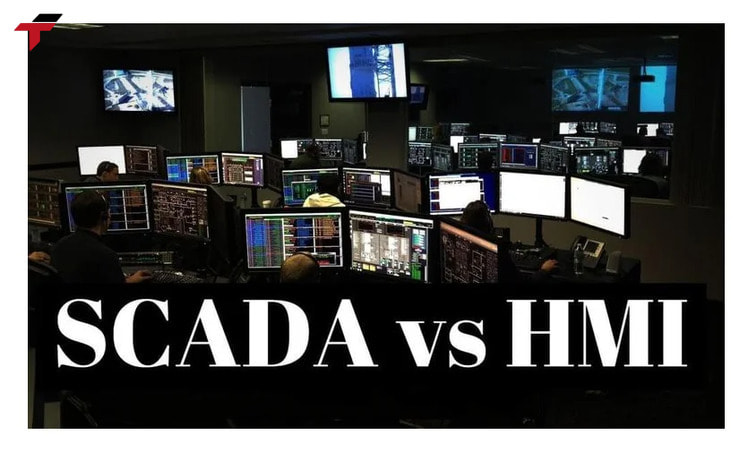
SCADA vs HMI represent two distinct control layers in industrial automation. HMI – Human Machine Interface – provides local control over a single machine; SCADA – Supervisory Control and Data Acquisition – monitors and manages entire plants or distributed facilities from a central workstation. Most modern industrial operations use both: HMI panels at individual machines connect upward to a SCADA system that aggregates data from PLCs, RTUs, and field devices across the whole facility.
For Malaysian system integrators and plant engineers, the decision is rarely binary. It depends on machine count, remote access requirements, data volume, and whether the operation spans multiple sites. This article examines eight dimensions of the SCADA vs HMI difference, explains how PLCs connect both systems in a three-layer control architecture, and provides a selection framework for three common Malaysian manufacturing scenarios.
————————————————————
SCADA System Architecture
In industrial automation, SCADA – Supervisory Control and Data Acquisition – is a system architecture that collects real-time data from field devices across multiple machines, production lines, or geographically distributed sites and delivers it to a central monitoring workstation.
A SCADA system connects to field devices – Programmable Logic Controllers (PLCs), Remote Terminal Units (RTUs), sensors, and actuators – that gather raw process data and pass it upward to SCADA servers.
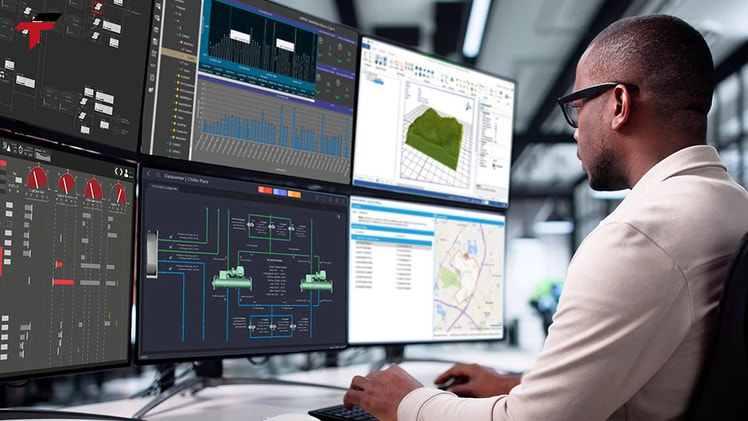
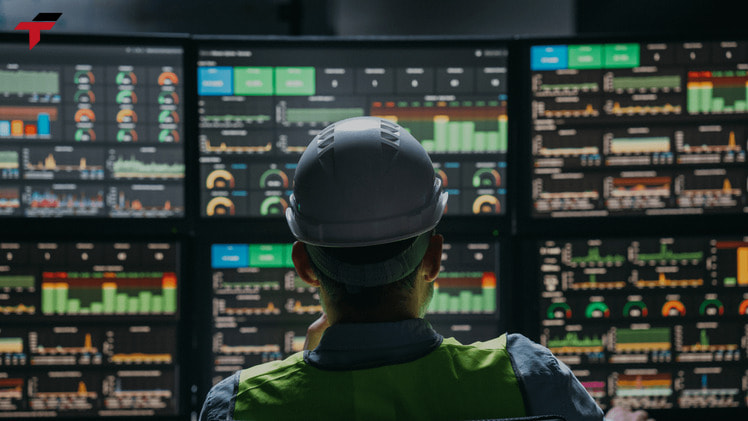
From those servers, operators at a control room workstation see dashboards showing the full operational picture: temperatures, pressures, flow rates, alarm states, and production counts across every connected asset.
SCADA’s defining capability is independence from physical proximity. Operators at a central workstation monitor and adjust equipment at a remote pump station, a satellite production unit, or a facility in a different building – without leaving the control room.
Beyond real-time display, SCADA stores historical data, generates trend reports, and triggers alarms via configurable communication protocols when process variables move outside set parameters.
A Distributed Control System (DCS) performs a similar supervisory function but suits tightly integrated continuous processes – petrochemical plants, utilities – rather than the discrete manufacturing environments common in Malaysian industry.
Where SCADA oversees the whole system, HMI handles the direct machine-level interaction – and that distinction defines how they work together.
HMI System Architecture
At the machine level in industrial environments, HMI – Human Machine Interface – defines the system-level architecture for direct operator interaction with a specific machine or process, delivered via a touchscreen panel or software display mounted near the equipment it controls.
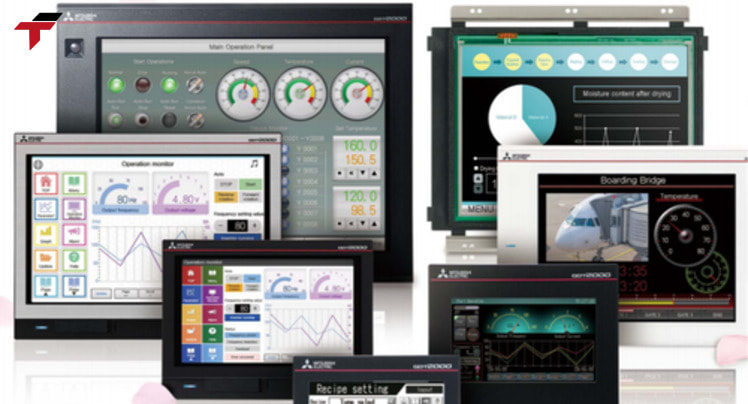
HMIs translate PLC output – raw I/O states, register values, process variables – into readable graphics: gauges, status indicators, trend graphs, and control buttons accessible to floor operators without programming knowledge.
Two distinct HMI forms appear in industrial settings. Hardware HMIs are standalone industrial touchscreen panels – units such as the Delta DOP-100 series or Xinje PLC compatible HMI units – engineered to withstand factory-floor vibration, dust, and temperature variation. Software HMIs run on standard computers or tablets and appear commonly within SCADA platforms, where the SCADA system’s own visualisation layer acts as a high-level HMI at the control room level.
HMI panels in industrial settings share four operational characteristics that distinguish them from SCADA systems.
- Focused on a single machine or localised process group
- Connected directly to a compatible PLC via RS-485, Ethernet, or proprietary fieldbus
- Display real-time data without independent logging to a central database
- Operated by personnel on-site, within visual range of the equipment
Understanding each system individually makes the differences sharper – the next section maps them side-by-side across eight operational dimensions.
SCADA vs HMI: Key Differences
For industrial control system specification, SCADA and HMI differ across eight operational dimensions – and each dimension determines which system matches a given application.
SCADA and HMI both display real-time process data and accept operator input. Beyond that shared function, their operational scope diverges at every level.
| Dimension | SCADA | HMI |
| **Scale** | Multiple machines, lines, or sites | Single machine or small process group |
| **Physical location** | Central workstation or control room | On-site, mounted near the machine |
| **Data handling** | Large-scale acquisition, historical logging, trend reporting | Real-time display; no independent historical logging |
| **System integration** | Connects to PLCs, RTUs, DCS, MES, ERP systems | Connects to a single PLC or compatible controller |
| **Control capability** | Advanced logic strategies, alarm routing, batch/recipe management | Direct operator input – setpoints, start/stop, parameter adjustment |
| **Hardware form** | PC, industrial workstation, or server | Industrial touchscreen panel or compact hardware unit |
| **Alarm management** | Multi-protocol notifications, escalation logic, event logging | Basic on-screen alerts; limited remote notification |
| **Deployment complexity** | Higher – server infrastructure, network setup, software licensing | Lower – configure panel, connect to PLC, deploy |
HMI operates on the micro level – one machine. SCADA operates on the macro level – the entire plant or network of facilities.
These differences don’t mean the two systems compete. In most industrial plants, SCADA and HMI operate as a connected pair.
SCADA vs HMI: Key Differences
Summary: SCADA vs HMI at a Glance
SCADA is a plant-wide supervisory system that collects data from PLCs, RTUs, and sensors distributed across multiple machines or sites, delivering that data to a central control room workstation with historical logging, alarm management, and remote control capability.
HMI is the local operator interface – a touchscreen panel or software display mounted at or near a specific machine, connected to a single PLC, providing real-time visualisation and direct parameter control for that machine only.
The two systems serve different layers of the same control architecture. HMI addresses the machine-level interaction requirement; SCADA addresses the facility-level monitoring requirement. Most industrial operations above a single-machine scale deploy both, with HMI panels feeding data upward into the SCADA network.
The critical specification question is not which system to choose – it is which scale of operation each system addresses.
SCADA and HMI Integration in Plant Architecture
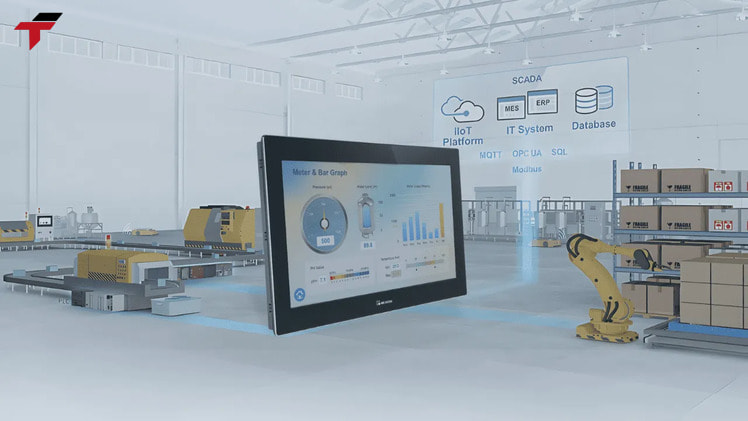
In plant-floor automation architecture, SCADA and HMI integration operates across two distinct layers – HMI handles direct machine interaction while SCADA aggregates data from multiple HMIs and field devices into a centralised monitoring system.
Data flows upward through the architecture. Sensors and actuators report states to PLCs. PLCs communicate with local HMI panels for operator interaction, and those same PLCs transmit process data to the SCADA system at the control room level.
A palm oil processing mill illustrates this architecture in practice. Each pressing machine has an HMI panel where the floor operator monitors pressing temperature and adjusts hydraulic pressure directly. The steriliser station has its own HMI for steam cycle management.
At the control room, the SCADA workstation receives data from all eight pressing stations, the steriliser, and the clarification unit simultaneously – giving the shift supervisor a complete production view without walking the floor.
HMIs handle the moment-to-moment machine interaction; SCADA connects those interactions into a plant-wide picture with historical records that operators and engineers use for performance analysis and fault investigation.
Understanding this architecture means understanding where PLCs fit – because both HMI and SCADA rely on PLCs as the control execution layer beneath them.
SCADA and HMI Integration in Plant Architecture
PLC, HMI, and SCADA: How the Three Fit Together
In industrial automation system design, a PLC – Programmable Logic Controller – executes the control logic that drives machines; HMI displays that logic and lets operators adjust it; SCADA collects data from many PLCs and provides plant-wide visibility.
The three systems form a hierarchy, with PLC Malaysia units at the base, executing deterministic control logic in milliseconds and reading I/O signals from sensors, switches, and actuators. HMIs connect above the PLC layer, translating register values into operator-readable displays. SCADA sits at the top, connecting to multiple PLCs across a factory Ethernet or industrial network.
A configuration common in Malaysian discrete manufacturing: a Mitsubishi PLC – such as the FX5U series – handles machine control logic. A Delta DOP-100 HMI panel provides the operator interface at the machine. A SCADA workstation at the production office monitors all PLCs on the factory network, logging production data and generating shift reports.
For compact standalone applications – a single injection moulding machine or a packaging unit – a compatible HMI paired with the machine PLC handles the complete operator interaction without SCADA involvement.
A PLC runs its programmed logic independently of HMI or SCADA. Without HMI or SCADA, operators have no visual interface and no centralised monitoring – acceptable for fully automated simple machines, insufficient for operations requiring regular parameter adjustment or any remote visibility.
Knowing how all three connect sets the foundation for the practical question: which combination does a specific Malaysian operation actually need?
HMI vs SCADA: Selection Guide for Malaysian Operations
For Malaysian manufacturing operations, the decision between HMI, SCADA, or both depends on four criteria: the number of machines to monitor, whether remote access is required, the volume of data requiring historical analysis, and whether the facility spans multiple locations.
Four criteria determine whether HMI, SCADA, or both suit the operation.
- Machine count: A single machine or small process group – HMI is sufficient. Three or more machines requiring coordinated monitoring – SCADA becomes cost-effective relative to the visibility gap it closes.
- Remote access: Engineers and operators who need to monitor or adjust equipment from outside the immediate production floor require SCADA. HMI panels are local-only by design.
- Data and reporting: Operations requiring shift reports, trend analysis, OEE tracking, or regulatory data logs need SCADA’s historian function. HMI provides current-state display only.
- Multi-site: Any facility with equipment across two or more physical locations – separate buildings, remote pump stations, satellite production sites – requires SCADA to consolidate visibility.
Three scenarios illustrate these criteria across Malaysian manufacturing contexts.
Scenario 1 – Single SME production line, Shah Alam: One injection moulding machine, one floor operator on-site. An HMI panel connected to the machine PLC handles all operator interaction. SCADA is unnecessary and over-specified for this configuration.
Scenario 2 – Palm oil mill, Sabah: Eight pressing stations, a steriliser, and a satellite loading station 3km from the main mill. HMI panels at each machine give floor operators local control. A SCADA system at the mill control room monitors all stations plus the remote loading point – the multi-site requirement makes SCADA essential.
Scenario 3 – Semiconductor facility, Penang: Twenty-plus process machines requiring real-time production data, alarm logging, process traceability, and shift reporting. SCADA is mandatory; HMIs at individual machines feed into the plant-wide SCADA network.
Local stock availability and local warranty coverage factor into the procurement decision – equipment with Malaysian support reduces downtime risk when components require replacement or reconfiguration.
Beyond the classic distinction, both HMI and SCADA have evolved – and what counts as “local” or “remote” control has changed significantly.
HMI vs SCADA: Selection Guide for Malaysian Operations
Modern HMI and SCADA Capabilities
In Industry 4.0 industrial environments, modern HMI and SCADA capabilities extend beyond their original hardware and network boundaries – mobile access, edge processing, and cloud integration now reshape what both systems deliver.
HMI panels now support mobile access, letting operators monitor and adjust machine parameters from a tablet anywhere in the plant. Edge HMIs process data locally at the machine, reducing communication latency and maintaining function during network interruptions. Browser-based HMI interfaces delivered via HTML5 remove the dependency on a dedicated hardware panel at specific machine installations.
On the SCADA side, cloud-hosted platforms store historian data off-premise and allow remote access without dedicated VPN infrastructure. AI-assisted alarming analyses alarm patterns to reduce alarm floods and surface actionable events. OPC-UA – OPC Unified Architecture – has emerged as the unifying communication standard connecting modern PLCs, HMIs, and SCADA platforms from different vendors, replacing proprietary protocols that historically locked control architectures into single-brand ecosystems.
Modern HMI and SCADA Capabilities
Frequently Asked Questions
Is HMI a part of SCADA?
Yes – HMI is a component or subset of a SCADA system. SCADA contains its own HMI at the supervisory level, providing the operator interface at the control room workstation. Individual machines connected to the SCADA network also carry standalone HMI panels, which feed data upward to the SCADA system while providing local operator access at the machine.
Can a PLC operate without HMI or SCADA?
Yes. A PLC executes control logic independently of HMI or SCADA. Without either, operators have no visual interface and no centralised monitoring. This is acceptable for fully automated simple machines with no regular operator adjustment requirement. It is insufficient for any operation needing parameter changes, remote visibility, or production data records.
Is SCADA outdated?
No. SCADA has modernised with cloud integration, OPC-UA connectivity, AI-assisted alarming, and historian database improvements. The real operational risk is legacy SCADA software running on end-of-life hardware and unsupported operating systems – not the SCADA concept, which remains the standard architecture for plant-wide industrial monitoring.
What is the difference between SCADA and DCS?
SCADA manages geographically distributed systems; DCS manages tightly integrated continuous processes from a single facility. SCADA suits discrete manufacturing, water and wastewater, and multi-site industrial operations. DCS suits petrochemical plants, utilities, and continuous batch processing. For Malaysian discrete manufacturing – food and beverage, packaging, rubber and glove production – PLCs with SCADA is the more common and cost-appropriate architecture.
Which costs more – HMI or SCADA?
HMI hardware panels carry a lower initial capital cost than a full SCADA platform deployment. A standalone industrial HMI panel represents a smaller investment than SCADA software licensing, server infrastructure, and network setup combined. Total cost depends on machine count, integration complexity, and the SCADA platform selected. For operations with three or more machines, the operational visibility SCADA provides typically justifies the higher deployment cost relative to the alternative of managing each machine in isolation.