
VFD Control Modes Explained: V/Hz, Sensorless Vector, and DTC

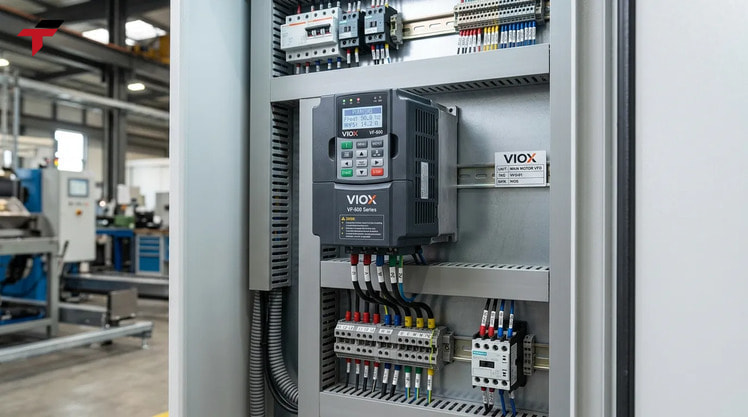
VFD control modes determine how a variable frequency drive regulates motor speed and torque – and selecting the wrong mode costs more than just efficiency. A V/Hz drive running a loaded conveyor slips under load; a closed-loop vector drive wired to five pump motors fails to control any of them. Four distinct control modes exist – volts-per-hertz, sensorless vector, field-oriented control, and direct torque control – each built for a different class of induction motor application.
This article maps each VFD control mode to its operating mechanism, speed accuracy range, torque capability, and practical load type. It also covers how Mitsubishi FR series, Siemens SINAMICS, and Panasonic inverters implement these modes – relevant context for system integrators and maintenance engineers specifying drives for Malaysian manufacturing facilities.
————————————————————
VFD Operation and the Role of Control Modes
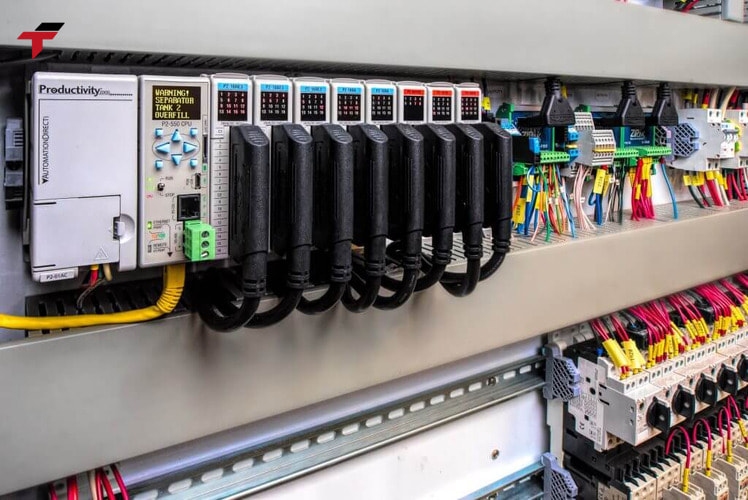
In industrial motor control, a variable frequency drive converts fixed-frequency AC supply into variable-frequency, variable-voltage output. The conversion happens in three stages: a rectifier converts AC mains to a DC bus, a capacitor bank smooths the DC voltage, and an inverter stage generates the variable AC output using pulse-width modulation (PWM).
The control mode governs what the inverter stage does with that DC bus energy. It determines whether the drive blindly follows a voltage-frequency ratio, estimates motor state from current feedback, or reads a physical encoder to close the loop entirely. The same 15 kW induction motor behaves differently – in speed accuracy, starting torque, and load-disturbance rejection – depending on which mode is active. Choosing the control mode is therefore a more critical specification decision than choosing the brand.
VFD Operation and the Role of Control Modes
V/Hz (Volts-per-Hertz) Control – The Open-Loop Standard
V/Hz control is the foundational operating mode of every variable frequency drive. The drive outputs voltage and frequency in a fixed linear ratio – as frequency drops, voltage drops proportionally – without monitoring what the motor actually does in response.
How the Voltage-Frequency Ratio Works
In V/Hz mode, the drive maintains a constant V/Hz ratio across three distinct speed zones. From zero to the drive’s minimum starting frequency, voltage compensation is applied: the V/Hz ratio is non-linear because starting voltage must be high enough to generate sufficient flux in the motor stator at low frequency. From the starting frequency up to rated frequency (typically 50 Hz or 60 Hz), the ratio is linear – halving the frequency halves the voltage, producing approximately half the motor speed. Above rated frequency, voltage is clamped at the rated maximum to protect winding insulation; torque decreases as frequency continues to rise.
A 480 V / 60 Hz motor running at 240 V / 30 Hz operates at approximately 50% speed. The drive produces that output regardless of whether the motor is turning, stalled, or driving a load.
Slip Compensation: Fixing V/Hz at Low Loads
Induction motors have an inherent slip factor – the rotor always turns slightly slower than the synchronous speed of the stator field. Under no load, slip is negligible. Under load, slip becomes significant: a motor commanded to run at 1,450 RPM may deliver 1,380 RPM when driving a heavy conveyor.
V/Hz drives address this through slip compensation: the drive monitors output current, estimates load torque from current magnitude, and adds a small frequency offset to compensate for predicted slip. Slip compensation improves steady-state speed accuracy but does not eliminate load-dependent speed variation – the compensation is estimated, not measured.
Best Applications for V/Hz Control
V/Hz is the correct mode for variable-torque, centrifugal loads where precise speed holding is unnecessary:
- Centrifugal pumps – torque demand proportional to speed squared; slip at full load is acceptable
- Fans and blowers – HVAC, cooling towers, exhaust systems; energy savings dominate the specification
- Material conveyors – where speed variation of ±2–3% does not affect process quality
- Multi-motor configurations – one VFD driving two or more motors simultaneously; only V/Hz supports this
V/Hz is not appropriate for loads requiring accurate speed holding under variable load, high starting torque, or low-speed operation below 10% of rated speed.
Sensorless Vector Control (SVC) – Closed-Loop Without an Encoder
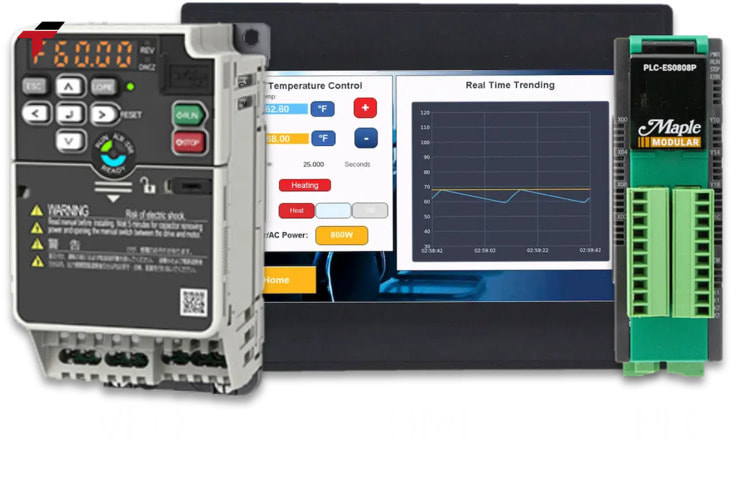
Sensorless vector control, also called open-loop vector control (SLVC), is not truly sensorless – it continuously monitors motor voltage and current to mathematically determine rotor speed. The drive uses an internal speed observer algorithm to simulate what an encoder would measure, creating a virtual closed-loop without a physical feedback device.
How SVC Calculates Motor Speed Mathematically
The drive’s speed observer uses a motor model loaded during auto-tuning. It compares the commanded voltage and frequency against the actual current draw, calculates the estimated rotor flux position, and derives a speed estimate accurate enough for real-time torque correction. The drive then adjusts voltage and frequency output to match the commanded speed – a virtual closed-loop operating entirely from current and voltage signals.
Auto-tuning is required before SVC operates correctly: the drive sends test signals to the motor at standstill or low speed to identify stator resistance, leakage inductance, and rotor time constant. These parameters populate the motor model. An incorrect motor nameplate entry produces an inaccurate model and degraded SVC performance.
Starting Torque and Low-Speed Operation
SVC delivers up to 200% of rated motor torque for brief periods during starting – sufficient for loaded conveyors and inclined lifts that V/Hz cannot start reliably. Speed accuracy in SVC mode falls within a 1–3% range of the setpoint, maintained down to approximately 1% of rated speed. This low-speed capability makes SVC practical for applications requiring slow, controlled starts without a separate braking resistor.
SVC outperforms V/Hz on torque delivery under load disturbances. When a heavy product hits a conveyor, the speed observer detects the current spike, recalculates the speed error, and corrects output within the drive’s control cycle – typically milliseconds.
When to Choose SVC Over V/Hz
Sensorless vector control suits applications where one or more of the following conditions are present:
- Accurate speed holding under variable load (packaging lines, winding, printing)
- High starting torque on single-motor circuits (loaded conveyors, agitators)
- Low-speed operation below 10% rated speed
- Encoder installation is impractical (wet environments, existing motor with no encoder mount)
Do not use SVC when multiple motors share one drive. The speed observer model is specific to one motor’s impedance characteristics – driving a second motor invalidates the model and produces incorrect torque control.
Sensorless Vector Control (SVC) – Closed-Loop Without an Encoder
Closed-Loop Vector Control – Field-Oriented Control with Encoder Feedback
Closed-loop vector control, also called field-oriented control (FOC), adds a physical encoder to the motor shaft. The encoder provides actual rotor position at every control cycle, eliminating the estimation uncertainty inherent in SVC. The drive uses this position data to decompose motor current into two independent components: the d-axis (flux-producing) and q-axis (torque-producing).
How Encoder Feedback Separates Flux from Torque
In field-oriented control, the drive independently controls the d-axis current to maintain the rated flux level and the q-axis current to deliver the commanded torque. This decoupling allows the drive to hold motor speed within a fraction of 1% of setpoint – even as load changes continuously – because torque correction does not disturb the flux level, and vice versa.
The encoder signal also allows the drive to adjust carrier frequency and PWM timing in real time based on actual rotor position. The result is smooth torque delivery at very low speeds, including at or near zero RPM – a capability SVC cannot reliably achieve because the speed observer loses accuracy below the minimum frequency the motor model can distinguish.
Precision Applications – Printing, Textile, CNC
Closed-loop vector is the correct mode for applications requiring sub-1% speed accuracy through continuous load variation:
- Printing lines – web tension changes as roll diameter decreases; speed must hold within a fraction of 1% to maintain print registration
- Textile winding machines – yarn tension directly tied to spindle speed accuracy; closed-loop vector prevents yarn breakage at high winding speeds
- CNC feed axes – servo-like performance from an induction motor drive; position accuracy depends on consistent speed response
The encoder adds cost and installation complexity – conduit routing, cable shielding, and encoder mounting alignment. For applications where SVC speed accuracy is sufficient, closed-loop vector adds cost without performance gain.
Direct Torque Control (DTC) – Fast Torque Response Without Field Orientation
Direct torque control is a fundamentally different architecture from field-oriented control. Where FOC uses mathematical coordinate transformation to separate flux and torque, DTC bypasses transformation entirely. The drive estimates stator flux magnitude and motor torque from voltage and current measurements, compares both against reference values, and selects the optimal inverter switching state from a pre-computed lookup table – all within a single control cycle.
DTC vs Field-Oriented Control: Key Differences
The lookup table approach eliminates the modulator stage required by FOC. FOC generates a sinusoidal reference, feeds it through a pulse-width modulator, and then applies the resulting switching pattern to the inverter. DTC selects directly from a finite set of inverter states – the one that simultaneously reduces flux error and torque error in the shortest time.
| V/Hz | Sensorless Vector | Closed-Loop FOC | DTC | |
| Torque response | Slow (seconds) | Moderate (tens of ms) | Fast (5–10 ms) | Fastest (<2 ms typical) |
| Speed accuracy | ±2–3% | 1–3% of setpoint | Sub-1% | Sub-1% |
| Encoder required | No | No | Yes | No |
| Motors per drive | Multiple | One | One | One |
| Setup complexity | Simple | Moderate (auto-tune) | Complex (encoder + tuning) | Moderate–complex |
DTC achieves torque response typically below 2 ms – significantly faster than FOC’s 5–10 ms – without requiring an encoder. ABB pioneered DTC in their ACS series drives, where the control algorithm runs at 40 kHz sample rate to resolve switching state selection fast enough to minimise torque ripple.
DTC in High-Dynamic Industrial Applications
DTC handles loads where torque response in under 2 ms prevents mechanical damage or safety incidents. Applications include:
- Hoists and cranes – load must be caught instantly when the brake releases; slow torque response causes load drop
- Paper mills and metal rolling – tension control on continuous web processes; torque disturbances propagate as defects
- High-speed winding – where SVC torque response is too slow to prevent yarn or wire breakage during load transients
DTC requires an accurate motor model – typically loaded via a motor identification run – but does not require encoder installation. For applications needing DTC-class torque response with position feedback, some drives combine DTC with an optional encoder for additional speed accuracy.
Direct Torque Control (DTC) – Fast Torque Response Without Field Orientation
V/Hz vs Sensorless Vector vs Closed-Loop Vector vs DTC: Side-by-Side Comparison
Four VFD control modes serve distinct application requirements. The table below compares them across the parameters that determine mode selection in practice.
| Control Mode | Speed Accuracy | Starting Torque | Encoder | Motors per Drive | Setup | Best For |
| **V/Hz** | ±2–3% | Low–medium | No | Multiple | Simple | Fans, pumps, HVAC, multi-motor |
| **Sensorless Vector** | 1–3% of setpoint | Up to 200% rated | No | One | Moderate (auto-tune) | Packaging, winding, conveyors |
| **Closed-Loop Vector** | Sub-1% | Full rated at 0 RPM | Yes | One | Complex | CNC, printing, precision textile |
| **DTC** | Sub-1% | Excellent + fastest | No | One | Moderate–complex | Hoists, cranes, paper mill |
Speed accuracy values are stable ranges from competitor consensus (AutomationDirect, dattech) and physics. Cite as ranges – not point estimates – when specifying to procurement.
Choosing the Right VFD Control Mode for Your Load
Control mode selection follows load type, not budget. Specifying a higher-complexity mode for a simple fan adds cost and configuration time without performance gain. Specifying V/Hz for a precision winding machine produces unacceptable quality variation.
Centrifugal Pumps and Fans → V/Hz
Centrifugal loads – pumps, fans, blowers, cooling towers – follow the affine law: torque is proportional to speed squared, and power is proportional to speed cubed. Running a fan at 70% speed reduces power consumption to approximately one-third of full-speed draw. At 50% speed, power drops to approximately one-eighth. These savings are available regardless of control mode – but V/Hz is the correct choice because speed accuracy beyond ±3% has no process consequence for these loads.
V/Hz additionally supports multiple motors on one drive – relevant for palm oil plants, water treatment facilities, and HVAC systems where zone pumps or cooling tower fans run from a single variable-speed drive.
Conveyors and Material Handling → Sensorless Vector
Conveyor loads are not centrifugal – torque demand changes as product weight varies. A glove conveyor running empty at 1,450 RPM must hold 1,445 RPM when a loaded tray reaches the belt. V/Hz slip under this load change is 50–100 RPM – visible as product jam at transfer points. SVC speed observer corrects this within milliseconds.
In Malaysian semiconductor and F&B manufacturing, SVC is the minimum specification for indexed conveyors, transfer systems, and belt feeders. High starting torque (up to 200% rated) allows SVC to start loaded conveyors without a braking resistor or reduced-voltage starting sequence.
Precision Drives – Textile, Printing, Winding → Closed-Loop Vector
Precision drives require sub-1% speed accuracy through continuous load variation. Encoder feedback is the only method that delivers this reliably – SVC estimated speed drifts as motor temperature changes, affecting the motor model accuracy. Closed-loop vector compensates because it reads actual rotor position, not an estimate.
Specify closed-loop vector for: textile spindles, printing press feed drives, wire and cable winding machines, and CNC feed axes driven by induction motors. Budget for encoder installation – cable routing through conduit, shielded cable, and encoder mount alignment – as part of the commissioning scope.
High-Dynamic or Safety-Critical Loads → DTC
Hoists, cranes, and paper mill winders require torque available in under 2 ms. Safety regulations for overhead lifting typically require that rated torque be available before the brake releases – a requirement SVC and closed-loop FOC may not meet at brake-release speed. DTC meets this requirement without encoder installation, which matters on legacy hoist equipment where encoder retrofitting is impractical.
For applications where DTC is unavailable in the selected drive brand, closed-loop vector with the fastest available control cycle setting is the next best option.
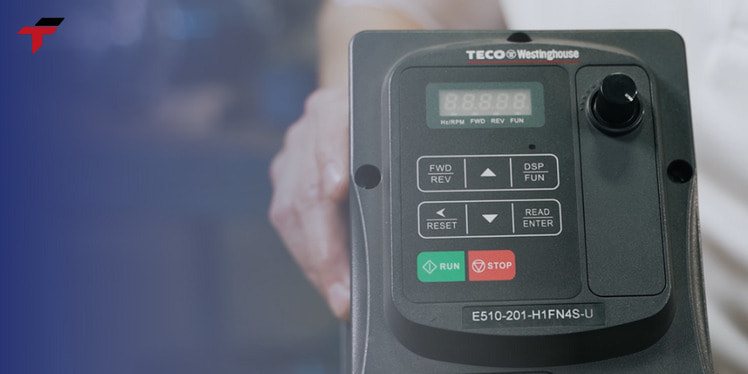
Choosing the Right VFD Control Mode for Your Load
VFD Control Modes in Mitsubishi, Panasonic, and Siemens Drives
Control mode availability varies by drive series within each brand. Selecting a drive without confirming which modes the series supports is a common specification error – particularly when upgrading from V/Hz to vector control mid-project.
Mitsubishi FR Series implements control modes across its series tiers. Entry-level FR-D700 series supports V/Hz and sensorless vector (SVC) as standard – adequate for pump, fan, and general conveyor applications. The mid-range FR-E800 and advanced FR-A800 series add closed-loop vector via optional encoder feedback and extend to PM motor control, relevant when specifying permanent magnet synchronous motors alongside standard induction motors. Mitsubishi FR drives dominate F&B, packaging, and palm oil processing applications in Malaysia due to local support depth and established service infrastructure.
Siemens SINAMICS G120 supports V/Hz, sensorless vector (called “Vector control without encoder” in Siemens documentation), and closed-loop field-oriented control with encoder – covering the full mode range below DTC. The higher-tier SINAMICS S120 series adds DTC-class torque response for crane and hoist applications. SINAMICS G120 is the common choice in automotive assembly and heavy manufacturing where PROFINET integration and Siemens PLC compatibility are design requirements.
Panasonic VF Series inverters support V/Hz and sensorless vector as standard. Panasonic’s MINAS servo drive series operates in closed-loop vector as a native mode – relevant when specifying servo-class performance from a Panasonic ecosystem. Panasonic inverters see wide use in semiconductor equipment and SME automation where compact form factor and Panasonic PLC communication compatibility are factors.
No single brand provides best-in-class performance across every control mode and every application type. Mode availability, communication protocol support, and local service coverage should be confirmed against the specific drive series – not assumed from the brand name alone.
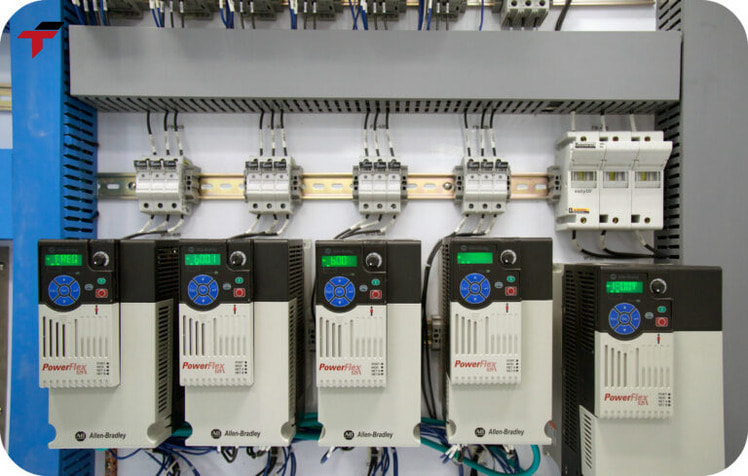
VFD Control Modes in Mitsubishi, Panasonic, and Siemens Drives
Mid-Article Summary
Four control modes cover every standard induction motor application. V/Hz suits multi-motor centrifugal loads. Sensorless vector serves single-motor conveyors and packaging lines where high starting torque matters. Closed-loop vector adds encoder feedback for sub-1% accuracy in precision drives. DTC delivers torque in under 2 ms for hoists and paper mills without an encoder. Mode selection follows load type – not preference or brand.
Frequently Asked Questions
Variable frequency drives present four control modes in their parameter menus. The questions below address the most common selection and specification queries from maintenance engineers and system integrators.
What is DTC mode in a VFD?
Direct torque control (DTC) is a VFD control architecture that selects inverter switching states from a pre-computed lookup table using real-time torque error and stator flux error – without coordinate transformation. Torque response is typically below 2 ms, faster than field-oriented control. DTC requires an accurate motor model loaded via identification run but does not require an encoder. It is specified for hoists, cranes, and paper mill winding applications where slow torque response causes mechanical damage or safety incidents.
What are the main types of VFD control modes?
From simplest to most complex: V/Hz (volts-per-hertz, open-loop), sensorless vector control (virtual closed-loop via current monitoring), closed-loop vector / field-oriented control (encoder-based), and direct torque control (lookup-table torque selection). Each successive mode offers higher speed accuracy and torque response at the cost of greater setup complexity and, in the case of closed-loop vector, encoder hardware.
What is the difference between V/Hz and vector control?
V/Hz outputs a fixed voltage-to-frequency ratio without monitoring actual motor speed – it is open-loop. Vector control (sensorless or closed-loop) monitors or measures motor state to independently control flux and torque. The result: vector modes hold speed more accurately under load (1–3% vs ±2–3% for V/Hz) and deliver significantly higher starting torque. V/Hz allows one drive to run multiple motors simultaneously; vector modes are limited to one motor per drive.
Can one VFD run multiple motors?
V/Hz mode only. One VFD in V/Hz mode can drive multiple motors connected in parallel, provided the combined motor current does not exceed the drive’s rated output current. Sensorless vector, closed-loop vector, and DTC modes each rely on a motor model or encoder calibrated to one specific motor – connecting additional motors invalidates the model and produces incorrect torque control. Multi-motor applications must use V/Hz.