
Omron PLC Series Guide: CP1E, CP2E, CJ2M and NX1P

Omron PLC lineups divide into three generations of hardware: the CP-series compact controllers (CP1E, CP2E, CP1L, CP1H), the CJ-series modular controllers (CJ2M), and the NX-series machine automation controllers (NX1P). Each generation raises the ceiling on I/O count, program memory and network protocols, and each pairs with different programming software, CX-Programmer or Sysmac Studio. Omron PLC families also sit beside two neighbours that are not classic PLCs: the ZEN programmable relay below them and the NX Safety controllers beside them. This guide places every series on that ladder so a maintenance engineer, system integrator or buyer sees which Omron PLC matches a machine before opening a datasheet.
Omron PLC Series at a Glance
An Omron PLC series is a controller family that shares one CPU architecture, one I/O expansion system and one programming environment; the six series below cover micro machines to motion-synchronised lines. Omron’s own PLC overview groups them as compact PLCs offering scalable options, modular controllers for complex high-performance applications, and controllers for synchronised device control, IoT connectivity and advanced motion control.
| Series | Class | I/O | Program memory | Network | Programming software |
| CP1E | Micro (discontinued) | 10 to 60 built-in; 140 max local (NA20) | 2K to 8K steps (listed models) | USB, RS-232C, RS-485; Ethernet via option | CX-Programmer |
| CP2E | Micro | Up to 60 onboard | 4K steps (Essential), 10K steps (Network) | Ethernet TCP/IP on Network type; up to 3 serial ports | CX-Programmer |
| CP1L | Compact | 40 built-in on the EM40 model | 10K steps on CP1L-EM40DT-D | Ethernet TCP/IP; serial option boards | CX-Programmer |
| CP1H | Compact | 40 built-in | 20K steps | Fieldbus via CJ1 special I/O units | CX-Programmer |
| CJ2M | Modular | 2,560 max | 5K to 60K steps | EtherNet/IP built in on CPU3x models | CX-Programmer |
| NX1P | Machine controller | 24 or 40 built-in | 1 MB or 1.5 MB | EtherCAT and EtherNet/IP built in | Sysmac Studio |
The rest of this guide reads down that table, from the smallest controller to the largest.
Omron PLC History: From Timer Switches to Machine Automation Controllers
Omron’s PLC history begins with a timer-switch maker: Kazuma Tateishi founded the company in 1933 in Osaka as Tateishi Electric Manufacturing Co., and it traded as Omron Tateisi Electronics until 1990. The name “Omron” comes from Omuro, the Kyoto district where the company originated. Mizen Automation’s company history describes the first products as timer switches, and Wikipedia’s Omron entry lists programmable logic controllers among the industrial automation products Omron sells today, alongside sensors, safety components, relays and robots.
The controller line itself moved through three visible steps. Mizen Automation credits the CJ and CS series as popular mid-range PLCs that added integrated safety-rated controls and advanced motion control. Omron’s PLC page describes the next step directly: PLCs “have evolved over time into more advanced systems known as Machine Automation Controllers.” The NX and NJ families are that step, and RealPars describes them as a single hybrid device that combines PLC logic with motion control.
That history explains the layout of the current range, and the sections that follow read it from the smallest CP-series controller upward, starting with the CP1E.
Omron PLC History: From Timer Switches to Machine Automation Controllers
Omron CP1E: The Entry-Level Series and Its Discontinuation
The Omron PLC CP1E is a micro PLC that Omron markets as “the economic machine controller,” aimed at relatively simple applications with outstanding positioning capability. Omron Europe’s product page lists 10-point models (CP1E-E10DR, E10DT and E10DT1 variants) with 2K steps of program memory and 2K words of data memory, and a 20-point analog model (CP1E-NA20DT) with two analog inputs, one analog output and 8K steps of program memory.
The CP1E is applied according to three specification points:
- The E30/40/60, N30/40/60 and NA20 CPU units accept added I/O, analog I/O or temperature inputs, and Omron lists up to 140 local I/O points and three expansion units for the NA20.
- CPU units come with USB and RS-232C, and RS-485 and Ethernet arrive through option boards.
- Two point-to-point axes are available on the analog NA20 models.
The CP1E is a discontinued product: Omron Europe’s page states a discontinuation date of 31 March 2022 and points users to a replacement guide for choosing a CP2E CPU. For a plant running CP1E controllers, this shifts the practical question from “which CP1E to buy” to “which CP2E replaces it.” Flextech’s Omron PLC range lists CP1E among carried models; availability varies by part number, so confirm a specific model before planning a repair or spare-parts purchase.
The discontinuation of the CP1E moves attention to its successor, which keeps the same micro PLC role but adds Ethernet, more serial ports and a larger program memory on the Network type.
Omron CP2E: The CP1E Successor
The Omron CP2E is the CP2 Series compact controller, a micro PLC designed for compact equipment that supports data collection and machine-to-machine communication. Omron splits it into two types by suffix. The Essential type (CP2E-E) offers 4K steps of program memory, 14 to 60 integrated I/O points and serial RS-232C plus USB ports. The Network type (CP2E-N) offers 10K steps, the same I/O sizes and Ethernet TCP/IP plus RS-232C, RS-422 and RS-485.
The four features Omron’s product page lists as separating the CP2E from its predecessor are:
- Built-in two-port Ethernet switch.Ethernet devices daisy-chain through the controller, which reduces wiring cost between machines.
- Up to three serial ports.Serial devices connect for data collection, control and monitoring.
- 4-axis positioning with linear interpolation.Omron libraries for positioning, machine-to-machine communication and predictive maintenance come with it.
- Battery-free operation.LED indicators on the I/O terminals assist troubleshooting, and the operating temperature range is extended.
Sizes run from 14 to 60 I/O points, so a like-for-like replacement is a lookup by I/O count and supply voltage (100-240 VAC or 24 VDC), followed by a check that the output type matches: relay, NPN or PNP. Omron’s replacement guide is the authoritative mapping.
Where the CP1E and CP2E serve single machines, the CP1L and CP1H raise the ceiling on execution speed and pulse output, which is the attribute that decides positioning work on compact machines.
Omron CP1L and CP1H: Compact Machine Controllers
The Omron PLC CP1L and CP1H are compact PLCs for machines such as case-packers and stretch-wrappers, where high-speed counters and pulse outputs drive multi-axis positioning. Omron labels the CP1L “best in class compact machine controller” and the CP1H “fastest compact machine controller.”
CP1L. The CP1L-EM40DT-D listing shows 40 integrated I/O (16 NPN outputs), a built-in Ethernet port and 10K steps of program capacity. Its logic execution time is 0.55 µs, encoder input and pulse output each reach 100 kHz, and the operating range is 0 to 55 °C. Memory backup is battery-free. Analog input and output boards, serial option boards (RS-232C, RS-422/485), EtherNet/IP and Modbus TCP option boards, and an LCD board all attach through CP1W accessories.
CP1H. Omron describes the CP1H as combining the size of a micro PLC with the power of a modular PLC. It carries four built-in high-speed counters and four pulse outputs, with inputs and outputs up to 1 MHz. The instruction set and execution speed are compatible with the CJ1M. The CP1H-XA adds four analog inputs and two analog outputs with PID control and auto-tuning. Up to two CJ1 special I/O units attach, which opens PROFIBUS, DeviceNet, CAN and EtherNet/IP and supports all communication units of the CJ1 series.
Once a machine outgrows the fixed I/O and memory of a compact PLC, the next attribute to change is expandability, and that is where the rack-based CJ2M takes over.

Omron CP1L and CP1H: Compact Machine Controllers
Omron CJ2M: Modular Control for Larger Machines
The Omron CJ2M is a modular PLC in the CJ2 family, built from a CPU unit plus separate power, I/O and communication units on a rack. RealPars puts the CJ2M at more than 2,500 digital and pulse I/O points across local and remote racks, and Omron Europe lists 2,560 I/O maximum with three expansion racks.
The CJ2M range has ten CPU models in two groups:
| CPU group | Models | Program memory | Built-in communication |
| CPU1x | CJ2M-CPU11 to CPU15 | 5K to 60K steps | RS-232C serial and USB |
| CPU3x | CJ2M-CPU31 to CPU35 | 5K to 60K steps | EtherNet/IP and USB, with an option port for RS-232C/RS-485 |
Omron describes the CJ2 platform as scalable between CJ2M and the larger CJ2H CPUs, so program capacity spans 5K steps up to 400K steps and data memory reaches 832K words across the family. The CJ2 supports connectivity to most industrial communication networks, which suits plants that exchange data between machines. The guide to PLC and SCADA systems covers how that machine data reaches supervisory layers, and what is Modbus covers the serial protocol that CJ2M option ports and CP-series boards support.
The CJ2M covers rack-based scaling, and the NX1P takes the same machine-control role further by adding built-in motion and EtherCAT to one compact controller.
Omron NX1P: The Machine Automation Controller
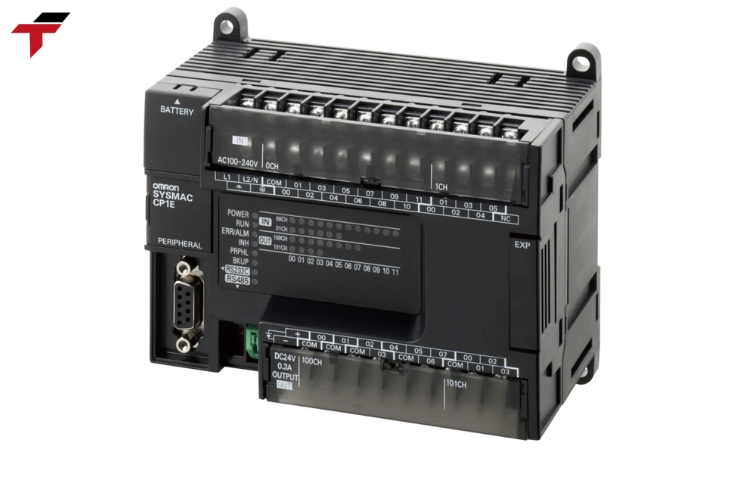
The Omron NX1P, part of the Omron PLC NX-series, is a compact machine automation controller that runs logic sequence and motion control in one CPU, with EtherCAT and EtherNet/IP ports built in. Omron Europe describes it as completing the NX/NJ family in a compact design and synchronising motion, I/O, safety and vision under one integrated development environment.
The NX1P specification includes these points, as listed by Omron:
- Cycle time:fastest primary task cycle of 2 ms (4 ms on the lower-memory NX1P2-9B models).
- Axes:up to 8 axes, of which up to 4 are synchronised.
- Built-in I/O:24 or 40 points, plus up to 8 local NX I/O units.
- EtherCAT:up to 16 slaves, with ring topology supported to keep communications running after a cable break.
- Memory:1 MB or 1.5 MB of program memory depending on model.
- Options:up to 2 option boards add serial communication or analog I/O.
Two tiers sit above it. RealPars describes the NX102 as a mid-range controller for up to 1,000 I/O and up to 12 motion axes with OPC UA, and the NX701 as the flagship, synchronising up to 256 axes with a 125 µs fastest cycle. RealPars also notes that NJ controllers accept legacy CJ-series I/O modules, although some CJ units cannot be used with an NJ CPU, which reduces the cost of upgrading an older CJ system.
Taken together, the CP, CJ and NX1P controllers form a ladder of I/O, memory and network capability, which the summary below condenses before the modules, safety range and software are covered.
Omron NX1P: The Machine Automation Controller
Summary: Where the Omron PLC Series Stand So Far
The Omron PLC series read as a ladder from single-machine control to synchronised motion. CP1E and CP2E cover single machines with modest I/O, and CP2E replaces the discontinued CP1E. CP1L and CP1H add speed and pulse outputs for positioning. CJ2M scales I/O and program memory on a rack, up to 2,560 I/O points. NX1P moves motion, EtherCAT and safety into one controller with 2 ms cycles. The next sections cover the modules that plug into those CPUs, the safety controllers that protect operators, the ZEN relay below the PLC range, and the software that programs each series.
Omron PLC Modules: Expansion, Communication and I/O Units
An Omron PLC module is any unit that attaches to the CPU to extend I/O, add a communication port or add a specialised function; each series uses its own module family. The families do not interchange across series.
| Series | Module family | Examples from Omron’s listings |
| CP1E, CP2E | Expansion I/O units | Added I/O, analog I/O and temperature inputs |
| CP1L, CP1H | CP1W option boards and expansion | CP1W-ADB21 (2 analog inputs), CP1W-DAB21V (2 analog outputs), CP1W-CIF01/CIF11 (serial), CP1W-EIP61 (EtherNet/IP), CP1W-MODTCP61 (Modbus TCP), CP1W-ME05M (memory cassette), CP1W-CN811 (expansion cable) |
| CJ2M | CJ-series units | Basic I/O units, special I/O units and CPU bus units on the main rack, expansion rack via I/O control and interface units |
| NX1P | NX I/O | Modular IP20 units, more than 100 models, 12 mm wide with push-in connectors |
NX I/O illustrates how module data reads. Omron’s analog input listings show 13-bit resolution (1:8000) for free-running units and 15-bit resolution (1:30000) for synchronous units, with conversion time listed per unit. Choosing a module therefore means matching three properties: signal type (4-20 mA or ±10 V), resolution and conversion time, and channel count per unit.
Modules extend what a CPU does, while safety controllers add a separate layer of certified protection, so the next section moves from I/O expansion to machine safety.
Omron Safety PLC: NX Safety and G9SP Controllers
An Omron safety PLC is a safety controller certified to functional-safety standards that monitors emergency stops, light curtains and door switches and drives the machine to a safe state. Omron’s programmable safety system range separates into NX Safety Hybrid, CIP Safety, NX Safety distributed, NX Safety stand-alone and the G9SP series.
| Family | Omron’s positioning |
| NX Safety Hybrid | From single machine to production line, safety interconnect |
| CIP Safety | From a production line to a single machine safety solution |
| NX Safety distributed | Integrated safety into machine automation |
| NX Safety stand-alone | Stand-alone safety controller on the NX platform |
| G9SP | The standalone safety controller |
Across that range, Omron lists safety I/O from 10 or 20 points up to 2,032, centralised and distributed architectures, CIP Safety and Safety over EtherCAT as safety protocols, and maximum safety levels of PLe (EN ISO 13849-1) and SIL3 (IEC 61508).
PLe is Performance Level e and SIL3 is Safety Integrity Level 3. Rabwell PLC’s comparison lists the NX-SL and G9SP as Omron’s safety controllers and notes that they operate alongside standard Omron PLCs or third-party controllers.
Safety controllers sit above the standard PLC range, and at the opposite end sits the ZEN, which covers tasks too small for a PLC at all.
Omron Safety PLC: NX Safety and G9SP Controllers
ZEN: The Omron Programmable Relay Below the PLC
The Omron ZEN is a programmable relay, a compact controller for small-scale automation that sits below the PLC series rather than inside them. Omron’s ZEN V2 page describes a 70 mm wide by 90 mm high body that provides relay, timer, counter and time-switch functions in a single unit. The ZEN-20C model listing adds 12 inputs and 8 outputs (relay or transistor), an LCD display with control and programming buttons, and a calendar and clock.
The ZEN Operation Manual describes it as a compact and highly functional controller for automating small-scale applications, and ZEN V2 is programmed with the separate ZEN-SOFT01-V4 software. Buyers searching for “plc zen omron” therefore need a scope check first: a task that needs only timers, counters and a handful of relay outputs fits the ZEN, while a task that needs analog signals, positioning or Ethernet fits the CP-series and above.
With the hardware range mapped from ZEN to NX1P, the remaining question is which software writes the logic for each series.
Omron PLC Programming: CX-Programmer vs Sysmac Studio
Omron PLC programming splits across two environments: CX-Programmer, part of the CX-One suite, for the CP and CJ series, and Sysmac Studio for the NX and NJ series. Omron describes CX-Programmer as the programming software for all Omron PLC series. Instrumentationtools lists CP1E, CP1L, CJ1M and CJ2M among the types it supports. RealPars describes Sysmac Studio as combining PLC, motion and HMI programming in one package, with offline simulation and a 3D simulator, and a Lite version that programs the NX1P2, NX102 and NJ1 with limited functionality.
| Item | CX-Programmer (CX-One) | Sysmac Studio |
| Series | CP1E, CP2E, CP1L, CP1H, CJ2M | NX1P, NX102, NX701, NJ |
| Languages | Ladder, structured text, function blocks | Ladder, structured text, function blocks |
| Notable features | Structures and arrays, timer and counter data types, drag-and-drop function blocks | Motion, HMI and simulation in one project |
| Trial or lite | CX-One Lite limited to the CPx platform | 30-day trial; Lite for NX1P2, NX102, NJ1 |
For a deeper software comparison across brands, see PLC programming software comparison.
The software split becomes concrete in a first project, so the next section walks through connecting, downloading and uploading a program in CX-Programmer.
Omron PLC Tutorial: Connect, Download and Upload with CX-Programmer
An Omron PLC tutorial for a first project follows five steps: power the PLC, connect the PC, go online, transfer the program and return the PLC to Monitor Mode. The sequence below follows Instrumentationtools’ demonstration on a CP1E-N30DSRA in CX-Programmer.
- Power and connect.Supply the PLC with 220 VAC and link it to the PC with a USB to Type-B cable (RS-232C is the alternative port).
- Go online.Open the project, choose PLC > Work Online (Ctrl+W) and confirm the connection prompt.
- Choose PLC > Transfer > To PLC (Ctrl+T) and select the program section.
- Confirm the mode change.Accept the prompt to switch the PLC into Program Mode.
- Wait for “Download successful,” then accept the return to Monitor Mode.
Upload runs the other way: PLC > Auto Online > Direct Online, select USB connection, and accept the automatic transfer from the PLC. CX-Programmer supports CP1L and CJ2M types as well, though ports and connection dialogs vary by CPU.
With the hardware, modules, software and first-project steps covered, the final step is matching a series to the machine’s I/O count, axes and network.
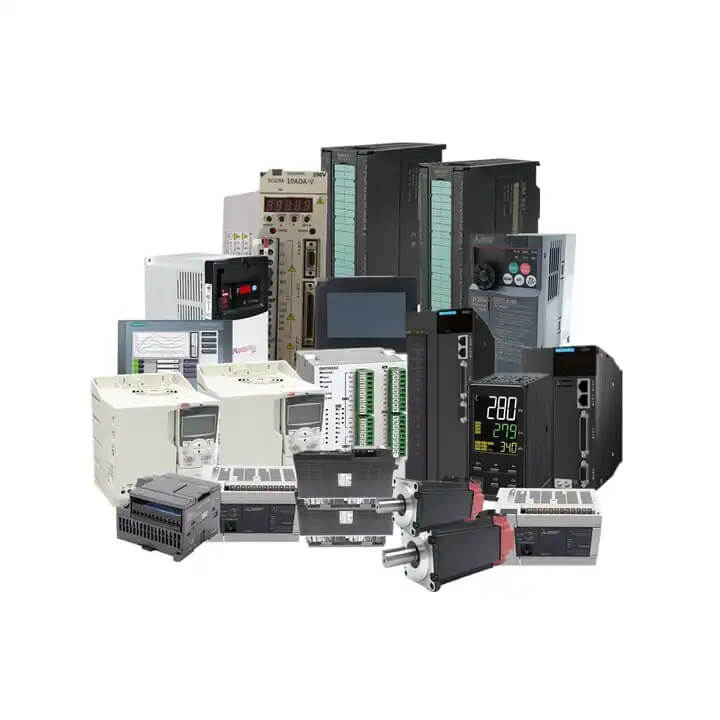
Omron PLC Tutorial: Connect, Download and Upload with CX-Programmer
Choosing Between Omron PLC Series
Three questions decide the Omron PLC series for a machine: the I/O point count, the number of positioning axes, and the network the controller joins. Flextech’s Malaysian price bands run: micro and nano PLCs sit in a RM 600 to RM 2,500 range, compact PLCs in RM 2,500 to RM 15,000, and modular PLCs in RM 15,000 to RM 80,000 and above. Sysmac Studio is bought separately from the NX1P CPU.
| Requirement | Series to shortlist |
| Single machine, modest I/O, relay outputs | CP2E (CP1E only for existing installations) |
| Ethernet and data collection on a small machine | CP2E-N or CP1L Ethernet models |
| Multi-axis pulse positioning at high speed | CP1H |
| Large I/O count, rack expansion, EtherNet/IP | CJ2M |
| Motion, EtherCAT and safety in one controller | NX1P |
| Timers and counters only, no analog | ZEN programmable relay |
Flextech’s brand-selection stance places Omron strongest in semiconductor and precision applications, which is an application fit rather than a rule for any single series. For part-number checks against these series, contact Flextech through the Omron PLC category, or see the wider PLC Malaysia range.
Frequently Asked Questions
The five questions below cover the points buyers and engineers raise most often on Omron PLC series: discontinuation status, programming software, the ZEN relay, the NX1P against the CJ2M, and safety controllers.
Is the Omron CP1E still in production?
No. Omron Europe lists the CP1E with a product discontinuation date of 31 March 2022 and provides a replacement guide for selecting a CP2E CPU.
Which software programs an Omron CP2E or CP1L?
CX-Programmer, which Omron describes as the programming software for all Omron PLC series and which is part of the CX-One suite. CX-One Lite is a limited edition for the CPx platform.
Is the Omron ZEN a PLC?
Not in the strict sense. The ZEN is a programmable relay with relay, timer, counter and time-switch functions in a 70 mm by 90 mm body, aimed at small-scale automation, and programmed with ZEN-SOFT01-V4.
What separates the NX1P from the CJ2M?
The CJ2M is a rack-based modular PLC with up to 2,560 I/O, while the NX1P is a compact machine controller with built-in EtherCAT, EtherNet/IP and up to 8 motion axes (4 synchronised), programmed in Sysmac Studio.
Does Omron make a safety PLC?
Yes. Omron’s programmable safety range includes the NX Safety controllers and the G9SP, with safety levels up to PLe (EN ISO 13849-1) and SIL3 (IEC 61508).