
Industrial Counter Selection Guide for Malaysian Manufacturing (2026)

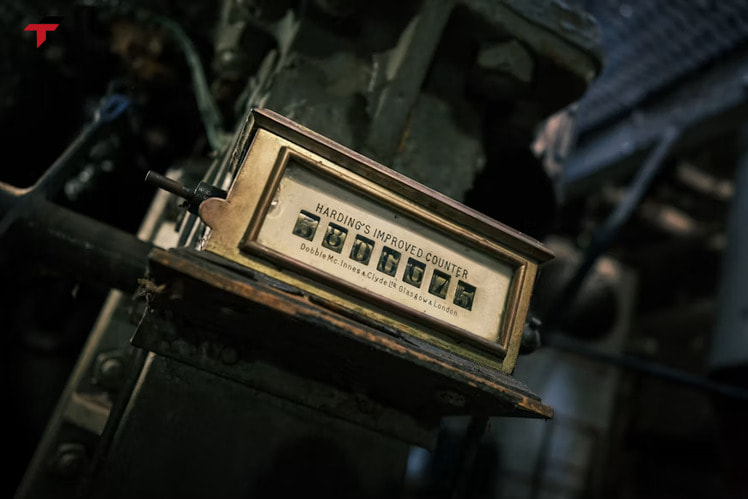
An industrial counter is a standalone panel-mount instrument that receives electrical pulse signals from sensors, switches, or encoders and displays a cumulative count, preset-controlled output, or real-time rate measurement – without PLC programming. For maintenance engineers and system integrators specifying panel-mount instrumentation in Malaysian manufacturing, the counter type and input signal configuration determine whether the instrument functions correctly on first wiring or produces zero output with no fault indication. Connecting mismatched input types (NPN sensor to PNP counter input, or vice versa) generates no error signal – the counter simply shows no count.
This guide covers three counter types (preset, totalizer, rate meter), how input signals work (NPN, PNP, voltage), four counting modes, digital vs electromechanical construction, the standalone counter vs PLC internal counter decision, five selection parameters, five Malaysian factory applications, and Autonics, Delta, and Panasonic counter availability through Flextech Industrial.
What an Industrial Counter Does in Factory Automation
An industrial counter accepts pulse or signal inputs from an upstream device – a proximity sensor, photoelectric sensor, limit switch, or encoder – and increments or decrements an internal count register with each received pulse.
The counter displays the running count on a built-in LED or LCD numerical display. In preset configurations, the counter triggers an output relay when the count reaches a user-defined target value. In totalizer mode, it accumulates count continuously and displays the running total. In rate meter mode, it measures pulse frequency and displays the result as pieces per minute or cycles per hour.
The defining characteristic of an industrial counter is hardware-only, self-contained operation. The counter requires no PLC, no ladder logic programme, and no HMI screen. A maintenance engineer sets the preset value via front-panel buttons, reads the count from the LED display, and resets the counter without accessing any control programme. This is the characteristic that makes standalone counters practical for batch control, cycle monitoring, and production shift counting on lines where PLC programming resources are limited or where a local display at the machine is operationally necessary.
Industrial counters mount in standard panel cutouts – 48×48 mm (1.89×1.89 in), 72×72 mm (2.83×2.83 in), or 96×96 mm (3.78×3.78 in) DIN standard – and operate on 24 VDC or 100–240 VAC power supplies. The front face is rated IP54 as standard for dust and splash protection.
Selecting the correct counter type is the first decision before specifying input wiring or brand.
3 Types of Industrial Counters and Their Applications
Industrial counters divide into three functional types based on their output behaviour and measurement role in the production process.
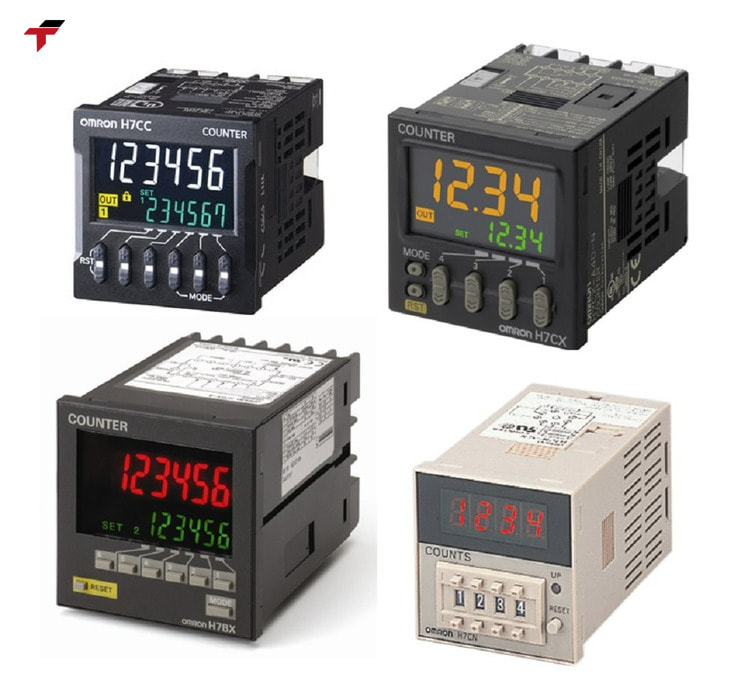
Preset Counter
A preset counter counts input pulses toward a user-set target value and triggers an output relay when the accumulated count reaches that target. The output holds until the counter is reset – via front-panel button, or automatically via an external reset signal from a PLC or machine control circuit.
The preset value is set via front-panel increment buttons. Digit count determines the maximum preset range: a 4-digit counter reaches 9,999; a 6-digit counter reaches 999,999. Output options include relay contact (NO/NC, for direct load control) or transistor output for faster-switching logic-level applications.
Preset counters are the correct choice for batch control – counting pieces into a carton, counting shots in a moulding machine before die maintenance, or counting press cycles before tool inspection. The counter directly controls the batch output signal without PLC programming involvement.
The preset counter controls output at a set count value; when the application requires production monitoring without output control, the totalizer counter occupies that role.
Totalizer Counter
A totalizer counter accumulates a running count without triggering an output at any preset value. The display shows the cumulative total since the last reset. Reset is operator-initiated or PLC-triggered at shift change, maintenance interval, or end-of-production run.
The practical distinction from a preset counter is operational: a preset counter controls; a totalizer monitors. A totalizer on a conveyor counts total pieces produced across a full shift. A machine cycle totalizer on a press or injection moulding machine counts strokes across the equipment lifetime – the number a maintenance engineer compares against the service interval to schedule preventive maintenance without paper-based cycle logging.
Totalizers are appropriate where the accumulated count is the management data – production shift output, equipment lifecycle tracking, or energy meter pulse counting – and where no automatic output action is required.
Where real-time process speed – not accumulated count – is the requirement, the rate meter counter is the applicable counter type.
Rate Meter Counter
A rate meter counter measures the frequency of incoming pulses and displays the result as a rate – pieces per minute, cycles per hour, or RPM equivalent – rather than an accumulated total. Some rate meter models display both the current rate and a running total simultaneously.
Rate meter counters serve a different function from preset and totalizer counters: they provide real-time process speed visibility. A rate meter at a conveyor inspection station shows pieces per minute. A drop below the minimum production rate triggers an alarm output before the batch falls short of the shift target. This replaces a dedicated tachometer in applications where a pulse-generating sensor is already present at the measurement point.
The three counter types – preset, totalizer, rate meter – cover the full range of factory counting requirements. The summary below maps each type to its application before moving to input wiring.
3 Types of Industrial Counters and Their Applications
Summary – Industrial Counter Type Selection
Preset counters control batch output by tripping a relay at a set count value. Totalizers monitor cumulative production without output control. Rate meters display real-time process speed rather than accumulated count. Selecting the correct type requires knowing whether the application demands batch output control (preset), production monitoring (totalizer), or speed visibility (rate meter) – input signal type and environmental rating determine the model within the chosen type.
Once the counter type is confirmed, input signal compatibility – NPN, PNP, or voltage contact – is the next parameter to verify before any wiring decision.
Input Signals and Counting Modes in Industrial Counters
Industrial counter wiring depends on two parameters confirmed before installation: the input signal type from the upstream sensor, and the counting mode configured on the counter.
NPN, PNP, and Voltage Input Compatibility
Industrial counters accept three input signal types. Input compatibility with the upstream sensor is the first wiring parameter to confirm – a mismatch produces zero count output with no visible fault.
| Input Type | Signal Logic | Compatible Sensors | Typical Malaysia Use |
| **NPN (sinking)** | Active LOW – pulls input to 0 V on detection | Autonics, Omron NPN proximity and photoelectric sensors | Default for Mitsubishi MELSEC and Panasonic FP-series PLC installations |
| **PNP (sourcing)** | Active HIGH – pulls input to 24 V on detection | Autonics, Omron PNP sensors | Siemens S7-series and Allen-Bradley installations |
| **Voltage / contact** | AC contact closure or DC voltage pulse | Limit switches, mechanical microswitches | Legacy factory lines with relay-based control |
NPN input counters are the standard specification for most Malaysian automation installations due to the prevalence of Mitsubishi and Panasonic PLC platforms, which default to NPN-compatible industrial sensors Malaysia and I/O wiring. Confirm input type against the sensor output specification – not the sensor body label – before ordering.
With input type confirmed, the counting mode configured on the counter determines how the instrument processes each incoming pulse.
4 Counting Modes – Add, Subtract, Batch, and Totalise
Industrial counters operate in four primary counting modes, each suited to a different production monitoring requirement.
Add (up) counting increments from zero toward the preset value. The output relay trips when count equals preset and holds until reset. Standard for piece counting on packaging lines and batch control applications.
Subtract (down) counting starts at the preset value and decrements to zero. The output trips at zero. Used for batch dispensing where the remaining quantity – not the accumulated count – is the operationally relevant number.
Totalise accumulates count continuously across multiple batches with no output trip. Reset is external – manual pushbutton or PLC-triggered signal. Used for production shift totals and machine cycle lifetime counts.
Batch (preset with auto-reset) counts to preset, trips output, auto-resets, and begins counting again without manual intervention. Used for continuous batch production cycles where the counter restarts automatically on each new batch.
————————————————————
The correct input type and counting mode define the wiring and configuration. The next decisions – digital vs electromechanical construction and standalone vs PLC counter – determine the hardware platform.
Digital vs Electromechanical Industrial Counters
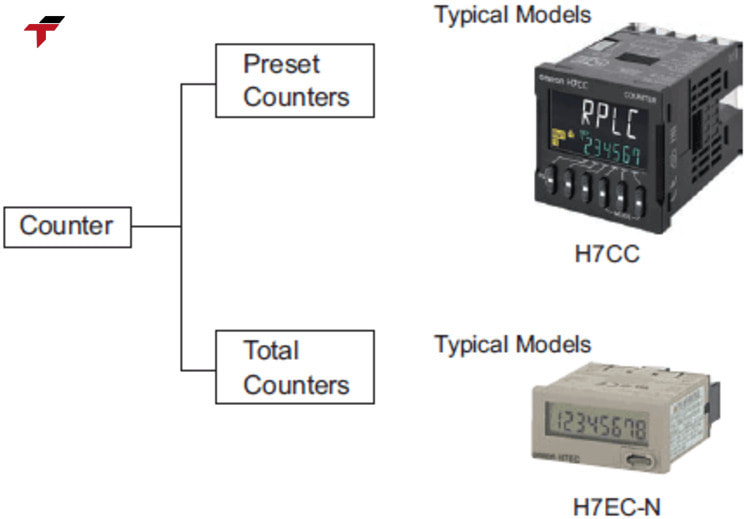
Digital and electromechanical counters both count input events but differ in construction, maximum input speed, maintenance requirements, and operating environment suitability.
| Parameter | Digital Counter | Electromechanical Counter |
| **Display** | LED or LCD 7-segment digits | Mechanical digit wheels (odometer style) |
| **Count speed** | High-speed pulse input (hundreds to thousands of pulses per minute) | Low-speed – limited by mechanical actuator response |
| **Preset / output** | Relay or transistor output at user-set preset | Cam-operated mechanical output at set position |
| **Accuracy over time** | No mechanical wear – count register does not drift | Subject to mechanical wear; cam position may shift |
| **Vibration resistance** | Moderate – LED display unaffected by vibration | High – mechanical digit wheels tolerant of vibration and shock |
| **Power requirement** | Requires DC or AC power supply | Self-powered models available |
| **Maintenance** | Minimal – no moving parts in counting mechanism | Periodic inspection of cams, gears, and mechanical linkages |
Digital counters are the standard for modern industrial automation. Relay output, high input speed, and panel-mount integration with 24 VDC control circuits make digital counters practical for the full range of automation counting tasks.
Electromechanical counters remain in use on legacy machinery, outdoor equipment without reliable power, and high-vibration environments where the mechanical robustness of digit wheel displays is operationally preferred over digital display sensitivity.
Digital construction confirmed – the next decision is whether the counter operates as a standalone instrument or as a function block inside the facility’s existing PLC.
Digital vs Electromechanical Industrial Counters
Standalone Industrial Counter vs PLC Internal Counter
PLCs contain internal counter function blocks – CTU (count up) and CTD (count down) per IEC 61131-3 standard – that count pulses arriving at any digital input. The question for system integrators is not whether the PLC can count, but whether a standalone industrial counter is the more practical solution for the specific application.
| Consideration | Standalone Industrial Counter | PLC Internal Counter |
| **Cost for simple count task** | Low – no I/O point, no programming time | Higher – requires available I/O, programme modification |
| **Local display at machine** | Built-in LED/LCD at the counter face | Requires HMI or separate remote display panel |
| **Installation** | Panel-mount, self-contained wiring | Requires wiring to PLC I/O rack |
| **Programming requirement** | None – hardware configuration only | Counter function block, reset logic, output assignment |
| **Multi-axis coordination** | Single count channel only | PLC coordinates count across multiple axes |
| **Data logging to SCADA** | Not standard | Count data available via PLC communication |
Use a standalone industrial counter when the counting task is self-contained – a single batch output relay at the machine, a local display for the operator, a totalizer for shift count, or a retrofit to a line without available PLC I/O capacity. The standalone counter resolves the application without programming resources.
Use the PLC internal counter when the count result feeds into multi-step control logic, coordinates with other machine axes, requires SCADA or MES data logging, or when a dedicated HMI already provides the operator display. In these cases, the PLC counter eliminates the standalone hardware cost while leveraging the control system already in place.
Platform choice made – the five parameters below translate the application requirements into a specific counter model specification.
5 Parameters for Selecting an Industrial Counter
Selecting an industrial counter requires matching five parameters to the application before specifying a brand or model.
- Input signal type. Determine whether the upstream sensor outputs NPN (sinking), PNP (sourcing), or contact closure. The counter input type must match. An NPN sensor connected to a PNP input counter produces zero count with no fault indication – a wiring mismatch not always visible on first inspection. Check the sensor output specification, not the sensor housing label.
- Maximum input frequency. Determine the fastest pulse rate the counter must capture. Slow mechanical operations (manual pushbuttons, low-speed conveyors) place minimal demands on input frequency. High-speed production lines with encoder-derived pulse trains or fast photoelectric sensors require counters rated for the application’s maximum pulse rate. Check the counter datasheet for maximum input frequency before specifying.
- Digit count and counting range. A 4-digit counter counts to 9,999 before overflow. A 6-digit counter counts to 999,999. Select based on the maximum batch size, shift total, or machine lifecycle count without overflow. A packaging line counting 50,000 pieces per shift requires at minimum a 5-digit totalizer – a 4-digit counter overflows twice per shift.
- Output type. Output type – relay contact or transistor – determines what load the counter can switch directly. Relay contact outputs are standard for batch control – the relay contact directly switches a diverter, stop signal, or alarm relay at rated current. Transistor outputs switch faster at logic-level voltages, requiring an interface relay for high-current loads. For most Malaysian factory batch control applications, relay output is the practical choice.
- Environmental rating. IP54 covers standard indoor factory environments – dust and splash protection adequate for most panel-mount applications. Washdown environments in F&B and rubber/glove manufacturing require IP65 or IP67-rated counters with sealed connectors. High-ambient-temperature environments above 50°C (122°F) in palm oil processing require confirming the counter’s operating temperature specification against the installation location.
These five parameters narrow the specification to a model category. The five Malaysian factory applications below show how each parameter maps to real production environments.
5 Parameters for Selecting an Industrial Counter
Industrial Counter Applications in Malaysian Manufacturing
Industrial counters serve five primary application areas in Malaysian factory automation, each with distinct counter type and configuration requirements.
Packaging line batch control. A preset counter on the output conveyor counts pieces into a carton. When the count reaches the preset batch size, the output relay signals the diverter gate or line stop. The counter auto-resets and the next batch begins. This is the most common industrial counter application in Malaysian FMCG and F&B packaging operations in Selangor and Penang.
Machine cycle monitoring for preventive maintenance. A totalizer on a press, injection moulding machine, or stamping die counts machine cycles from the last service. When the maintenance engineer performs scheduled service, the totalizer resets. Comparison of current count against the service interval determines the next maintenance date without paper-based cycle logging.
Production shift output tracking. A totalizer records pieces produced from shift start to shift end. The shift supervisor reads the count directly from the counter display. At shift change, the counter resets. This delivers real-time production output visibility without PLC programming or HMI screens.
Line speed and production rate monitoring. A rate meter counter at an inspection station measures pieces per minute. If the rate drops below a set threshold, the output relay triggers a warning alarm. This catches speed losses – jammed feeders, slow upstream processes – before the production shortfall becomes unrecoverable against the shift target.
Equipment runtime hour metering. An hour meter variant counts operating hours from power-on. Maintenance scheduling for compressors, hydraulic power units, and cooling fans uses the hour meter reading to determine service intervals – oil changes, filter replacements, bearing inspections – independent of calendar time.
Application requirements confirmed – the final step is verifying which counter brands are locally stocked in Malaysia to support these applications without import lead time risk.
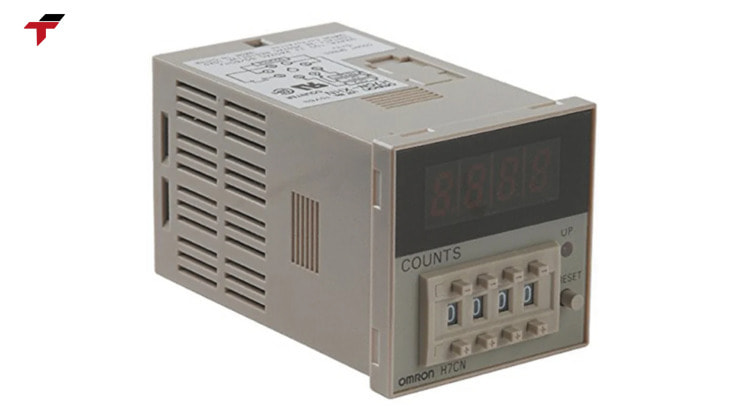
Autonics, Delta, and Panasonic Counters Available in Malaysia
Industrial counter availability through local distributors determines production continuity when replacement parts are required. Import lead times for non-stocked counter models typically run 4–12 weeks from international sources – a production variable that affects line scheduling when a counter failure causes a line stop.
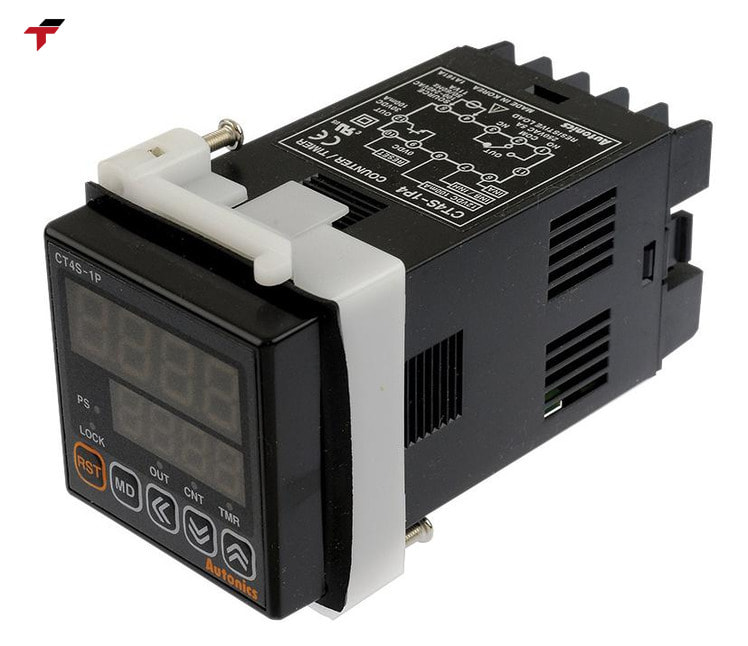
Autonics counters are the primary counter product line stocked by Flextech Industrial for Malaysian manufacturing applications. The CT6S series – 48×48 mm (1/16 DIN), 6-digit LED display – accepts both NPN and PNP input on the same unit, eliminating the need to specify input type at order time. Relay output is rated 250VAC 5A, with NPN open collector output running concurrently. RS485 communication is available on T-suffix models (CT6S-1P4T, CT6S-2P4T) for PC-based parameter setting and monitoring via Modbus – relevant for lines transitioning toward data-connected production tracking. The CT6S covers 9 counter input modes and 11 output modes across 1-preset and 2-preset variants, with power options at 24–48 VDC/24 VAC or 100–240 VAC.
Delta counters serve the same panel-mount DIN standard form factor as Autonics, with preset and totalizer functions. Delta counters suit installations where the factory already operates Delta PLCs, HMIs, or inverters – consistent brand ecosystem reduces cross-brand configuration overhead for maintenance teams.
Panasonic counters are specified for installations where Panasonic FP-series PLCs are the primary controller platform and the maintenance team prefers consistent brand sourcing across panel-mount instrumentation. Panasonic counter input configurations align directly with Panasonic FP-series NPN I/O defaults.
Flextech Industrial stocks Autonics, Delta, and Panasonic counters in Puchong, Selangor, with Malaysia-wide delivery. For specifications on counter model, digit count, input type, or output configuration, contact Flextech or browse the industrial sensors Malaysia catalogue.
Common questions from maintenance engineers and procurement teams on counter selection are answered below.
Autonics, Delta, and Panasonic Counters Available in Malaysia
Frequently Asked Questions
What is the difference between a preset counter and a totalizer?
A preset counter trips an output relay when the accumulated count reaches a user-set target value – used for batch control where reaching the count value triggers a machine action. A totalizer accumulates count continuously without tripping any output – used to monitor total production output, machine cycles, or equipment runtime across multiple batches or shifts.
What input type do industrial counters use – NPN or PNP?
Industrial counters are available in NPN (sinking) input and PNP (sourcing) input configurations. NPN input counters are standard for most Malaysian installations because Mitsubishi MELSEC and Panasonic FP-series PLC platforms default to NPN-compatible sensors and I/O wiring. Siemens S7-series and Allen-Bradley installations typically use PNP input counters. Confirm against the sensor output specification before ordering.
When should I use a standalone counter instead of a PLC internal counter?
A standalone industrial counter is the practical choice when the application requires only a single batch output relay with a local display, when no PLC I/O capacity is available, or when the counter is retrofitted to an existing line without PLC reprogramming access. When count data must feed into multi-step machine logic, coordinate across multiple axes, or log to a SCADA system, the PLC internal counter function block is the more appropriate solution.
What IP rating do industrial counters need for Malaysian factory conditions?
IP54 is the standard rating for most indoor factory environments – adequate for dust and splash protection in dry panel-mount applications. Washdown environments in F&B, rubber, and glove manufacturing require IP65 or IP67 counters with sealed connectors. Palm oil processing environments above 50°C ambient require confirming the counter’s operating temperature specification against the installation location.
What is a rate meter counter used for?
A rate meter counter displays real-time production speed – pieces per minute, cycles per hour, or RPM equivalent – rather than an accumulated total. It monitors conveyor speed, verifies line rate at inspection stations, and detects production slowdowns before they cause shift target shortfalls. Rate meter counters replace dedicated tachometers when a pulse-generating sensor is already present at the measurement point.
————————————————————
Flextech Industrial stocks Autonics, Delta, and Panasonic counters locally in Puchong, Selangor, with Malaysia-wide delivery. For counter specifications, input type confirmation, or sourcing advice, contact Flextech.