
A servo motor is an electric motor with a built-in feedback sensor (encoder) that provides precise control of position, speed, and torque in a closed-loop system. Servo motors power high-precision industrial applications — CNC machines, packaging lines, robotic arms, and semiconductor assembly equipment. This guide explains how servo motors work, the types available, critical specifications for sizing, and which brands Malaysian manufacturers trust for motion control.
What Is a Servo Motor? Definition and Working Principle
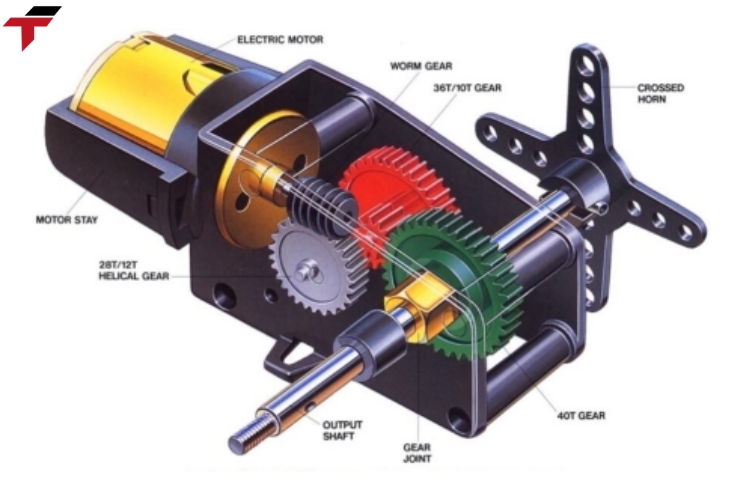
A servo motor operates as part of a closed-loop control system that continuously compares the actual motor position to the commanded position and corrects any error in real time. Three components work together: the servo motor itself (which converts electrical energy into rotary motion), the encoder (which measures the motor shaft’s exact position and speed), and the servo amplifier or drive (which receives commands and regulates the current flowing to the motor).
The control loop works as follows. A motion controller or PLC sends a position or speed command to the servo amplifier. The amplifier energises the motor windings with precisely controlled current. As the shaft rotates, the encoder feeds back the actual position — typically at 24-bit to 26-bit resolution, translating to 16.7 million to 67 million position readings per revolution. The amplifier compares the commanded position to the actual position and adjusts motor current within microseconds to eliminate any following error.
This closed-loop feedback mechanism distinguishes servo motors from standard induction motors and stepper motors. An induction motor spins at a speed determined by the power supply frequency — it has no position awareness. A stepper motor moves in fixed angular increments but operates open-loop; it does not verify whether the shaft actually reached the commanded position. Servo motors continuously verify position, making them the preferred choice for applications where accuracy and dynamic response are critical.
Servo systems have become the motion control standard in precision manufacturing — from semiconductor wafer handling in Penang to packaging machinery across Selangor and Johor.
Types of Servo Motors
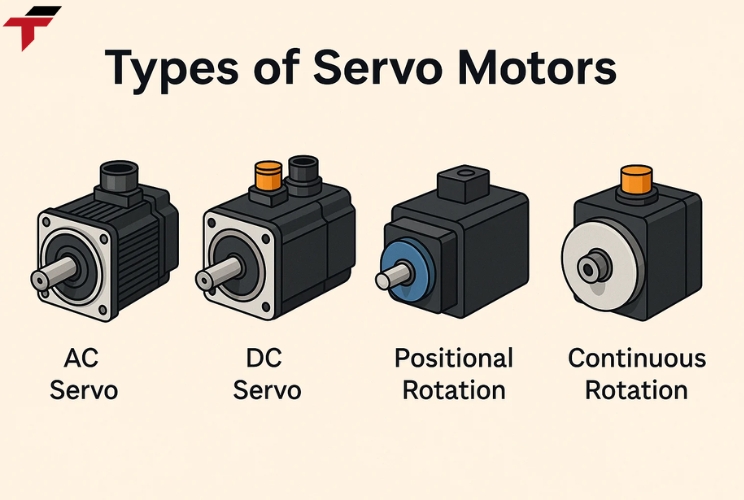
Servo motors divide into three main categories based on their construction and operating principle. AC servo motors dominate modern industrial applications.
AC Servo Motors
AC servo motors — specifically permanent magnet synchronous motors (PMSM) — represent over 90% of new servo installations in industrial automation. The rotor contains high-energy permanent magnets that create a magnetic field; the stator windings receive controlled AC current from the servo amplifier to produce a rotating magnetic field that drives the rotor.
AC servos deliver high torque density (strong torque relative to motor size), smooth rotation at low speeds, and maintenance-free operation with no brushes to wear. Power ratings range from 50W for small actuators to 55kW for heavy-duty positioning systems. Every major servo brand — Yaskawa, Mitsubishi, Omron — manufactures AC servo motors as their primary product line.
DC Servo Motors
DC servo motors use brushes and a commutator to deliver current to the rotor windings. While largely replaced by AC servos in new installations, DC servo motors remain in service on legacy CNC machines and older automated equipment. Their main drawback is brush wear — requiring periodic maintenance and replacement. DC servos still suit low-power applications where cost matters more than maintenance intervals.
Linear Servo Motors
Linear servo motors convert electrical energy directly into straight-line motion without gears, ball screws, or belt drives. The motor consists of a flat stator (forcer) that rides along a magnetic track. Linear servos eliminate mechanical backlash entirely, achieving positioning accuracy below 1 micron.
Linear servo applications include semiconductor pick-and-place machines, high-speed inspection systems, and precision metrology stages — equipment common in Malaysia’s Penang electronics manufacturing hub.
| Servo Type | Motion | Speed | Maintenance | Cost | Best For |
| AC Servo (PMSM) | Rotary | Up to 6,000+ RPM | None (brushless) | Medium-high | General industrial positioning |
| DC Servo | Rotary | Up to 5,000 RPM | Brush replacement | Lower | Legacy systems, low-power |
| Linear Servo | Linear | Up to 5 m/s+ | Minimal | High | Ultra-precision, no backlash |
Understanding servo types guides your initial selection; the next step is evaluating the specifications that determine whether a specific motor fits your mechanical load.
Key Specifications for Servo Motor Sizing
Servo motor sizing requires matching the motor’s torque, speed, and inertia characteristics to your mechanical load. Under-sizing causes the servo to overheat or fault under load; over-sizing wastes money and panel space.
Rated torque (Nm) — Calculate the total torque your application demands: load torque (the force needed to move or hold the workpiece) plus acceleration torque (the force needed to change speed) plus friction torque (from bearings, seals, and mechanical transmission). The servo motor’s rated continuous torque must exceed this total.
Rated speed (RPM) — Determine the maximum rotational speed your application requires at the motor shaft, accounting for any gear reduction between the motor and the load. Most AC servo motors provide rated speeds of 2,000-3,000 RPM with peak speeds reaching 6,000 RPM.
Encoder resolution — Higher resolution enables finer positioning accuracy. The Yaskawa Sigma-7 series uses a 24-bit absolute encoder (16.7 million pulses per revolution); the Mitsubishi MELSERVO MR-J5 pushes this to 26-bit resolution (67 million pulses per revolution). For typical industrial positioning — conveyor indexing, label placement, press feeds — 17-bit to 20-bit resolution is sufficient. Semiconductor and micro-assembly applications demand 23-bit or higher.
Inertia ratio — The ratio of load inertia to motor rotor inertia affects the system’s responsiveness and stability. A recommended inertia ratio is 10:1 or lower; 5:1 or lower is ideal for fast, dynamic applications. Modern servo amplifiers with auto-tuning can compensate for higher ratios, but exceeding the amplifier’s capability leads to oscillation and instability.
Power rating (W or kW) — Servo motor power must cover continuous operation plus peak demands during acceleration. A 400W servo motor suits a small indexing table; a 2-3 kW motor handles medium-speed packaging axes; 7.5 kW and above serves heavy press feeds and large gantry systems.
Communication protocol — The servo amplifier communicates with the PLC or motion controller through a fieldbus protocol. Yaskawa supports MECHATROLINK-III and EtherCAT; Mitsubishi uses CC-Link IE TSN and SSCNET III/H; Omron runs on EtherCAT. The protocol must match your controller platform.
| Specification | What It Determines | Typical Range |
| Rated Torque | Load-carrying ability | 0.16–350 Nm |
| Rated Speed | Maximum rotational speed | 2,000–6,000 RPM |
| Encoder Resolution | Positioning accuracy | 17-bit to 26-bit |
| Inertia Ratio | System stability | Target ≤10:1 (ideal ≤5:1) |
| Power Rating | Overall capacity | 50W–55kW |
With specifications understood, the next question is which servo brand and model best fits your machine design.
How to Choose the Right Servo Motor
Servo motor selection starts with your mechanical requirements and works backward to the motor model. Follow these steps to narrow your options.
Step 1 — Define the motion profile. Determine the distance, speed, acceleration, and cycle time your axis must achieve. A pick-and-place arm that moves 300 mm in 0.4 seconds has very different torque and speed requirements from a conveyor indexer that advances 500 mm every 2 seconds.
Step 2 — Calculate load torque and inertia. Use the mechanical equations for your transmission type (ball screw, belt drive, rack-and-pinion, direct drive). Every servo manufacturer provides sizing software: Yaskawa SigmaSize, Mitsubishi Servo Sizing Tool, Omron Servo Motor Selector.
Step 3 — Match the PLC/controller platform. If your factory standardises on Mitsubishi MELSEC PLCs, the MELSERVO MR-J5 integrates natively through CC-Link IE TSN with minimal configuration. Omron NJ/NX controllers pair with Omron 1S Series servos through EtherCAT via Sysmac Studio — a single software environment for both PLC and motion programming.
Step 4 — Compare pricing and availability in Malaysia. Yaskawa Sigma-7 motor-amplifier sets start from approximately RM 3,000 (50W); Mitsubishi MR-J5 sets from RM 3,500; Omron 1S sets from RM 2,500. Higher power ratings scale up accordingly. Contact Flextech Industrial for current pricing on your specific configuration.
For a detailed brand comparison and pricing table, see our Servo Motor Buying Guide for Malaysian Manufacturers.
Servo Motor Applications in Malaysian Industries
Servo motors drive precision motion across Malaysia’s key manufacturing sectors. The demand for servo systems grows as factories automate to offset rising labour costs and meet tighter quality standards.
Semiconductor and electronics — Penang’s electronics hub uses servo motors extensively in die bonding, wire bonding, and pick-and-place equipment. These applications demand sub-micron positioning accuracy and high acceleration for rapid cycle times. Yaskawa and Omron servos are common in this segment.
Packaging and converting — Servo motors control film feeding, label application, cartoning, and case packing on packaging lines. Mitsubishi MELSERVO MR-J5 systems — paired with FX5U or iQ-R PLCs — serve Malaysian packaging machine builders who export equipment across ASEAN.
Automotive parts manufacturing — Servo-driven press brakes, welding positioners, and assembly robots require high torque and fast response. Factories in Johor supplying Proton and Perodua specify Yaskawa and Mitsubishi servos for production line machinery.
Food and beverage — Servo motors handle fill-level dosing, capping torque control, and conveyor indexing in production lines at Malaysian F&B plants. The precision of servo control reduces product waste and improves fill accuracy.
Malaysia’s Smart Automation Grant (SAG), administered by MIDA, provides matching funding up to RM 1,000,000 for automation investments — covering servo motor systems as part of eligible capital equipment.
Servo Motor Brands in the Malaysian Market
Three servo motor brands hold the largest installed base in Malaysian factories, each offering complete motor-amplifier-cable packages.
Yaskawa Sigma-7 Series — Yaskawa holds over 30% global market share in servo motors, making it the world’s largest servo manufacturer. The Sigma-7 series features a 24-bit absolute encoder, vibration suppression, and auto-tuning across 50W to 55kW models. Communication options include MECHATROLINK-III, EtherCAT, and EtherNet/IP. Price range: RM 3,000–25,000 per motor-amplifier set.
Mitsubishi Electric MELSERVO MR-J5 — The MR-J5 features a 26-bit absolute encoder (67 million pulses per revolution) — the highest resolution among mainstream brands. Machine-learning vibration suppression and one-touch auto-tuning reduce commissioning time. Communication: CC-Link IE TSN and SSCNET III/H. Price range: RM 3,500–28,000 per set. Dominant in Asian markets.
Omron 1S Series — The 1S Series integrates tightly with Omron SYSMAC NJ/NX controllers via EtherCAT. A battery-free absolute encoder eliminates battery replacement maintenance. Built-in safety functions (STO, SS1) meet machine safety standards without external relays. Price range: RM 2,500–15,000. Power range: 50W–15kW.
| Brand | Series | Encoder | Communication | Power Range | Price (MYR) |
| Yaskawa | Sigma-7 | 24-bit absolute | MECHATROLINK-III, EtherCAT | 50W–55kW | RM 3,000–25,000 |
| Mitsubishi | MR-J5 | 26-bit absolute | CC-Link IE TSN, SSCNET III/H | 50W–55kW | RM 3,500–28,000 |
| Omron | 1S | 23-bit absolute | EtherCAT | 50W–15kW | RM 2,500–15,000 |
Flextech Industrial Supplies stocks genuine servo motors and amplifiers from Yaskawa, Mitsubishi, and Omron — with technical support for sizing and selection. Contact Flextech for current pricing and lead times.
Frequently Asked Questions
Q: What is a servo motor in simple terms?
A servo motor is an electric motor paired with a position sensor (encoder) that allows precise control of shaft position, speed, and torque. Unlike standard motors that simply spin when powered, a servo motor receives position commands and continuously adjusts to reach and hold the exact commanded position — making it essential for automated machinery that requires accuracy.
Q: How does a servo motor differ from a stepper motor?
A servo motor operates in closed-loop control with encoder feedback, maintaining accurate position even under varying loads. A stepper motor moves in fixed angular steps without position verification (open-loop). Servo motors deliver higher speed (6,000+ RPM vs 1,000-2,000 RPM for steppers), maintain torque at high speeds, and cost more (RM 3,000+ vs RM 300-1,500 for steppers). Stepper motors suit low-speed, cost-sensitive applications where missing a step is acceptable.
Q: What is the difference between AC and DC servo motors?
AC servo motors use permanent magnets and receive alternating current from a servo amplifier — they are brushless and maintenance-free. DC servo motors use brushes and a commutator, requiring periodic brush replacement. AC servo motors dominate modern industrial applications due to their higher power density, longer lifespan, and superior dynamic response. DC servos remain in some legacy systems.
Q: How do I size a servo motor for my application?
Servo motor sizing requires calculating four parameters: load torque (force to move the workpiece), acceleration torque (force to reach target speed), inertia ratio (load inertia divided by motor inertia — target below 10:1), and duty cycle (continuous vs intermittent operation). Every major brand provides free sizing software. For assistance with servo sizing in Malaysia, contact Flextech Industrial’s technical team.
Q: How much does a servo motor cost in Malaysia?
Servo motor prices in Malaysia range from approximately RM 2,500 for a 50W Omron 1S motor-amplifier set to RM 28,000 for a high-power Mitsubishi MR-J5 configuration. A typical mid-range 1-2 kW servo set costs RM 5,000–10,000. Prices include the motor and amplifier; cables, connectors, and mechanical couplings are additional. Contact Flextech Industrial for current pricing.
Q: Which servo motor brand is most reliable?
Yaskawa, Mitsubishi Electric, and Omron all manufacture servo motors to high reliability standards with mean time between failure (MTBF) exceeding 50,000 hours. Yaskawa holds the largest global market share. Mitsubishi leads in Southeast Asian installations. Omron’s battery-free encoder eliminates a common failure point. Brand reliability differences are negligible; choose based on your PLC ecosystem and application requirements.
Conclusion
A servo motor delivers the precise position, speed, and torque control that modern automated machinery demands. The closed-loop feedback from high-resolution encoders ensures that every motion command executes accurately — whether your application is a pick-and-place arm cycling every 0.3 seconds or a press feed indexing heavy steel coil.
Selecting the right servo motor requires matching torque, speed, inertia, and communication protocol to your mechanical load and PLC platform. Malaysian manufacturers have strong local access to Yaskawa, Mitsubishi, and Omron servo systems through multi-brand suppliers.
Get a Quote from Flextech Industrial — contact our team for servo motor pricing, sizing assistance, and delivery across Malaysia.

