
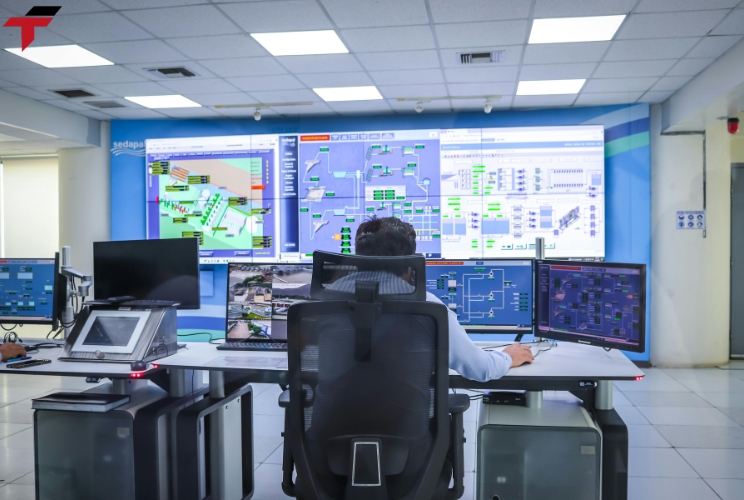
A SCADA (Supervisory Control and Data Acquisition) system is a software and hardware platform that monitors, controls, and records data from industrial processes across an entire facility — or across multiple sites — from a central control room. SCADA systems aggregate real-time information from PLCs, sensors, and instruments distributed throughout a plant, presenting operators with a unified view of all processes on PC-based displays. This guide explains how SCADA works, its core components, architecture types, and how Malaysian industries use SCADA for plant-wide automation.
What Is SCADA? Definition and Core Functions
SCADA stands for Supervisory Control and Data Acquisition — a name that describes exactly what the system does. It provides supervisory control: operators issue high-level commands (change a setpoint, switch an operating mode, start a sequence) from a central workstation, and those commands reach the local PLCs that execute the control logic. It performs data acquisition: the system continuously collects measurement values, equipment status, alarm states, and event logs from every connected device in the plant.
A SCADA system differs from a standalone HMI panel in scope and architecture. An HMI panel sits at a single machine or production zone, displaying data from one or a few PLCs. A SCADA system integrates data from dozens or hundreds of PLCs, remote terminal units (RTUs), and instruments across an entire facility — or across geographically distributed sites connected by wide-area networks.
SCADA systems serve three primary functions. Real-time monitoring gives operators a live overview of the entire operation: process flows, equipment states, tank levels, temperatures, pressures, and production counts — all updated continuously. Alarm management filters, prioritises, and logs abnormal conditions across the plant, directing operators to the most critical issues first. Historical data logging records process variables over time, enabling trend analysis, regulatory compliance reporting, batch traceability, and performance optimisation.
These functions make SCADA indispensable for facilities where manual monitoring is impractical — water treatment plants with pumping stations spread across a city, palm oil refineries with multiple processing stages, or power distribution networks spanning a region.
SCADA System Architecture and Components
A SCADA system consists of five layers, each performing a specific role in the data flow from field instruments to operator screens.
Field Instruments and Sensors
Sensors and transmitters — proximity sensors, pressure transmitters, flow meters, temperature probes, level sensors — measure physical conditions throughout the plant. Actuators — motor starters, control valves, solenoids, VFDs — execute control actions. These field instruments connect directly to PLCs or RTUs through hardwired signals or industrial fieldbuses.
PLCs and RTUs
PLCs (programmable logic controllers) and RTUs (remote terminal units) sit at the local control level. Each PLC executes its own control program — running a pump station, managing a batch reactor, or controlling a packaging line — independently of the SCADA system. The SCADA server reads data from these PLCs and sends supervisory commands to them. If the SCADA network goes down, each PLC continues operating its local process autonomously.
RTUs serve remote locations — water pumping stations, electrical substations, oil pipeline valve stations — where a full PLC may not be required. RTUs collect sensor data and transmit it to the SCADA server over radio, cellular, or fiber optic links.
Communication Network
The communication network connects PLCs and RTUs to the SCADA server. Modern SCADA systems use industrial Ethernet protocols: PROFINET (Siemens ecosystem), EtherNet/IP (Allen-Bradley), Modbus TCP (universal), or OPC UA (vendor-neutral, Industry 4.0 standard). Legacy systems may still use serial Modbus RTU or PROFIBUS links.
Network topology — star, ring, or redundant ring — affects system resilience. Critical SCADA installations use redundant Ethernet rings so that a single cable failure does not interrupt communication. Fiber optic links serve long distances and electrically noisy environments.
SCADA Server and Historian
The SCADA server processes incoming data from all connected PLCs, runs alarm logic, performs calculations, and stores historical data in a database (historian). The historian records process variables at configurable intervals — from sub-second for fast processes to minutes for slow-changing parameters. Historical data supports trend analysis, root-cause investigation, regulatory auditing, and production reporting.
Operator Workstations (HMI Displays)
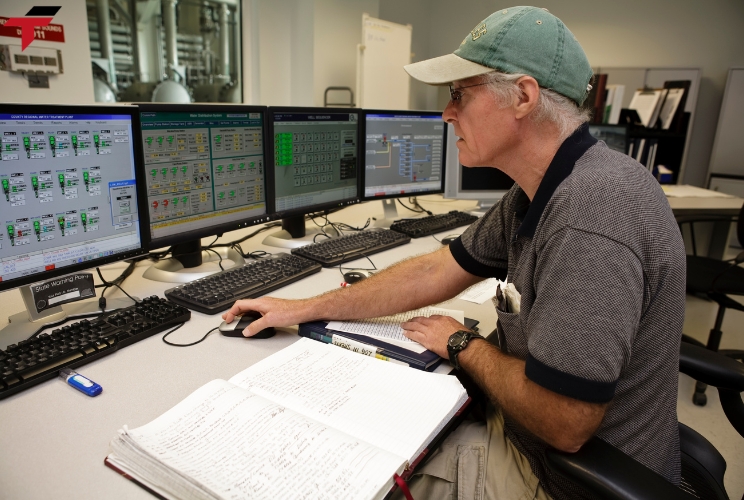
Operators interact with the SCADA system through PC-based workstations running SCADA visualization software. Multi-monitor setups display process overviews, detailed equipment screens, alarm lists, and trend charts simultaneously. Unlike standalone HMI panels, SCADA workstations can display any part of the plant — operators navigate between zones, buildings, or even remote sites from a single chair.
| SCADA Component | Function | Example Products |
| Field Instruments | Measure and actuate | Omron E2E sensors, Keyence pressure sensors |
| PLCs / RTUs | Local control logic | Siemens S7-1500, Mitsubishi iQ-R, Omron NJ |
| Communication | Data transport | PROFINET, EtherNet/IP, Modbus TCP, OPC UA |
| SCADA Server | Data processing, historian | Siemens WinCC, Ignition, AVEVA |
| Operator Workstation | Visualization, control | Multi-screen PC stations |
SCADA architecture determines system capability; the next consideration is how modern SCADA has evolved to support connected, cloud-enabled operations.
Types of SCADA Systems
SCADA technology has evolved through four generations, each expanding the system’s reach and integration capability.
First Generation: Monolithic SCADA
Early SCADA systems ran on mainframe computers with proprietary protocols and no network connectivity. Each system was an isolated island — no data sharing between sites. Legacy monolithic systems still operate in some older Malaysian facilities, though they are being replaced as equipment reaches end-of-life.
Second Generation: Distributed SCADA
Distributed SCADA introduced LAN (local area network) connectivity, allowing multiple operator stations to share data from a central server within a single plant. Siemens WinCC, Allen-Bradley FactoryTalk, and other modern platforms operate in this architecture. Most Malaysian manufacturing plants currently use distributed SCADA for factory-level monitoring.
Third Generation: Networked SCADA
Networked SCADA connects distributed systems across wide-area networks (WAN) and the internet, enabling multi-site monitoring from a central operations centre. Water utilities monitoring pump stations across Selangor, or a palm oil company overseeing mills across multiple states, use networked SCADA to centralise operational visibility.
Fourth Generation: IoT and Cloud SCADA
Cloud-based SCADA platforms integrate with IoT devices and cloud computing, providing remote browser-based access, scalable data storage, and advanced analytics. OPC UA serves as the standard communication protocol for Industry 4.0 integration, enabling SCADA systems to exchange data with ERP, MES, and analytics platforms. Cloud SCADA aligns with Malaysia’s NIMP 2030 smart factory vision.
| Generation | Connectivity | Scope | Technology |
| Monolithic | None | Single site, standalone | Mainframe, proprietary |
| Distributed | LAN | Single plant, shared | Server-client, Ethernet |
| Networked | WAN / Internet | Multi-site, centralised | Web-enabled, standard protocols |
| Cloud / IoT | Cloud + Edge | Enterprise-wide, remote | OPC UA, cloud databases, analytics |
Understanding SCADA types helps define your system requirements; the PLC and HMI hardware you select determines how effectively the SCADA system operates at the field level.
How PLCs and HMIs Connect to SCADA
SCADA systems depend on PLCs for local control execution and HMI panels for local operator access — both components that Flextech Industrial supplies for Malaysian automation projects.
PLC integration — Each PLC in a SCADA system runs its own control program independently. The SCADA server reads PLC data registers to display values on operator screens and writes to PLC registers when operators issue supervisory commands. A Siemens SCADA (WinCC) connects natively to Siemens SIMATIC S7-1200 and S7-1500 PLCs via PROFINET. Multi-vendor SCADA platforms connect to any PLC brand through Modbus TCP or OPC UA drivers.
HMI panels at machine level — While SCADA provides the plant-wide view, local HMI panels give operators at individual machines direct access to control and diagnostics without walking to the control room. A typical architecture pairs a Siemens KTP or Comfort Panel at each machine with a central SCADA system — both connected to the same S7-1500 PLC.
Sensor and VFD data — Sensors and VFDs connect to PLCs, which relay their data to SCADA. Pressure readings from Omron sensors, motor speed feedback from Siemens or Mitsubishi VFDs, and position data from Yaskawa servos all flow through the PLC to the SCADA historian for plant-wide visibility.
For detailed guidance on selecting PLCs and HMIs for your SCADA project, see our Complete Guide to Buying PLCs in Malaysia and Complete Guide to Buying HMIs in Malaysia.
SCADA Applications in Malaysian Industries
SCADA systems serve industries where processes are too large or distributed for single-machine monitoring.
Water treatment and distribution — Municipal water authorities in Selangor and Johor use SCADA to monitor treatment plant operations, pump station pressures, reservoir levels, and distribution network flow rates across dozens of remote sites. PLCs at each station handle local pump control; SCADA aggregates data at the operations centre.
Palm oil processing — Large palm oil companies operate multiple mills across Peninsular Malaysia and East Malaysia. SCADA systems provide centralised visibility into steriliser conditions, extraction rates, CPO quality parameters, and effluent treatment across all mills. Siemens and Allen-Bradley PLCs commonly serve as the field controllers.
Power generation and distribution — Tenaga Nasional (TNB) substations and independent power producers use SCADA for grid monitoring, load management, and fault detection. SCADA enables remote switching operations that would otherwise require personnel at each substation.
Large manufacturing plants — Automotive assembly plants, semiconductor fabrication facilities, and chemical processing plants in Malaysia use SCADA for production tracking, energy monitoring, and quality data management. NIMP 2030’s target of 3,000 smart factories will drive SCADA adoption as the integration layer between shop-floor automation and enterprise systems.

Frequently Asked Questions
Q: What does SCADA stand for?
SCADA stands for Supervisory Control and Data Acquisition. It describes a system that provides supervisory-level monitoring and control of industrial processes while continuously acquiring data from field devices such as PLCs, sensors, and instruments. SCADA systems operate at the plant level, above individual machine controllers.
Q: What is the difference between SCADA and HMI?
An HMI (human machine interface) is a single display panel installed at a machine or zone for local operator interaction with one or a few PLCs. A SCADA system is plant-wide software running on PC-based workstations that monitors and controls all PLCs, instruments, and processes across an entire facility. SCADA includes HMI functionality but extends to historical data logging, alarm management, and multi-site connectivity.
Q: What is the difference between SCADA and PLC?
A PLC (programmable logic controller) executes real-time control logic — reading sensors, running programs, driving outputs — at the machine level. A SCADA system sits above PLCs, collecting their data, providing plant-wide visualisation, and enabling supervisory commands. PLCs operate autonomously; SCADA provides the higher-level coordination and data management layer. Most SCADA systems connect to multiple PLCs.
Q: Do I need SCADA for my factory?
A SCADA system is justified when your factory has multiple process areas or production lines with PLCs that need centralised monitoring, alarm management, and historical data logging. Small factories with a few machines typically use standalone HMI panels. Large plants with 10+ PLCs, distributed processes, or regulatory reporting requirements benefit significantly from SCADA integration. Malaysian manufacturers pursuing NIMP 2030 smart factory certification often implement SCADA as their integration platform.
Q: Which PLCs work with SCADA systems?
All major PLC brands — Siemens SIMATIC, Allen-Bradley (Rockwell Automation), Mitsubishi Electric MELSEC, Omron SYSMAC, and Keyence KV — support SCADA connectivity through industrial Ethernet protocols. Modbus TCP and OPC UA provide universal connectivity across brands. Flextech Industrial supplies PLCs from all five brands for SCADA integration projects in Malaysia.
Q: How much does a SCADA system cost in Malaysia?
SCADA system costs vary widely based on the number of connected PLCs, I/O points, operator stations, and software licensing model. A small single-server SCADA system monitoring 3-5 PLCs may cost RM 30,000-80,000 including hardware and software licensing. Large multi-site systems with redundant servers, historian databases, and web-based remote access can exceed RM 500,000. The PLC and HMI hardware at the field level represents additional cost — contact Flextech Industrial for component pricing.
Conclusion
A SCADA system provides the plant-wide visibility, alarm management, and historical data logging that individual HMI panels and PLCs cannot deliver on their own. By aggregating data from all field controllers into a centralised platform, SCADA enables informed decision-making, faster fault response, and compliance with regulatory reporting requirements.
Malaysian industries — from water treatment and palm oil processing to large-scale manufacturing — depend on SCADA systems built on reliable PLC and HMI hardware from established automation brands.
Get a Quote from Flextech Industrial — contact our team for PLCs, HMIs, and automation components for your SCADA project. We supply genuine hardware from Siemens, Mitsubishi, Omron, Allen-Bradley, and Keyence with delivery across Malaysia.

