
A VFD (variable frequency drive) is an electronic device that controls the speed and torque of an AC electric motor by varying the frequency and voltage of the power it supplies. VFDs are also called inverters, AC drives, or adjustable-speed drives. These controllers save energy, reduce mechanical stress on equipment, and provide precise motor speed control across industries — from water treatment pumps to manufacturing conveyors. This guide explains how VFDs work, the types available, sizing rules, and which brands serve Malaysian factories.
What Is a VFD? Definition and How It Works
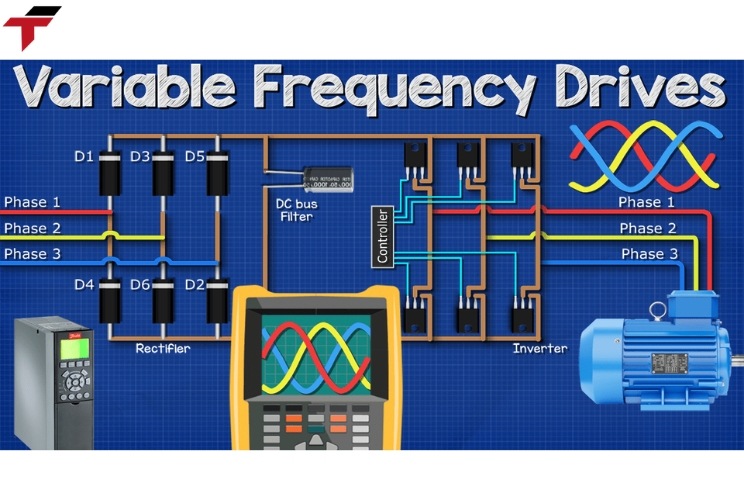
A variable frequency drive converts incoming fixed-frequency AC power (50 Hz in Malaysia) into variable-frequency AC output that controls motor speed. Since an AC induction motor’s speed is proportional to the supply frequency, reducing the frequency from 50 Hz to 25 Hz cuts the motor speed roughly in half. The VFD makes this adjustment electronically, without mechanical gearboxes or pulleys.
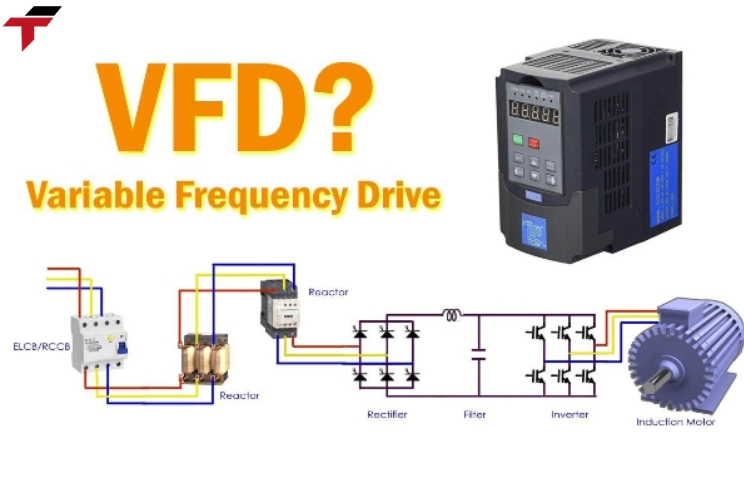
VFD operation involves three internal stages. The rectifier converts incoming AC power to DC using a diode bridge. The DC bus stores this energy in a capacitor bank, smoothing voltage ripples. The inverter then converts DC back to AC at the desired frequency and voltage using high-speed IGBT transistors that switch thousands of times per second in a pattern called pulse-width modulation (PWM). The resulting output mimics a sine wave that the motor interprets as a variable-frequency power supply.
VFDs use different control methods depending on the application’s torque requirements. V/f (voltage-to-frequency) control maintains a constant ratio between voltage and frequency — suitable for fans, pumps, and simple conveyors. Sensorless vector control estimates motor flux and torque mathematically, providing better low-speed torque without an encoder — suitable for conveyors under varying loads. Closed-loop vector control uses an encoder for precise speed regulation — required for hoists, winders, and tension-controlled applications.
The energy savings from VFD-controlled motors are substantial: the affinity laws of fluid dynamics state that pump or fan power consumption is proportional to the cube of speed. Reducing a pump’s speed by 20% cuts energy consumption by approximately 49%. For Malaysian factories where electricity costs represent a significant operating expense, VFDs pay for themselves within months on large motors.
Types of VFDs
VFD products fall into categories based on their control capability and application scope. Most Malaysian installations use general-purpose drives.
General-Purpose VFDs
General-purpose VFDs provide V/f control and basic sensorless vector control for standard AC induction motors. They suit applications where precise speed regulation is not critical — fans, pumps, blowers, basic conveyors, and mixers. These drives offer the lowest cost per kilowatt and the simplest commissioning process.
The Siemens SINAMICS V20 (0.12–30 kW, RM 800–8,000), Delta MS300 (0.4–22 kW, RM 500–4,000), and Yaskawa GA500 (0.1–30 kW, RM 1,500–10,000) all serve this segment. Delta MS300 provides the most cost-effective option for straightforward speed control in Malaysian factories.
High-Performance VFDs
High-performance VFDs deliver full sensorless vector and closed-loop vector control for demanding applications — cranes, hoists, winders, extruders, and process machines requiring precise torque control at low speeds. These drives include advanced features: auto-tuning, dynamic braking, Safe Torque Off (STO), and multiple motor control.
The Siemens SINAMICS G120C (0.55–132 kW, RM 2,000–15,000) and Mitsubishi FR-E800 (0.1–22 kW, RM 1,200–8,000) offer high-performance control with integrated PLC functionality and fieldbus communication. The FR-E800 includes a built-in PLC function block that handles simple automation logic without a separate controller.
Regenerative VFDs
Regenerative VFDs return braking energy to the electrical grid instead of dissipating it as heat through braking resistors. Elevator drives, downhill conveyor systems, and centrifuge deceleration applications benefit from regenerative operation — recovering energy that would otherwise be wasted. Regenerative drives cost more upfront but reduce electricity bills and eliminate the heat generated by resistor banks.
| VFD Type | Control Method | Applications | Price Level |
| General-Purpose | V/f, basic vector | Fans, pumps, simple conveyors | Lowest |
| High-Performance | Full vector, closed-loop | Cranes, winders, process machines | Medium |
| Regenerative | Energy recovery | Elevators, downhill conveyors | Highest |
Selecting the right VFD type is the first decision; the next step is matching the drive’s power rating to your motor.
Key VFD Specifications and Sizing
VFD sizing centres on matching the drive to the connected motor while accounting for application-specific demands. An undersized VFD trips on overcurrent; an oversized VFD wastes capital.
Power rating (kW) — Select a VFD rated one step above your motor’s nameplate power. A 2.2 kW motor requires a 3.0 kW VFD to provide headroom for starting current and momentary overloads. This one-step-up rule is standard practice across the industry.
Voltage and phases — Malaysian industrial power is typically 3-phase 415V AC, 50 Hz. Ensure the VFD’s input voltage rating matches your supply. Single-phase 240V VFDs are available for small applications (up to ~2.2 kW) where three-phase supply is not available.
Control method — V/f control suffices for pumps and fans. Vector control is necessary for applications requiring high starting torque or precise speed holding under varying loads. Closed-loop vector (with encoder feedback) suits cranes and hoists where load-dependent speed droop is unacceptable.
Communication protocol — VFDs in automated systems need to receive speed commands and report status to a PLC. The Siemens G120C communicates via PROFINET; the Mitsubishi FR-E800 supports CC-Link IE TSN; the Yaskawa GA500 offers EtherNet/IP and Modbus TCP. Standalone VFDs without PLC integration typically use analog 0-10V or 4-20mA speed reference signals.
Duty type — Standard VFDs handle Normal Duty (110% overload for 60 seconds) for fans and pumps. Heavy Duty applications (150% overload for 60 seconds) — conveyors, crushers, compressors — require either a heavy-duty rated VFD or upsizing by one frame.
| Motor Rating (kW) | Recommended VFD Rating | Typical Application |
| 0.75 kW | 1.1 kW VFD | Small fans, pumps |
| 2.2 kW | 3.0 kW VFD | Conveyors, mixers |
| 7.5 kW | 11 kW VFD | Large fans, compressors |
| 15 kW | 18.5 kW VFD | Large process equipment |
| 37 kW | 45 kW VFD | Heavy industrial drives |
Proper sizing ensures reliable operation; the application environment determines how much energy the VFD will save.
VFD Applications and Energy Savings
VFDs deliver measurable energy savings in any application where motors do not need to run at full speed continuously. Three applications account for the majority of VFD installations worldwide.
Pump Speed Control
VFDs on pumps provide the most dramatic energy savings in industrial facilities. The pump affinity laws dictate that power consumption decreases with the cube of speed: operating a pump at 80% speed uses only about 51% of full-speed power. Water treatment plants, cooling water systems, and process pumping stations in Malaysian factories routinely achieve 30-50% energy reduction after VFD installation.
Fan and Blower Control
HVAC fans, dust collection blowers, and cooling tower fans operate at varying loads throughout the day. VFDs adjust fan speed to match the actual airflow demand instead of throttling output with dampers — which wastes energy. A 37 kW blower running at 70% speed with a VFD consumes approximately 34% of full-speed energy compared to near-full energy consumption when throttled by a damper at the same airflow.
Conveyor and Process Speed Control
Manufacturing conveyors, extruders, and mixers use VFDs to match line speed to production requirements. A packaging line that runs at 80% capacity during off-peak shifts saves significant energy compared to running motors at full speed and using mechanical braking. VFDs also provide soft-start capability — ramping motor speed up gradually instead of applying full voltage at startup. Soft starting reduces mechanical stress on belts, gears, and couplings, extending equipment lifespan.
VFD installations across Malaysian manufacturers align with national energy efficiency goals. The Malaysian government’s Smart Automation Grant (SAG) and Investment Tax Allowance (ITA) incentivise automation and energy efficiency upgrades, making VFD investments financially attractive for SMEs.
VFD Brands in the Malaysian Market
Four VFD brands maintain strong presence in Malaysian industrial applications, each targeting different segments of the market.
Siemens SINAMICS V20 — The entry-level Siemens drive for standalone applications. Power range: 0.12–30 kW. V/f and basic vector control. Communication via USS or Modbus RTU. Price range: RM 800–8,000. Pairs naturally with Siemens PLCs for integrated automation.
Siemens SINAMICS G120C — Compact high-performance drive with PROFINET, PROFIBUS, and EtherNet/IP support. Power range: 0.55–132 kW. Full vector control with integrated safety functions. Price range: RM 2,000–15,000.
Mitsubishi Electric FR-E800 — The latest compact VFD from Mitsubishi with CC-Link IE TSN connectivity and built-in PLC function blocks. Power range: 0.1–22 kW. Supports PM motor control for energy-efficient motor types. Price range: RM 1,200–8,000.
Delta MS300 — The most cost-effective general-purpose option in the Malaysian market. Power range: 0.4–22 kW. Modbus and optional CANopen communication. Price range: RM 500–4,000. Popular with machine builders seeking value without sacrificing reliability.
Yaskawa GA500 — Compact general-purpose drive with multi-protocol support (EtherNet/IP, Modbus TCP, DeviceNet). Power range: 0.1–30 kW. Price range: RM 1,500–10,000. Strong presence in precision applications.
| Brand | Model | Power Range | Communication | Price (MYR) | Strength |
| Siemens | V20 | 0.12–30 kW | USS, Modbus RTU | RM 800–8,000 | Reliable, Siemens ecosystem |
| Siemens | G120C | 0.55–132 kW | PROFINET, EtherNet/IP | RM 2,000–15,000 | High performance, safety |
| Mitsubishi | FR-E800 | 0.1–22 kW | CC-Link IE TSN, Modbus | RM 1,200–8,000 | Built-in PLC, compact |
| Delta | MS300 | 0.4–22 kW | Modbus, CANopen | RM 500–4,000 | Most affordable |
| Yaskawa | GA500 | 0.1–30 kW | EtherNet/IP, Modbus TCP | RM 1,500–10,000 | Multi-protocol, precision |
Flextech Industrial Supplies provides genuine VFDs from Siemens, Mitsubishi, Delta, and Yaskawa — with motor-matching guidance and delivery across Malaysia from our Selangor warehouse.
Frequently Asked Questions
Q: What is a VFD and what does it do?
A VFD (variable frequency drive) is an electronic controller that adjusts the speed of an AC electric motor by changing the frequency and voltage of its power supply. VFDs enable precise motor speed control, reduce energy consumption, provide soft-start capability, and protect motors from overcurrent and overload conditions. They are also referred to as inverters or AC drives.
Q: How does a VFD save energy?
A VFD saves energy by running motors only as fast as the application demands. For pumps and fans, the relationship between speed and power consumption is cubic: reducing speed by 20% cuts power consumption by approximately 49%. Without a VFD, motors run at full speed and excess flow is throttled mechanically — wasting energy as heat and friction. Malaysian factories typically achieve 30-50% energy savings on pump and fan applications after VFD installation.
Q: What is the difference between a VFD and a soft starter?
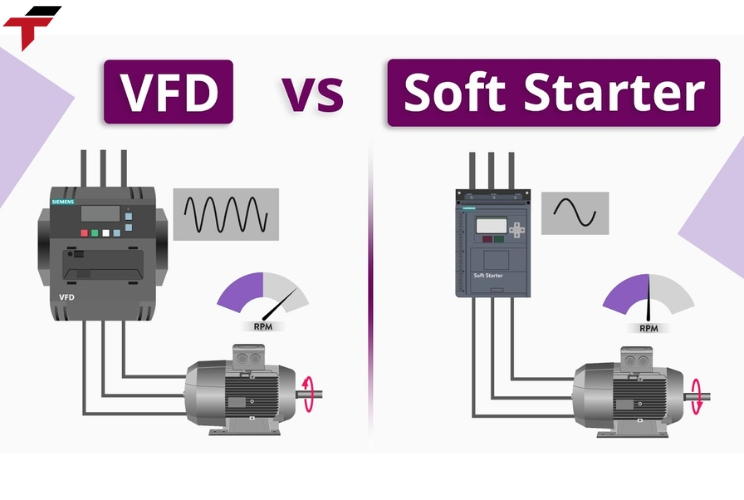
A VFD provides continuous variable speed control throughout motor operation — adjusting speed, torque, and direction at any time. A soft starter only limits inrush current during motor startup and optionally during stopping; once the motor reaches full speed, the soft starter bypasses and the motor runs at fixed speed. Use a VFD when variable speed is needed; use a soft starter when you only need gentle starting.
Q: How do I size a VFD for my motor?
Select a VFD with a kW rating one step above your motor’s nameplate rating. A 2.2 kW motor requires a 3.0 kW VFD; a 7.5 kW motor needs an 11 kW VFD. This provides headroom for starting current and temporary overloads. For heavy-duty applications (crushers, hoists), consider two steps above. Contact Flextech Industrial for sizing assistance.
Q: How much does a VFD cost in Malaysia?
VFD prices in Malaysia range from approximately RM 500 for a small Delta MS300 (0.4 kW) to RM 15,000 for a Siemens G120C at higher power ratings. A typical 2.2–3.0 kW general-purpose VFD costs RM 1,000–3,000 depending on brand and features. Contact Flextech Industrial for current pricing on specific models and power ratings.
Q: Can a VFD damage a motor?
A VFD’s PWM output creates voltage spikes that can stress motor winding insulation over time — particularly on older motors not rated for inverter duty. Modern inverter-rated motors (Class F/H insulation) handle VFD output without issues. For long cable runs between VFD and motor (over 30 metres), adding an output reactor or dV/dt filter protects winding insulation. Proper installation practices prevent any VFD-related motor damage.
Q: Where can I buy genuine VFDs in Malaysia?
Flextech Industrial Supplies stocks authentic VFDs from Siemens, Mitsubishi, Delta, and Yaskawa at our Puchong, Selangor facility. We provide motor-matching and sizing guidance, competitive pricing, and delivery across Peninsular Malaysia. Browse our VFD product range or request a quote for your application requirements.
Conclusion
A VFD gives your factory precise control over motor speed — saving energy, reducing mechanical wear, and enabling process flexibility that fixed-speed motors cannot provide. Whether you are controlling a water pump, a production conveyor, or an HVAC fan system, a properly sized VFD delivers measurable operational and financial benefits.
Malaysian manufacturers benefit from competitive VFD pricing across four major brands, government incentives for energy efficiency and automation upgrades, and growing awareness of the energy savings VFDs provide under NIMP 2030 smart factory initiatives.
Get a Quote from Flextech Industrial — contact our team for VFD pricing, motor-matching assistance, and fast delivery across Malaysia.

