
An HMI (human machine interface) is an operator panel — typically a touchscreen display — that allows factory personnel to monitor, control, and interact with industrial machines and processes in real time. HMI panels connect to PLCs and other controllers to visualise production data, manage alarms, adjust parameters, and log operational records. This guide covers how HMIs work, the types available, key specifications to evaluate, and which brands serve Malaysian manufacturers.
What Is an HMI? Definition and Function
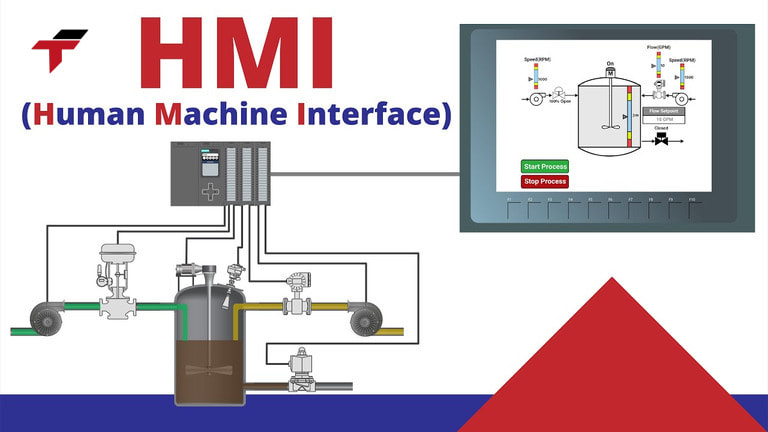
A human machine interface translates raw PLC data — digital states, analog values, timer counts, fault codes — into visual graphics that operators can understand at a glance. Instead of reading LED indicators on a control panel or checking parameter values on a PLC programming laptop, operators interact with a colour touchscreen that displays process diagrams, trend charts, alarm lists, and control buttons.
HMI panels perform three core functions in an automation system. First, they provide real-time monitoring: displaying machine status, sensor readings, production counts, and process variables as the system runs. Second, they enable operator control: allowing authorised personnel to start or stop equipment, change speed setpoints, switch operating modes, and acknowledge alarms through touch inputs. Third, HMIs handle data logging: recording production data, alarm histories, and batch records that quality teams and managers use for reporting and traceability.
Every HMI panel communicates with one or more PLCs through industrial protocols — PROFINET, EtherNet/IP, CC-Link, EtherCAT, or Modbus. The protocol must match or be compatible with the connected PLC; selecting an HMI that speaks the same protocol as your controller eliminates the need for additional gateway hardware.
Touch panel HMI systems now account for over 90% of new installations in industrial automation, replacing older push-button panels and text-based displays with intuitive graphical interfaces.
Types of HMI Systems
HMI technology has evolved from simple indicator lights to sophisticated multi-touch displays. Understanding the types available helps you match the right interface to your application’s complexity and budget.
Touch Panel HMI
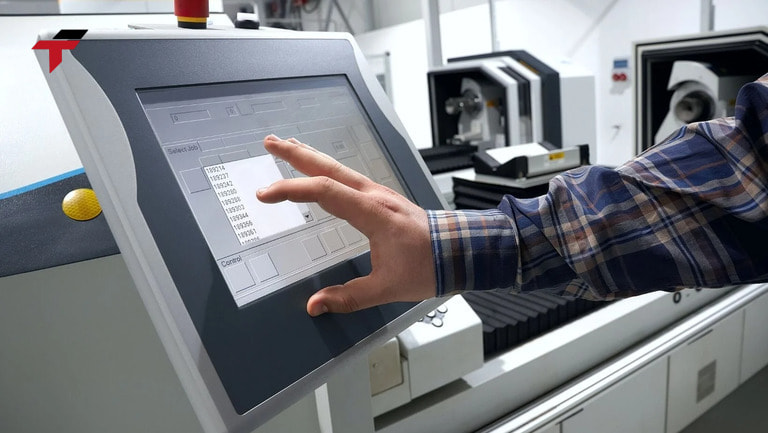
Touch panel HMIs are the standard choice for machine-level and production line applications. These dedicated industrial displays feature resistive or capacitive touchscreens, built-in communication ports, and embedded firmware optimised for real-time visualization. Touch panels range from compact 4-inch screens for single-machine monitoring to 22-inch widescreen displays for control room environments.
Resistive touchscreens respond to pressure — operators can use gloves, which matters in Malaysian factories where PPE is mandatory. Capacitive touchscreens support multi-touch gestures (pinch-to-zoom, swipe) and offer better optical clarity, but require bare-finger or capacitive-glove contact.
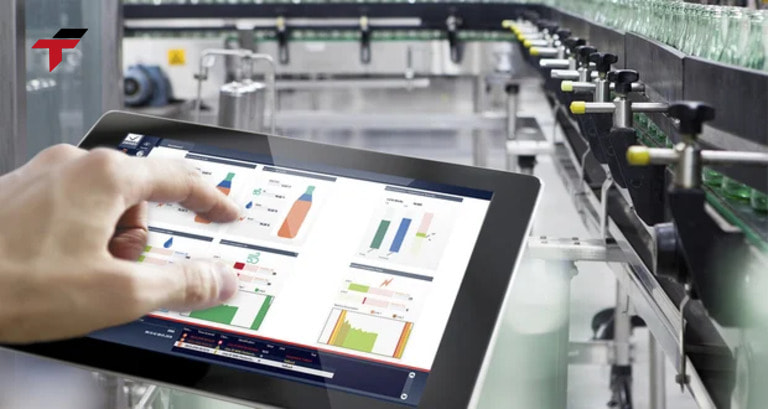
Touch panel HMIs are the standard choice for machine-level and production line applications.
Web-Based HMI
Web-based HMI platforms serve process visualisation through a standard web browser. The HMI runs on an industrial PC or server, and operators access it from any device with a browser — desktop, tablet, or smartphone. Siemens Unified Comfort Panels use HTML5-based visualization that supports remote browser access alongside the local touchscreen.
Web-based HMIs suit applications requiring remote monitoring — plant managers checking production status from an office, or maintenance engineers viewing alarms from home during off-hours.
SCADA Visualization
SCADA (Supervisory Control and Data Acquisition) systems function as plant-wide HMI platforms, aggregating data from dozens or hundreds of PLCs across an entire facility. While standalone HMI panels serve individual machines or zones, SCADA software running on dedicated PCs provides a unified view of the whole operation — including historical trending, report generation, and multi-site connectivity.
| HMI Type | Best For | Screen Size | Access | Price Range (MYR) |
| Touch Panel | Machine/line control | 4″–22″ | Local panel | RM 1,000–20,000 |
| Web-Based | Remote monitoring | Any (browser) | Local + remote | RM 6,000–25,000 |
| SCADA Software | Plant-wide control | PC monitors | Multi-station | RM 15,000–100,000+ |
Each HMI type connects to PLCs through communication protocols; the specifications of the panel itself determine how effectively it serves the operator.
Key HMI Specifications
Selecting the right HMI panel requires evaluating several specifications against your application’s needs. Screen size, communication protocol, and environmental rating are the three most critical factors.
Screen Size and Resolution
HMI screen size directly affects how much information an operator can view simultaneously. A 4-inch panel suits a single pump or motor station. A 7-inch display — the most commonly installed size in Malaysian factories — provides enough space for a process overview, parameter displays, and navigation buttons. Complex production lines with multiple zones require 10-inch to 15-inch panels. Control room applications demand 19-inch or larger displays at Full HD resolution.
| Screen Size | Resolution | Typical Application |
| 4″–5″ | 480×272 | Single machine, compact equipment |
| 7″ | 800×480 | Standard machine control (most popular) |
| 10″ | 1024×600 | Multi-zone production lines |
| 12″–15″ | 1280×800+ | SCADA overview, palm oil mills |
| 19″–22″ | 1920×1080 | Control room displays, water treatment |
Communication Protocols
The HMI must communicate with your PLC using a compatible protocol. Siemens SIMATIC HMI panels connect natively to Siemens PLCs via PROFINET. Mitsubishi GOT panels pair with MELSEC PLCs through CC-Link. Omron NA Series panels use EtherCAT to integrate with Omron SYSMAC controllers.
Pro-face GP4000 panels stand out for multi-protocol support — compatible with over 100 PLC drivers from different manufacturers. In mixed-brand environments, Pro-face HMIs or any panel supporting Modbus TCP eliminate the need to standardise on a single PLC brand.
Environmental Rating
HMI panels installed on machine fronts or in washdown areas need appropriate IP ratings. Standard panels carry IP65 (dust-tight, water-jet resistant) — sufficient for most Malaysian factory environments. Food and beverage applications requiring regular washdown demand IP67 or higher ratings. Panel cutout mounting from the front provides the IP-rated seal, while the rear connections remain protected inside the control enclosure.
HMI specifications determine the hardware; the software running on the panel determines how operators interact with the machine.
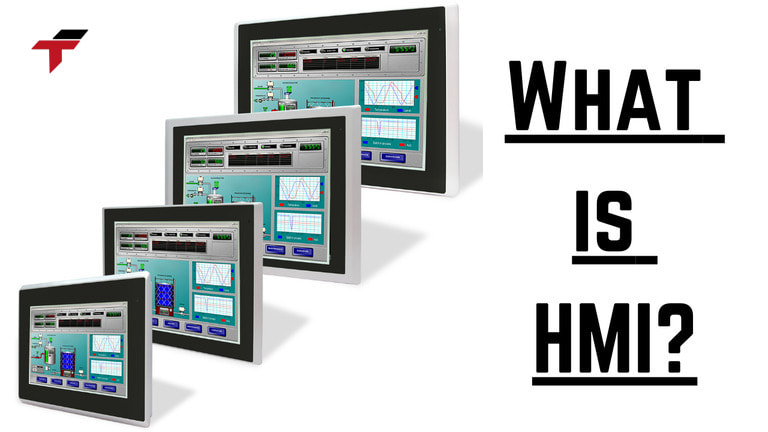
The HMI must communicate with your PLC using a compatible protocol.
How to Choose the Right HMI
HMI selection follows a logical sequence: match the PLC brand, determine the screen size, verify the environmental rating, and compare pricing within those constraints.
Match your PLC: If your system runs on Siemens S7-1200 or S7-1500 PLCs, Siemens KTP or Comfort panels integrate through TIA Portal with shared tags — the fastest development workflow. Mitsubishi PLCs pair naturally with GOT panels using GT Designer3. Omron NJ/NX controllers work best with Omron NA Series HMIs through Sysmac Studio.
Size the screen: Count the number of process variables, alarm indicators, and navigation elements your operators need to see. A rule of thumb — if the screen design requires scrolling or multiple page tabs to show essential information, move up one screen size.
Budget accordingly: A Siemens KTP400 Basic (4″) starts around RM 1,200; a Comfort Panel 15″ reaches RM 15,000. Mitsubishi GOT2000 panels range from RM 1,000 (GT21 economy) to RM 12,000 (GT27 premium). Pro-face GP4000 panels sit in the RM 2,000–10,000 range.
For a detailed comparison of HMI brands, models, and Malaysia pricing, see our Complete Guide to Buying HMIs in Malaysia.
Common HMI Applications in Industrial Automation
HMI panels serve every industry where machines need operator oversight. In Malaysia, the following sectors drive the highest HMI demand.
Food and beverage manufacturing — HMIs display recipe parameters, batch progress, CIP status, and temperature/pressure readings. Operators at Nestle, F&N, and Dutch Lady plants use 10-inch to 15-inch panels for production line monitoring. IP67-rated panels are standard in wet processing areas.
Palm oil processing — Mills use HMI panels to visualise steriliser pressure cycles, oil extraction press parameters, and storage tank levels. Large mills install 15-inch panels at operator stations and SCADA displays in control rooms.
Semiconductor and electronics — Penang’s E&E factories require HMIs for automated test equipment interfaces, cleanroom environmental monitoring, and production tracking. Compact 7-inch panels serve individual machines, while larger displays aggregate line-level data.
Automotive assembly — Production display panels show cycle time, unit counts, and quality metrics at each workstation. HMIs also provide maintenance teams with diagnostic access to PLC fault logs.
Malaysia’s manufacturing sector contributes approximately 22.5% of GDP (RM 382 billion); as NIMP 2030 drives smart factory adoption, HMI installations will accelerate across all sectors.
HMI Brands in the Malaysian Market
Four HMI brands dominate the Malaysian industrial automation market, each with strengths tied to specific PLC ecosystems and application requirements.
Siemens SIMATIC HMI — KTP Basic Panels (RM 1,200–5,000) and Comfort Panels (RM 4,000–15,000) integrate tightly with Siemens S7 PLCs through TIA Portal. The Unified Comfort Panel series (RM 6,000–20,000) adds HTML5 visualization and web-based access. Siemens panels dominate process industries in Malaysia.
Mitsubishi GOT2000 Series — Four tiers from the economy GT21 to the premium GT27 (multi-touch, video). GOT panels pair natively with MELSEC PLCs and support CC-Link communication. Price range: RM 1,000–12,000. Popular in discrete manufacturing.
Omron NA/NB Series — The NA Series combines HMI and machine controller functions within Sysmac Studio, providing a unified development environment with Omron NJ/NX PLCs. Price range: RM 1,500–15,000. NB Series is a standalone, cost-effective option.
Pro-face GP4000 Series — Supports 100+ PLC drivers, making it the strongest option for multi-brand PLC environments. Price range: RM 2,000–10,000. Pro-face panels suit system integrators working across different client factories with varying PLC standards.
| Brand | Entry Model | Premium Model | Protocol | Price Range (MYR) |
| Siemens | KTP400 Basic | Unified Comfort 22″ | PROFINET, MPI | RM 1,200–20,000 |
| Mitsubishi | GT21 3.8″ | GT27 15″ | CC-Link, Ethernet | RM 1,000–12,000 |
| Omron | NB3.5 | NA 15″ | EtherCAT, EtherNet/IP | RM 1,500–15,000 |
| Pro-face | GP4100 3.5″ | GP4500 15″ | Multi-protocol (100+) | RM 2,000–10,000 |
Flextech Industrial Supplies carries genuine HMI panels from all four brands, available from our Puchong, Selangor warehouse with fast delivery across Malaysia.
HMI Brands in the Malaysian Market
Frequently Asked Questions
Q: What does HMI stand for in industrial automation?
HMI stands for human machine interface. It refers to the operator panel — usually a touchscreen display — that lets factory personnel monitor machine status, adjust parameters, and manage alarms in real time. HMI panels connect to PLCs through industrial communication protocols to visualise and control automated processes.
Q: What is the difference between an HMI and a SCADA system?
An HMI panel is a dedicated hardware display installed at a machine or production line for local operator control. A SCADA system is software running on PCs that provides plant-wide monitoring and data management, aggregating information from multiple PLCs and HMIs across an entire facility. Many Malaysian factories use HMI panels at machine level and SCADA software in the control room.
Q: What screen size HMI do I need?
The right HMI screen size depends on your application complexity. A 4-5 inch panel suits single-machine monitoring. A 7-inch panel — the most popular size in Malaysia — handles standard machine control. Multi-zone production lines typically need 10-inch panels. Plant overview and SCADA displays require 15 inches or larger. Choose the smallest screen that shows all essential information without requiring operators to scroll through pages.
Q: Can I use a different brand HMI with my PLC?
Yes — HMI and PLC brands do not need to match, provided they share a compatible communication protocol. Modbus TCP is supported by nearly all HMI and PLC brands, serving as a universal bridge. Pro-face panels support over 100 PLC drivers, making them the most flexible option for mixed-brand environments. Same-brand pairing (Siemens HMI + Siemens PLC) does offer faster development through integrated software tools.
Q: How much does an HMI panel cost in Malaysia?
HMI panel prices in Malaysia range from approximately RM 1,000 for a basic 4-inch economy panel (Mitsubishi GT21) to RM 20,000 for a premium 22-inch Siemens Unified Comfort Panel. The most commonly purchased size — a 7-inch touch panel — costs between RM 1,500 and RM 5,000 depending on the brand and feature set. Contact Flextech Industrial for current pricing on specific models.
Q: Do HMI panels require programming?
HMI panels require screen design and configuration using the manufacturer’s software — Siemens TIA Portal (WinCC), Mitsubishi GT Designer3, Omron NB-Designer or Sysmac Studio, Pro-face GP-Pro EX. The development process involves creating graphical screens, linking display elements to PLC tags (variables), and configuring alarm and logging settings. Most engineers learn HMI programming within a few days of hands-on training.
Q: Where can I buy genuine HMI panels in Malaysia?
Flextech Industrial Supplies stocks authentic HMI panels from Siemens, Mitsubishi, Omron, and Pro-face at our Puchong, Selangor facility. We provide technical support for screen size and protocol selection, competitive pricing, and delivery across Peninsular Malaysia. Browse our HMI product catalogue or request a quote for your specific model.
Where can I buy genuine HMI panels in Malaysia?
Conclusion
An HMI panel gives your operators the visibility and control they need to run automated machines efficiently — translating PLC data into actionable graphics, managing alarms, and logging production records. The right HMI depends on your PLC brand, screen size requirements, environmental conditions, and budget.
Malaysian manufacturers across F&B, palm oil, automotive, and electronics sectors rely on HMI panels from Siemens, Mitsubishi, Omron, and Pro-face to keep their production lines running smoothly.
Get a Quote from Flextech Industrial — contact our team for HMI pricing, model recommendations, and fast delivery across Malaysia.

