
I/O modules (input/output modules) are the hardware components that connect field devices — sensors, switches, motors, valves, indicators — to a PLC’s central processing unit. Every signal entering or leaving a PLC passes through an I/O module, making these components the physical interface between the digital controller and the real-world process it controls. This guide explains I/O module types, critical specifications, selection criteria, and which brands Malaysian automation projects rely on.
What Are I/O Modules? Definition and Function
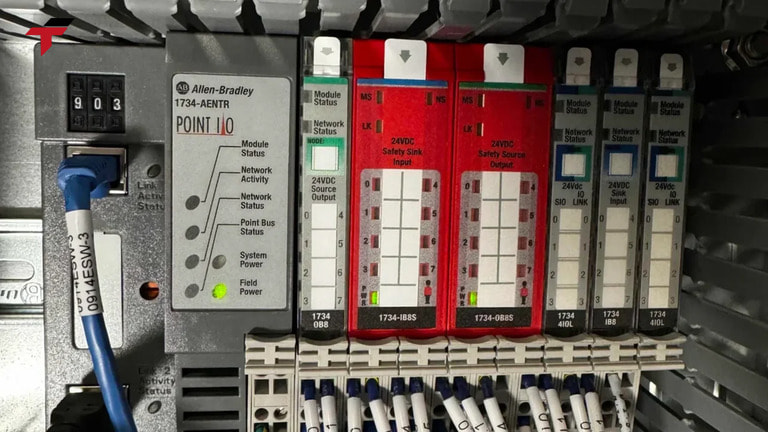
I/O modules serve as the signal translators in a PLC system. Input modules receive electrical signals from field devices — a 24V DC signal from a proximity sensor, a 4-20 mA current loop from a pressure transmitter, a thermocouple millivolt reading from a temperature probe — and convert those signals into digital data the PLC CPU can process. Output modules work in reverse: they receive commands from the CPU and convert them into electrical outputs that drive contactors, solenoid valves, indicator lights, VFDs, and other actuators.
I/O modules provide electrical isolation between field wiring and the PLC processor, protecting the CPU from voltage spikes, short circuits, and ground faults that occur in industrial environments. Optical isolators inside digital modules and galvanic isolation in analog modules create a protective barrier that keeps field-side electrical problems from damaging the controller.
In modular PLC systems — Siemens S7-1500, Allen-Bradley CompactLogix, Mitsubishi iQ-R — I/O modules plug into a backplane alongside the CPU module. Each module handles a specific signal type and channel count. Engineers select the combination of modules that matches their application’s I/O requirements and install them on the same rack or distributed across the plant via remote I/O networks.
Compact PLCs (Siemens S7-1200, Mitsubishi FX5U, Omron CP2E) include built-in I/O on the CPU module and accept expansion modules for additional channels. The built-in I/O handles basic requirements; expansion modules add capacity as the application grows.
What Are I/O Modules? Definition and Function
Types of I/O Modules
I/O modules divide into digital, analog, and specialty categories. Each type handles a specific class of electrical signals from the field.
Digital Input Modules (DI)
Digital input modules read ON/OFF signals from field devices — proximity sensors, limit switches, push buttons, safety contacts, and relay contacts. Each input channel detects whether voltage is present (ON / logic 1) or absent (OFF / logic 0). Standard digital inputs operate at 24V DC in most industrial applications.
Digital input modules are available in 8-point, 16-point, and 32-point configurations. A Siemens SM 1221 signal module for the S7-1200 provides 16 digital inputs at 24V DC. A Mitsubishi RX10 module for the iQ-R series offers 16 digital inputs. Higher-density 32-point modules reduce rack space and per-point cost for applications with many discrete sensors.
Some digital input modules include high-speed counter inputs for encoder signals, frequency measurement, or pulse counting — critical for speed monitoring and position tracking applications.
Digital Output Modules (DO)
Digital output modules switch field devices ON or OFF under PLC program control. Three output technologies serve different loads.
Transistor outputs switch 24V DC loads — solenoid valves, indicator lights, relay coils — at high speed (microsecond switching). Transistor outputs are the standard choice for most industrial applications in Malaysian factories.
Relay outputs use electromechanical relays to switch AC or DC loads up to several amps — suitable for motor contactors, heaters, and mixed-voltage loads. Relay outputs switch slower than transistors and have limited mechanical life (typically 100,000-500,000 operations).
Triac outputs switch AC loads without mechanical contacts — ideal for AC solenoid valves and AC-powered devices where relay life is a concern.
| Output Type | Voltage | Switching Speed | Life | Best For |
| Transistor | 24V DC | Microseconds | Unlimited (solid-state) | Solenoids, lights, relays |
| Relay | AC or DC | Milliseconds | 100K-500K operations | AC loads, mixed voltage |
| Triac | AC | Milliseconds | Unlimited (solid-state) | AC solenoids, heaters |
Analog Input Modules (AI)
Analog input modules convert continuous electrical signals into digital values the PLC can process mathematically. Common input signal types include:
- 4-20 mA current loop — The most common industrial analog signal. Used by pressure transmitters, flow meters, and level sensors. Resistant to electrical noise and wire resistance over long cable runs.
- 0-10 V voltage — Used by position sensors, speed references, and some temperature transmitters. More susceptible to voltage drop on long cables.
- Thermocouple (TC) — Millivolt signals from Type J, K, T, R, S thermocouples for high-temperature measurement.
- RTD (Pt100/Pt1000) — Resistance-based temperature measurement using 2-wire, 3-wire, or 4-wire connections.
Analog input resolution determines measurement precision. A 12-bit module resolves the 4-20 mA range into 4,096 steps; a 16-bit module provides 65,536 steps — significantly finer measurement for process control applications.
The Siemens SM 1231 analog input module for S7-1200 provides 8 channels at 16-bit resolution. Mitsubishi R60AD8 offers 8 channels with voltage/current selection per channel for the iQ-R platform.
Analog Output Modules (AO)
Analog output modules send proportional control signals from the PLC to field devices. A 4-20 mA output drives a proportional control valve; a 0-10 V output sets a VFD speed reference. Analog outputs enable the PLC to perform continuous control — PID loops for temperature regulation, pressure control, and flow management.
Analog output modules typically provide 2, 4, or 8 output channels. Resolution (12-bit or 16-bit) determines the smoothness of the output signal — important for precise valve positioning and speed control.
Specialty Modules
Beyond standard digital and analog types, PLC manufacturers offer specialty I/O modules for specific functions.
- High-speed counter modules — Count encoder pulses at MHz rates for speed, position, and flow measurement.
- Positioning modules — Generate pulse trains to control stepper motors and servo drives.
- Communication modules — Add fieldbus interfaces (PROFIBUS, Modbus RTU, CANopen) to the PLC.
- Safety I/O modules — SIL-rated inputs and outputs for emergency stop, safety light curtains, and guard monitoring (compliant with ISO 13849 and IEC 62061).
- Temperature modules — Dedicated thermocouple and RTD input modules with cold-junction compensation and linearisation built in.
Understanding I/O module types helps you select the right modules; specifications determine whether the modules perform reliably in your application.
Key I/O Module Specifications
Specifying I/O modules requires matching several parameters to your field devices and application requirements.
Number of channels — Count every field device signal: each sensor input, each actuator output, each analog measurement. Add 20-30% spare channels for future expansion and troubleshooting flexibility. A machine requiring 24 digital inputs and 8 digital outputs needs modules providing at least 31 DI and 10 DO channels.
Signal type and voltage — Verify that the module’s signal type matches your field devices. 24V DC digital inputs are standard in Malaysia. Analog modules must support the specific signal range (4-20 mA, 0-10V, TC type, RTD type) used by your transmitters and sensors.
Resolution (analog) — 12-bit resolution provides adequate precision for most process monitoring. 16-bit resolution is required for fine control applications — PID temperature regulation, precision dosing, and quality-critical process variables.
Isolation — Verify the isolation voltage between channels and between field side and backplane. Standard isolation is 500V AC; applications with high-voltage field devices or long cable runs benefit from reinforced isolation.
Scan rate / conversion time — Analog modules require time to convert each channel. A module with 8 channels and 1 ms conversion per channel takes 8 ms to update all channels. High-speed applications — surge detection, fast batch processes — need modules with faster conversion rates.
| Specification | Digital Modules | Analog Modules |
| Channel count | 8, 16, 32 points | 2, 4, 8 channels |
| Signal type | 24V DC (standard) | 4-20mA, 0-10V, TC, RTD |
| Resolution | N/A (ON/OFF) | 12-bit or 16-bit |
| Response time | < 1 ms | 1-10 ms per channel |
| Isolation | 500V AC typical | 500-1500V AC |
Specifications guide module selection; the PLC brand determines which modules are compatible with your system.
I/O Module Brands Available in Malaysia
Each PLC brand offers a corresponding range of I/O modules designed for its backplane and communication system. Mixing I/O module brands on the same backplane is not possible — the modules must match the PLC platform.
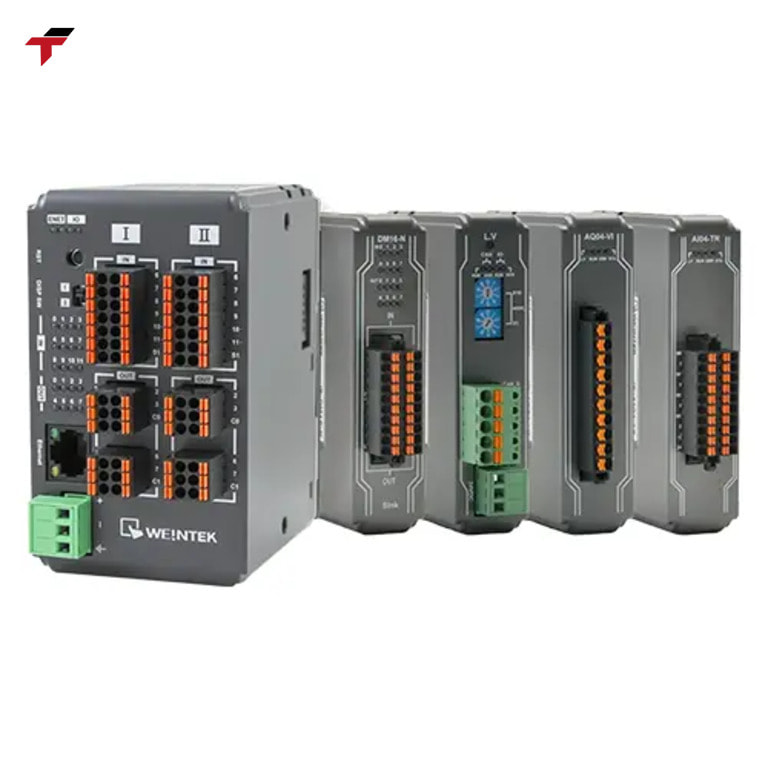
Siemens SIMATIC I/O Modules
Siemens offers I/O modules across three platforms.
S7-1200 Signal Modules (SM) — SM 1221 (DI), SM 1222 (DO), SM 1231 (AI), SM 1232 (AO). These modules plug into the right side of the S7-1200 CPU, expanding the built-in I/O. Compact and cost-effective for small-medium applications. Price range: RM 400–2,000 per module.
S7-1500 Signal Modules — Higher channel density, faster conversion times, and advanced diagnostics compared to S7-1200 modules. Support PROFINET-based I/O integration. Price range: RM 800–4,000 per module.
ET 200SP Distributed I/O — Remote I/O system connected to S7-1500 or S7-1200 CPUs via PROFINET. ET 200SP modules mount in remote cabinets close to field devices, reducing cable runs and installation costs. Ideal for distributed plant architectures and SCADA systems.
I/O Module Brands Available in Malaysia
Mitsubishi Electric MELSEC I/O Modules
iQ-R Series — RX (DI), RY (DO), R60AD (AI), R60DA (AO) modules for the modular iQ-R platform. High-speed bus communication between modules. Compatible with CC-Link IE TSN remote I/O. Price range: RM 600–3,000 per module.
FX5 Series — Expansion adapters and extension modules for the FX5U compact PLC. FX5-8EX (8 DI), FX5-8EYR (8 DO relay), FX5-4AD (4 AI). Price range: RM 300–1,500 per module.
Omron I/O Modules
NX Series — I/O modules for the NJ/NX machine controller platform, connected via EtherCAT. NX-ID (DI), NX-OD (DO), NX-AD (AI), NX-DA (AO). High-speed EtherCAT communication supports distributed I/O with minimal wiring. Price range: RM 500–2,500 per module.
CJ Series — Modular I/O for CJ2M PLC (legacy but widely installed). Price range: RM 400–2,000 per module.
| Brand | Platform | DI Module | AI Module | Remote I/O | Price Range (MYR) |
| Siemens | S7-1200 | SM 1221 | SM 1231 | ET 200SP | RM 400–4,000 |
| Siemens | S7-1500 | DI 32x24V DC | AI 8x16bit | ET 200SP | RM 800–4,000 |
| Mitsubishi | iQ-R | RX | R60AD | CC-Link IE TSN | RM 600–3,000 |
| Mitsubishi | FX5 | FX5-8EX | FX5-4AD | N/A (local) | RM 300–1,500 |
| Omron | NX/NJ | NX-ID | NX-AD | EtherCAT | RM 500–2,500 |
Flextech Industrial Supplies stocks genuine I/O modules from Siemens, Mitsubishi, and Omron at our Puchong, Selangor warehouse — supporting PLC system builds and expansion projects across Malaysia.
How to Plan I/O for Your PLC System
I/O planning determines the cost and expandability of your PLC system. A systematic approach prevents under-sizing (running out of channels) and over-sizing (wasting budget on unused modules).
Step 1 — Create an I/O list. Document every field device connected to the PLC: sensor type, signal type (DI, DO, AI, AO), cable length, and location. Group signals by type and physical location.
Step 2 — Add spare capacity. Apply a 20-30% spare channel reserve across each I/O type. A machine with 40 digital inputs should have modules providing at least 50-52 DI channels. Spare channels accommodate future sensors, debugging connections, and design changes during commissioning.
Step 3 — Decide local vs remote I/O. If field devices are concentrated near the PLC panel, local I/O modules on the backplane are the most cost-effective. If devices are distributed across a large machine or plant (more than 20-30 metres from the PLC), remote I/O stations — Siemens ET 200SP, Mitsubishi CC-Link IE TSN remote stations, Omron EtherCAT couplers — reduce cable runs and installation labour.
Step 4 — Match NPN/PNP convention. In Malaysia, factories using Siemens and Allen-Bradley PLCs typically wire PNP (sourcing) sensors. Mitsubishi and Omron PLC users often use NPN (sinking) sensors. Verify your I/O module input type matches the sensor output type to avoid wiring incompatibility.
For detailed PLC and I/O module selection guidance, see our Complete Guide to Buying PLCs in Malaysia.
How to Plan I/O for Your PLC System
Frequently Asked Questions
Q: What is an I/O module in a PLC?
An I/O module is a hardware component that connects field devices (sensors, switches, motors, valves) to a PLC’s CPU. Input modules receive electrical signals from sensors and convert them to digital data for the CPU. Output modules receive commands from the CPU and convert them to electrical signals that drive actuators. I/O modules are the physical interface between the PLC controller and the automated process.
Q: What is the difference between digital and analog I/O?
Digital I/O handles ON/OFF signals — a sensor detecting presence (ON) or absence (OFF), an output energising a relay or de-energising it. Analog I/O handles proportional signals — a pressure transmitter sending 4-20 mA proportional to 0-10 bar, or an output sending 0-10 V to set a VFD speed. Digital I/O answers “is it there?” while analog I/O answers “how much?”
Q: How many I/O points do I need for my PLC system?
Count every sensor input and actuator output in your application, then add 20-30% spare capacity. A typical packaging machine uses 30-60 digital inputs (sensors, switches), 20-40 digital outputs (solenoids, motors), 4-8 analog inputs (pressure, temperature), and 2-4 analog outputs (VFD speed, valve position). Your system integrator can help create a detailed I/O list during the design phase.
Q: Can I mix I/O modules from different PLC brands?
No — I/O modules must match the PLC platform they are installed on. Siemens S7-1500 I/O modules only work with Siemens S7-1500 backplanes. Mitsubishi iQ-R modules only work with iQ-R base units. Remote I/O systems communicate through brand-specific protocols (PROFINET for Siemens, CC-Link for Mitsubishi, EtherCAT for Omron). Cross-brand I/O integration requires a gateway or using a universal protocol like Modbus TCP.
Q: What is remote I/O and when should I use it?
Remote I/O places I/O modules in satellite cabinets distributed across a plant, connected to the main PLC CPU via an industrial network (PROFINET, EtherCAT, CC-Link IE TSN). Use remote I/O when field devices are far from the PLC panel — reducing cable runs, installation labour, and signal degradation. Remote I/O is standard in large Malaysian manufacturing plants, SCADA systems, and distributed process facilities.
Q: How much do PLC I/O modules cost in Malaysia?
PLC I/O module prices in Malaysia depend on the brand, type, and channel count. A basic 16-point digital input module costs RM 300-800. A 16-bit 8-channel analog input module costs RM 800-2,500. Specialty modules (high-speed counter, safety I/O) range from RM 1,000-4,000. Contact Flextech Industrial for current pricing on specific module part numbers.
Conclusion
I/O modules form the critical link between your PLC controller and the physical process — every sensor signal and actuator command passes through these components. Selecting the right module types, channel counts, and signal specifications ensures your automation system reads field data accurately and controls outputs reliably.
Malaysian manufacturers building or expanding PLC systems need I/O modules that match their controller platform, field device conventions, and spare capacity requirements.
Browse PLC I/O Modules at Flextech Industrial — we stock genuine Siemens SM and ET 200SP modules, Mitsubishi iQ-R and FX5 expansion modules, and Omron NX/CJ I/O units. Contact our team for module selection and pricing across Malaysia.

