
PLC (programmable logic controller) and DCS (distributed control system) represent two distinct architectures for industrial automation — each designed for different types of processes and scale. PLCs excel at discrete, fast-response machine control; DCS platforms are built for continuous process control with integrated operator interfaces and data management. This guide compares both architectures across performance, cost, application fit, and helps Malaysian manufacturers decide which approach suits their facility.
PLC and DCS: Core Definitions
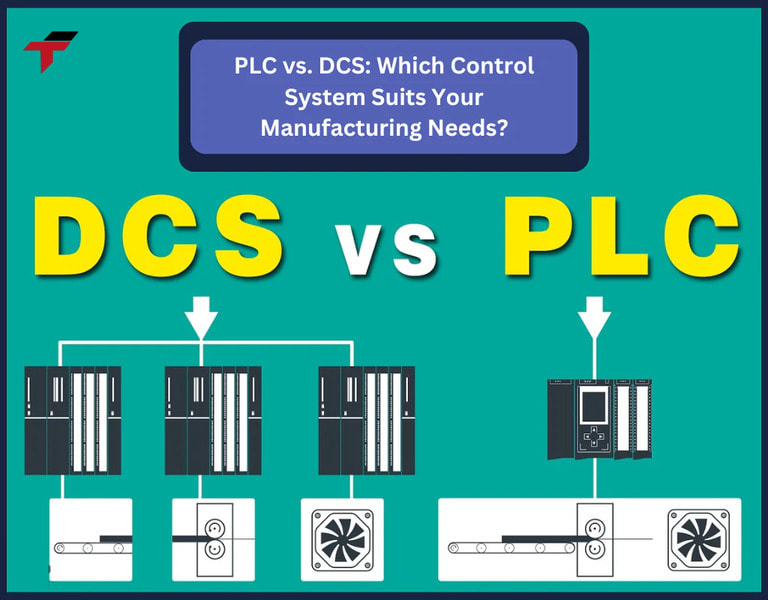
A PLC is a modular, standalone controller that executes a stored program to manage machine inputs and outputs. PLCs were originally designed to replace relay logic panels for discrete manufacturing — turning things ON and OFF based on sensor inputs. Modern PLCs handle analog processing, motion control, and communication, but their fundamental strength remains fast, deterministic control of individual machines and production zones.
A DCS is an integrated control platform designed from the ground up for continuous process control. The system distributes controllers across a plant, connects them through a dedicated process network, and provides unified operator stations, alarm management, historical trending, and batch control as built-in functions — not add-ons. DCS platforms were born in chemical plants, refineries, and power stations where hundreds of analog control loops run simultaneously and controller redundancy is mandatory.
The distinction has blurred over the past decade. Modern PLCs paired with SCADA software can replicate many DCS functions. DCS platforms now offer discrete control modules for hybrid applications. The choice between PLC and DCS depends on your process type, scale, and operational requirements.
PLC and DCS: Core Definitions
Architecture and Design Philosophy
PLC and DCS architectures reflect fundamentally different design philosophies that influence every aspect of system specification, programming, and operation.
PLC Architecture
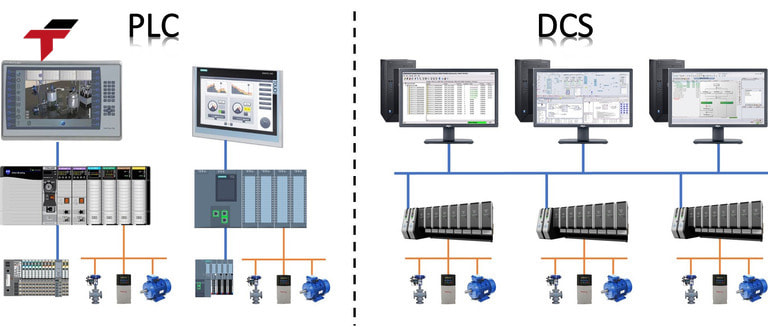
PLC systems are built from the machine level up. Each PLC controls a specific machine, production cell, or process zone independently. System integrators select the PLC brand and model, pair it with the appropriate I/O modules, add an HMI panel for local operator access, and optionally connect everything to a SCADA system for plant-wide monitoring.
This modular approach gives PLC systems flexibility: you can mix PLC brands across a plant, upgrade one zone without affecting others, and scale by adding controllers as production expands. Engineering teams write control programs using IEC 61131-3 languages — Ladder Diagram, Structured Text, Function Block Diagram — in brand-specific software (Siemens TIA Portal, Mitsubishi GX Works3, Omron Sysmac Studio).
A typical PLC system for a Malaysian factory includes Siemens S7-1200 or S7-1500 PLCs, Siemens KTP or Comfort HMI panels, and WinCC SCADA software for plant-wide visualisation.
DCS Architecture
DCS systems are designed as a unified platform from the plant level down. The DCS vendor provides the controllers, I/O modules, operator workstations, engineering software, historian, and alarm management system as an integrated package. All components communicate through a proprietary or semi-proprietary process network designed for deterministic, redundant data exchange.
Major DCS platforms include Honeywell Experion PKS, ABB Ability Symphony Plus, Emerson DeltaV, Siemens PCS 7, and Yokogawa CENTUM VP. DCS programming uses function block-based continuous control schemes — PID loops, cascade control, ratio control, feedforward compensation — as native building blocks.
DCS platforms provide built-in redundancy: dual controllers, dual communication networks, and seamless switchover to backup components without process interruption. This redundancy is inherent in the architecture rather than an optional add-on.
| Aspect | PLC (+SCADA) | DCS |
| Design philosophy | Machine-centric, bottom-up | Process-centric, top-down |
| Controller | Independent per zone | Distributed, interconnected |
| Operator interface | Separate HMI + SCADA | Integrated operator stations |
| Historian | Add-on (SCADA historian) | Built-in |
| Alarm management | Add-on (SCADA) | Built-in, ISA-18.2 compliant |
| Redundancy | Optional (extra cost) | Built-in (standard) |
| Multi-vendor | Yes (brand mixing possible) | No (single DCS vendor) |
The architectural differences translate directly into performance characteristics that matter for your specific application.
Performance Comparison
PLC and DCS performance profiles serve different control requirements. Choosing the right platform means matching those profiles to your process needs.
Speed and Determinism
PLCs deliver faster scan cycles — from sub-millisecond on compact controllers to microsecond-level on high-performance models like the Keyence KV-8000 (16.6 ns per step). This speed suits discrete control where response time matters: high-speed counting, motion control, reject mechanisms, and rapid sequence logic.
DCS controllers typically operate at slower scan rates — 100 milliseconds to 1 second — appropriate for continuous process control where variables change gradually. Temperature, pressure, flow, and level control loops do not require microsecond response; they need stability, noise filtering, and steady-state performance.
I/O Handling
PLCs handle discrete (digital) I/O efficiently and have evolved to manage analog I/O competently. DCS platforms are optimised for analog signal processing from the ground up, with built-in PID tuning tools, signal conditioning, and advanced regulatory control blocks.
A manufacturing line with 200 digital I/O and 20 analog signals fits a PLC system naturally. A process plant with 50 digital I/O and 500 analog control loops fits a DCS architecture.
Redundancy and Availability
DCS systems provide redundancy as a core feature — dual controllers, dual networks, hot-standby failover. Achieving equivalent redundancy with PLCs requires purchasing redundancy modules, configuring standby CPUs, and implementing network ring protocols — all adding cost and engineering effort.
For processes where an unplanned shutdown costs tens of thousands of Ringgit per hour or creates safety hazards (chemical reactions, high-temperature processes), DCS-level redundancy is justified. For discrete manufacturing where a line stoppage is inconvenient but not dangerous, standard PLC reliability (99.9%+ uptime without redundancy) is sufficient.
PLC and DCS performance profiles serve different control requirements.
Application Fit: PLC or DCS?
The process type is the strongest predictor of whether PLC or DCS architecture fits best.
PLC Is the Right Choice When:
- Discrete manufacturing dominates — Assembly lines, packaging, material handling, and CNC machining involve mostly ON/OFF logic with some analog control. PLCs handle this efficiently at lower cost.
- Fast response is critical — High-speed sorting, reject mechanisms, motion control, and precision positioning need sub-millisecond scan times.
- The system is machine-centric — Each machine or cell operates relatively independently. PLC-based control per machine, connected to a SCADA system, provides flexibility and scalability.
- Budget is constrained — A PLC + SCADA system for a medium factory costs RM 50,000–500,000. Equivalent DCS scope starts at RM 500,000 and scales to several million.
- Multi-brand flexibility matters — You want the option to use Siemens PLCs in one area, Mitsubishi in another, and upgrade brands independently.
DCS Is the Right Choice When:
- Continuous process control dominates — Chemical reactions, refining, power generation, and water treatment involve hundreds of PID loops running 24/7.
- Built-in redundancy is mandatory — Process safety or business continuity requires hot-standby controllers and networks without custom engineering.
- Integrated batch management is needed — ISA-88 compliant batch control with recipe management, phase logic, and batch reporting is native to DCS platforms.
- Regulatory compliance demands built-in audit trails — Pharmaceutical, food safety (HACCP), and environmental compliance benefit from DCS historian and alarm management integration.
- Scale exceeds 5,000+ I/O points with heavy analog — At large scale, DCS per-point costs become competitive with PLC + SCADA systems.
The Overlap Zone
Batch processing, food and beverage manufacturing, palm oil refining, and water treatment sit in an overlap zone where both architectures can work. These applications mix discrete logic (conveyor control, valve sequencing) with continuous control (temperature regulation, flow control, level management).
In Malaysia, many palm oil mills and F&B plants use PLC + SCADA solutions from Siemens or Allen-Bradley because the scale (typically 200-2,000 I/O points) fits the PLC cost structure, and local system integrators have strong PLC expertise. Larger petrochemical and utility installations — oil refineries in Johor, power plants, and water treatment facilities serving Selangor and Penang — typically deploy DCS platforms.
| Application | Recommended | Reason |
| Assembly line | PLC | Fast discrete control, machine-centric |
| Packaging line | PLC | High speed, servo/motion integration |
| Palm oil mill | PLC + SCADA | Moderate scale, mixed discrete/analog |
| Chemical plant | DCS | Continuous process, redundancy needed |
| Water treatment | DCS or PLC + SCADA | Depends on scale and distribution |
| Power plant | DCS | Redundancy, regulatory compliance |
| Semiconductor fab | PLC | High-speed, precision, machine-level |
Cost Comparison
Cost is often the deciding factor for Malaysian manufacturers evaluating PLC versus DCS. The two architectures have different cost structures.
PLC + SCADA system — Hardware costs are transparent and modular. A Siemens S7-1500 CPU costs RM 5,000-30,000; I/O modules RM 500-2,000 each; HMI panels RM 1,200-15,000; SCADA software licensing varies by I/O count. Engineering costs scale with system complexity. A complete PLC + SCADA system for a medium Malaysian factory: RM 50,000-500,000.
DCS system — Initial license and hardware costs are higher, but the integrated platform reduces engineering hours for large-scale systems. DCS pricing is less transparent — vendors quote as complete packages. A DCS for a medium process plant: RM 500,000-5,000,000. Per-point cost decreases as system size increases, making DCS more competitive at very large scale.
Lifecycle costs — DCS platforms carry higher vendor dependency. Upgrading or replacing a DCS requires working with the original vendor, and migration projects are expensive. PLC systems offer more flexibility — you can replace one PLC brand with another without affecting the rest of the plant.
For Malaysian factories in the SME category, PLC + SCADA provides the optimal balance of capability and cost. The Smart Automation Grant (SAG) from MIDA covers PLC and SCADA hardware as eligible automation investments.

Cost is often the deciding factor for Malaysian manufacturers evaluating PLC versus DCS.
Frequently Asked Questions
Q: What is the main difference between PLC and DCS?
The main difference is design philosophy. A PLC is a standalone, machine-level controller optimised for fast discrete control; multiple PLCs connect to a SCADA system for plant-wide monitoring. A DCS is an integrated platform designed for continuous process control, with built-in operator stations, historian, alarm management, and controller redundancy as standard features.
Q: Can a PLC replace a DCS?
A modern PLC paired with SCADA software can replicate many DCS functions for small to medium process applications. Siemens S7-1500 PLCs with WinCC SCADA, for example, handle PID control, alarm management, and historical logging. However, for large continuous processes with 5,000+ analog I/O points, mandatory redundancy, and ISA-88 batch control requirements, a DCS platform remains more efficient to engineer and maintain.
Q: Which is more expensive — PLC or DCS?
PLCs are significantly less expensive at small to medium scale. A PLC + SCADA system for a medium Malaysian factory costs RM 50,000-500,000, while a comparable DCS starts at RM 500,000. At very large scale (10,000+ I/O points), DCS per-point costs become competitive because the integrated platform reduces engineering effort. Total lifecycle cost — including maintenance, upgrades, and vendor dependency — must be factored into the comparison.
Q: Is DCS being replaced by PLC?
DCS is not being replaced by PLCs, but the two architectures are converging. Modern PLCs now handle analog control, OPC UA communication, and advanced process functions that were previously DCS-exclusive. DCS platforms now include discrete control capabilities. For greenfield projects in the overlap zone (batch processing, F&B, palm oil), Malaysian engineers increasingly choose PLC + SCADA for its lower cost and flexibility. Continuous process industries (chemical, refining, power) continue to specify DCS.
Q: Which PLC brands work well for SCADA integration in Malaysia?
Siemens SIMATIC S7-1500 integrates seamlessly with WinCC SCADA through PROFINET and shared TIA Portal engineering. Allen-Bradley CompactLogix works natively with FactoryTalk SCADA. Mitsubishi iQ-R connects to SCADA platforms via CC-Link IE TSN and Modbus TCP. Omron NJ/NX controllers support OPC UA for vendor-neutral SCADA connectivity. Flextech Industrial supplies all these PLC brands for SCADA projects in Malaysia.
Q: What PLC do I need for my factory in Malaysia?
The right PLC depends on your I/O count, communication requirements, existing brand standardisation, and budget. Compact PLCs (Siemens S7-1200, Mitsubishi FX5U) suit standalone machines at RM 1,500-5,000. Modular PLCs (Siemens S7-1500, Allen-Bradley CompactLogix, Mitsubishi iQ-R) serve medium to large systems at RM 5,000-30,000. For a detailed comparison, see our Complete Guide to Buying PLCs in Malaysia.
Conclusion
PLC and DCS serve different segments of industrial automation. PLCs deliver cost-effective, fast, flexible control for discrete manufacturing and moderate-scale process applications. DCS platforms provide integrated, redundant, process-optimised control for continuous operations at large scale. The boundary between them continues to blur as PLC capabilities expand and DCS platforms add discrete control modules.
For most Malaysian manufacturers — especially in automotive, F&B, packaging, and palm oil sectors — a PLC + SCADA architecture provides the right balance of performance, cost, and local engineering support.
Get a Quote from Flextech Industrial — contact our team for PLC hardware from Siemens, Mitsubishi, Omron, Allen-Bradley, and Keyence. We supply the controllers, I/O modules, and HMI panels for your automation projects across Malaysia.

